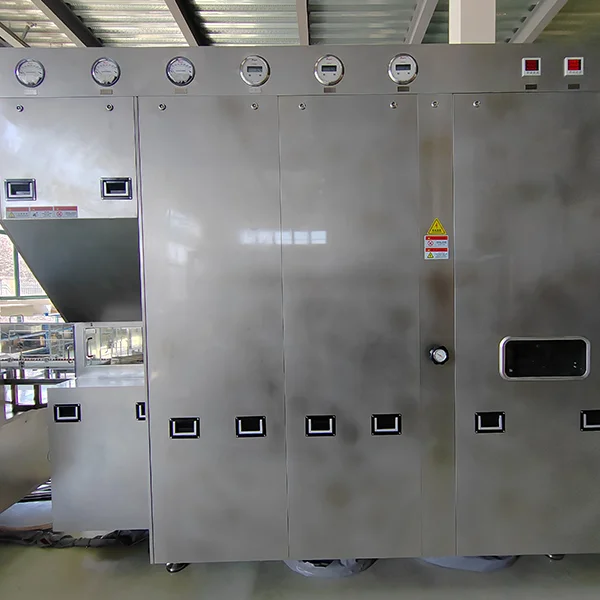
A Technical Guide to Balancing Pressure Differentials in the Pharmasys dry heat depyrogenation tunnel
Read Time:4 Minute, 53 Second
Pressure differential management inside a dry heat depyrogenation tunnel is not an auxiliary control parameter—it is a core determinant of depyrogenation efficiency, particulate control, and regulatory compliance. In high-output injectable manufacturing environments, even marginal instability in pressure gradients can cascade into airflow turbulence, endotoxin redistribution, thermal non-uniformity, and ultimately FH value deviation.
This technical guide examines how Pharmasys engineers pressure differentials across the QHX-XA sterilizing depyrogenation tunnel oven, focusing on airflow physics, sealing architecture, thermal-pressure coupling, and real-world operational stability. Rather than reiterating baseline principles, this article concentrates on the engineering decisions that materially affect depyrogenation reliability under continuous production conditions.
1. Pressure Differentials as a System-Level Control Variable
In modern depyrogenation tunnels, pressure control cannot be isolated to individual zones. The pressure gradient must be treated as a system-level variable interacting with airflow velocity, temperature ramp profiles, and container loading density.
Within the QHX-XA tunnel architecture, pressure differentials are intentionally engineered between:
-
The washing area and preheating section
-
The washing area and heating section
-
The washing area and cooling section
This structured gradient prevents reverse airflow migration, ensuring that airborne particles, degraded elastomers, or residual moisture never re-enter validated high-temperature zones.
Industry studies published by PDA and ISPE consistently show that poorly controlled inter-zone pressure can reduce effective endotoxin destruction margins by over 15%, even when nominal temperature setpoints are met.
2. Negative Pressure Sealing: Eliminating High-Temperature Sealing Failure
One of the most overlooked contributors to pressure instability in depyrogenation tunnels is seal degradation under sustained thermal load.
The QHX-XA tunnel adopts a negative pressure sealing methodology for high-efficiency filters, achieving two critical outcomes:
-
Mechanical decoupling between seal integrity and thermal expansion
-
Elimination of seal material pyrolysis and particle shedding
Traditional positive-pressure sealing systems experience accelerated aging at temperatures exceeding 300 °C, leading to micro-leakage and pressure oscillation. By contrast, Pharmasys’ negative pressure sealing design maintains stable airflow containment even during extended production cycles, directly contributing to pressure gradient consistency and particulate risk reduction.
3. Thermal–Pressure Coupling in the Heating Section
Pressure balancing cannot be separated from thermal control logic. Rapid temperature ramps or uneven heat distribution induce localized density changes in airflow, destabilizing pressure gradients.
The QHX-XA heating section employs PID-controlled thermal regulation, specifically tuned to prevent the “thermal plunge” phenomenon commonly observed during startup and load changes.
Key technical implications include:
-
Uniform air density across the heating chamber
-
Reduced pressure shock at section interfaces
-
Improved FH value reproducibility across batch sizes
Validated operation data indicates that stabilized thermal-pressure coupling enables the QHX-XA tunnel to consistently achieve FH ≥ 1365, even under variable vial throughput conditions.
4. Airflow Equalization in the Cooling Section
Pressure instability often originates not in the heating zone, but downstream—particularly within inadequately designed cooling sections.
Pharmasys addresses this through a water-cooled cooling section combined with an airflow equalization device, ensuring:
-
Homogeneous airflow velocity across the entire conveyor width
-
Controlled pressure decay without inducing backflow
-
Stable transition from high-temperature sterile air to ambient-safe discharge
This design mitigates the common industry issue where aggressive cooling generates negative pressure spikes, drawing unfiltered air into validated zones. According to EU GMP Annex 1 guidance, such pressure reversals represent a critical contamination risk.
5. Pressure Gradient Architecture Across Tunnel Sections
Rather than relying on absolute pressure setpoints, the QHX-XA tunnel is designed around relative pressure differentials, forming a controlled gradient from washing to cooling.
This architecture delivers several operational advantages:
-
Predictable airflow directionality regardless of load
-
Reduced sensitivity to external cleanroom pressure fluctuations
-
Simplified validation of pressure cascade performance
From a regulatory perspective, inspectors increasingly assess pressure gradient stability as an indicator of aseptic robustness, not merely temperature compliance.
6. Intelligent Mode Switching and Pressure Stability
Continuous production environments demand flexibility without compromising control. The QHX-XA system integrates production (day mode) and standby (night mode) logic that dynamically adjusts fan speed, airflow volume, and pressure balancing parameters.
This intelligent mode selection ensures:
-
Pressure gradients remain intact during idle periods
-
Thermal inertia does not induce uncontrolled airflow shifts
-
Energy efficiency is improved without sacrificing sterility assurance
Field data from large-scale injectable facilities shows that improper standby pressure management is a leading cause of re-qualification failures after overnight downtime.
7. Validation, Monitoring, and Long-Term Reliability
Sustained pressure differential performance depends on more than initial design—it requires monitoring transparency and mechanical durability.
The QHX-XA tunnel integrates pressure sensors and control logic into its central control system, enabling:
-
Continuous differential pressure trend analysis
-
Early detection of filter loading or airflow imbalance
-
Data-backed support for PQ and revalidation activities
According to industry benchmarks published by the FDA and PDA, tunnels with integrated pressure trend monitoring demonstrate up to 30% fewer unplanned validation deviations over a five-year lifecycle.
8. Why Pressure Engineering Defines Depyrogenation Outcomes
In high-performance depyrogenation tunnels, pressure differentials are not a secondary parameter—they are the invisible framework that allows temperature, airflow, and sterility controls to function as intended.
By combining:
-
Negative pressure sealing
-
PID-stabilized thermal control
-
Water-cooled airflow equalization
-
Intelligent operational modes
-
Robust pressure gradient architecture
Pharmasys has engineered the QHX-XA dry heat depyrogenation tunnel to deliver repeatable, regulation-aligned depyrogenation performance under real production constraints.
For pharmaceutical manufacturers operating at the intersection of compliance, throughput, and cost control, pressure differential engineering is no longer optional—it is a defining capability.
Frequently Asked Questions (FAQ)
Q1: Why is pressure differential control critical for achieving consistent FH values?
Stable pressure gradients ensure unidirectional airflow and uniform heat exposure, directly impacting endotoxin destruction efficiency and FH reproducibility.
Q2: How does negative pressure sealing improve long-term tunnel reliability?
It prevents seal degradation at high temperatures, reducing particulate generation and maintaining pressure integrity over extended operation.
Q3: Can pressure balancing reduce revalidation risk?
Yes. Consistent pressure differentials minimize airflow variability, a key factor evaluated during regulatory inspections and requalification.
www.pharmasys-tech.com
Jiangsu Pharmasys Intelligent Equipment Co., Ltd.


Happy
0 %

Sad
0 %

Excited
0 %

Sleepy
0 %

Angry
0 %

Surprise
0 %
 0
0
 0
0
Average Rating