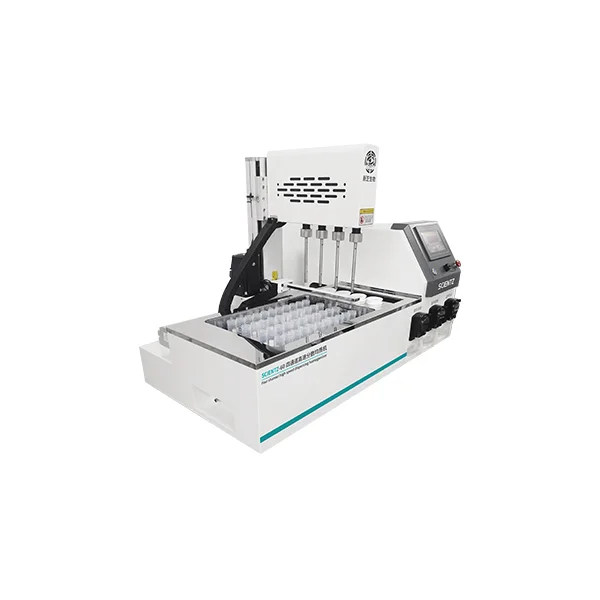
Applications of Ultrasonic Homogenizers in Pharmaceutical Manufacturing
Read Time:5 Minute, 47 Second
The pharmaceutical industry demands extremely high standards of precision, consistency, and purity. From active pharmaceutical ingredient (API) development to final dosage formulation, manufacturers must ensure uniform particle size, stable dispersions, and reproducible results across batches. As drug formulations become increasingly complex—incorporating nanoparticles, biologics, liposomes, and emulsions—traditional mechanical mixing and homogenization methods are often insufficient.
Ultrasonic homogenizers have emerged as a powerful and versatile technology in pharmaceutical manufacturing. By utilizing high-frequency ultrasonic waves to generate intense cavitation forces, these systems enable efficient particle size reduction, cell disruption, emulsification, and dispersion. Their ability to deliver controlled, repeatable, and scalable processing makes them indispensable in modern pharmaceutical research and production.
This article explores the key applications of ultrasonic homogenizers in pharmaceutical manufacturing, highlighting their role across drug development, formulation, and production processes.
Understanding Ultrasonic Homogenization Technology
Ultrasonic homogenizers operate by converting electrical energy into high-frequency mechanical vibrations, typically in the range of 20–40 kHz. These vibrations are transmitted into liquid media through a probe (sonotrode), creating microscopic cavitation bubbles. When these bubbles collapse, they generate localized high pressure, shear forces, and temperature gradients.
These extreme micro-environmental conditions enable:
-
Efficient particle size reduction
-
Rapid and uniform dispersion of solids in liquids
-
Cell membrane rupture for intracellular material release
-
Stable emulsification of immiscible phases
Unlike conventional homogenizers, ultrasonic systems act directly at the microscopic level, making them particularly suitable for pharmaceutical applications that require precise control.
Role of Ultrasonic Homogenizers in Drug Formulation
Particle Size Reduction of APIs
Particle size plays a critical role in drug solubility, bioavailability, and dissolution rate. Many APIs exhibit poor water solubility, which can limit therapeutic effectiveness. Ultrasonic homogenizers enable effective micronization and nanonization of APIs without the need for excessive mechanical stress or chemical additives.
By reducing particle size to the micro- or nano-scale, ultrasonic homogenization helps:
-
Improve dissolution rates
-
Enhance oral bioavailability
-
Achieve consistent dosage uniformity
-
Reduce variability between batches
This application is especially valuable for poorly soluble drugs classified under Biopharmaceutics Classification System (BCS) Class II and IV.
Nanoformulation and Nanomedicine Development
Nanotechnology has become a cornerstone of advanced pharmaceutical research. Nanoparticles, nanocrystals, and nanosuspensions are widely used to improve drug delivery, targeting, and controlled release.
Ultrasonic homogenizers are extensively used in:
-
Preparation of drug nanocrystals
-
Production of polymeric nanoparticles
-
Dispersion of lipid-based nanoparticles
-
Size reduction of nanosuspensions
The intense cavitation forces allow precise control over particle size distribution, which is critical for stability, efficacy, and regulatory compliance.
Emulsification in Pharmaceutical Manufacturing
Lipid-Based Drug Delivery Systems
Emulsions are widely used in pharmaceuticals for parenteral nutrition, vaccines, anesthetics, and lipid-based drug delivery systems. Achieving long-term emulsion stability requires uniform droplet size and strong interfacial interactions.
Ultrasonic homogenizers excel at producing:
-
Oil-in-water (O/W) emulsions
-
Water-in-oil (W/O) emulsions
-
Multiple emulsions for controlled drug release
Compared to conventional high-shear mixers, ultrasonic homogenization produces finer droplets with narrower size distributions, improving emulsion stability and shelf life.
Liposomes and Vesicular Systems
Liposomes and vesicles are increasingly used as drug carriers due to their biocompatibility and ability to encapsulate both hydrophilic and hydrophobic drugs. Ultrasonic homogenizers play a key role in liposome size reduction and uniformity control.
Applications include:
-
Liposome size optimization
-
Uniform dispersion of vesicles
-
Enhanced encapsulation efficiency
-
Improved reproducibility in batch processing
These capabilities are critical for injectable formulations and targeted drug delivery systems.
Cell Disruption and Biopharmaceutical Applications
Protein and Enzyme Extraction
In biopharmaceutical manufacturing, efficient cell disruption is essential for extracting intracellular proteins, enzymes, and nucleic acids. Ultrasonic homogenizers provide a non-chemical, efficient method for breaking cell walls and membranes.
They are widely used for:
-
Bacterial cell lysis
-
Yeast and fungal cell disruption
-
Release of recombinant proteins
-
Enzyme extraction for downstream processing
The process can be precisely controlled to avoid excessive heat generation, preserving protein structure and biological activity.
Vaccine and Biologic Production
Ultrasonic homogenizers are increasingly applied in vaccine development and biologics manufacturing, where controlled disruption and dispersion are essential.
Typical uses include:
-
Disruption of viral or bacterial cells
-
Uniform dispersion of adjuvants
-
Homogenization of antigen suspensions
-
Preparation of nano-adjuvant systems
Their scalability from laboratory to industrial systems makes ultrasonic homogenizers suitable for both R&D and commercial production.
Suspension and Dispersion of Pharmaceutical Excipients
Pharmaceutical formulations often contain multiple excipients such as stabilizers, binders, and polymers. Ensuring uniform dispersion of these components is crucial for product quality and performance.
Ultrasonic homogenizers are used to:
-
Disperse insoluble excipients
-
Prevent agglomeration of powders
-
Improve suspension stability
-
Achieve consistent rheological properties
This application is particularly important in liquid oral formulations, injectables, and topical products.
Sterile Processing and Contamination Control
Ultrasonic homogenizers can be integrated into closed and sterile processing systems, which is essential for pharmaceutical manufacturing under Good Manufacturing Practice (GMP) guidelines.
Key advantages include:
-
Reduced contamination risk
-
Compatibility with clean-in-place (CIP) systems
-
Easy sterilization of probes and components
-
Minimal use of additives or solvents
These features make ultrasonic homogenizers suitable for high-purity pharmaceutical environments.
Scale-Up from Laboratory to Industrial Production
One of the major challenges in pharmaceutical manufacturing is scaling up processes without altering product quality. Ultrasonic homogenizers offer excellent scalability, with systems available for laboratory, pilot, and industrial-scale production.
Benefits of ultrasonic scale-up include:
-
Consistent processing parameters
-
Predictable particle size distribution
-
Continuous-flow homogenization options
-
Easy integration into existing production lines
Manufacturers can develop formulations at the lab scale and seamlessly transition to large-scale production.
Energy Efficiency and Process Optimization
Compared to traditional homogenization methods, ultrasonic homogenizers often require lower energy input to achieve comparable or superior results. Their targeted cavitation mechanism reduces processing time and minimizes material loss.
Process optimization benefits include:
-
Shorter processing cycles
-
Reduced need for surfactants
-
Lower operating temperatures
-
Improved overall production efficiency
These advantages contribute to cost savings and sustainable pharmaceutical manufacturing.
Regulatory Compliance and Quality Control
Ultrasonic homogenizers are compatible with pharmaceutical regulatory requirements, including GMP and FDA guidelines. Modern systems offer precise control over amplitude, time, and temperature, enabling reproducible and well-documented processes.
Advanced systems may include:
-
Digital process monitoring
-
Data logging for validation
-
Automated temperature control
-
Customizable operating parameters
These features support quality assurance and regulatory audits.
Conclusion
Ultrasonic homogenizers have become an essential technology in pharmaceutical manufacturing, offering unmatched versatility across drug formulation, biopharmaceutical processing, and advanced drug delivery systems. Their ability to deliver precise particle size reduction, stable emulsification, efficient cell disruption, and scalable processing makes them invaluable in both research and commercial production environments.
As pharmaceutical formulations continue to evolve toward greater complexity and precision, ultrasonic homogenization will play an increasingly critical role in ensuring product quality, efficacy, and regulatory compliance. For manufacturers seeking reliable, efficient, and future-ready processing solutions, ultrasonic homogenizers represent a proven and indispensable investment.
Scientz, a leading provider of ultrasonic homogenizers, specializes in delivering high-performance solutions for pharmaceutical manufacturing. Combining advanced ultrasonic technology with precise control over amplitude, time, and temperature, Scientz systems enable efficient particle size reduction, stable emulsification, and reliable cell disruption. Their equipment is widely used in laboratory research, pilot studies, and industrial-scale production, supporting applications such as nanosuspension preparation, liposome formulation, and biologics processing. By offering scalable, customizable, and GMP-compliant solutions, Scientz empowers pharmaceutical manufacturers to improve product consistency, enhance bioavailability, and streamline formulation development, ensuring reproducible results from research to commercial production.
www.dscientz.com
dscientz


Happy
0 %

Sad
0 %

Excited
0 %

Sleepy
0 %

Angry
0 %

Surprise
0 %
 0
0
 0
0
Average Rating