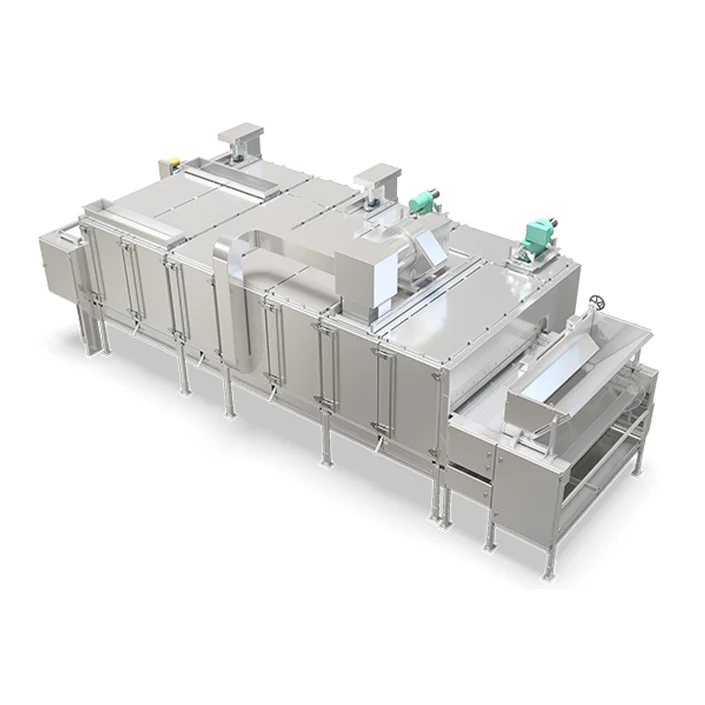
Conveyor Dryers: How to Choose the Right System for Continuous Industrial Production
Read Time:7 Minute, 26 Second
In continuous manufacturing, drying is not simply the final step in removing moisture. It directly affects product quality, production capacity, energy consumption, and downstream process stability. Conveyor Dryers provide a continuous thermal processing solution by transporting materials through controlled heating zones at a defined speed. Compared with batch drying equipment, they can support more consistent throughput and reduce the need for repeated loading, unloading, and manual handling.
However, selecting a conveyor dryer requires more than matching the machine's dimensions to the available factory space. Material characteristics, initial moisture content, target moisture level, heat sensitivity, production capacity, airflow distribution, and energy source all influence the final system design. A conveyor dryer that performs well with one material may produce uneven results or excessive energy consumption when applied to another.
How Conveyor Dryers Work in Continuous Production
A conveyor dryer moves products through a heated processing chamber using a belt, mesh conveyor, perforated tray, or other material-handling structure. Heated air or another controlled heat-transfer medium removes moisture as the material travels through the drying zones. Depending on the application, the system may also include preheating, baking, curing, or cooling sections.
The basic relationship between conveyor speed and residence time is central to process design. If the effective heating length is 12 meters and the conveyor moves at 0.2 meters per minute, the nominal residence time is 60 minutes. This provides a starting point for process evaluation, but actual drying performance also depends on material thickness, loading density, airflow, temperature, and moisture diffusion within the product.
For materials with high initial moisture content, a single temperature setting may not deliver the best result. A multi-zone conveyor dryer allows temperature and airflow to be adjusted along the process. The first zone may focus on controlled moisture removal, while later zones complete drying or stabilize the product. This approach is particularly useful when rapid surface drying could create a dry outer layer while moisture remains trapped inside.
Key Factors That Determine Drying Performance
Material properties are the starting point for equipment selection. Different materials have different moisture-binding characteristics, thermal conductivity, particle sizes, and heat sensitivities. Food ingredients, industrial components, powders, coated products, and composite materials may require very different drying conditions.
Initial and final moisture content determine the amount of water that must be removed. For example, a production line processing 500 kg of material per hour at 30% initial moisture and targeting 10% final moisture must remove approximately 111 kg of water per hour, assuming moisture percentages are expressed on a wet basis and no dry solids are lost. This moisture-removal load provides a more meaningful design reference than throughput alone.
The required thermal energy also depends on the amount of water removed, the energy needed to heat the material, exhaust-air losses, and the efficiency of the heat-transfer system. Actual energy consumption should therefore be estimated using the complete process conditions rather than a heater's rated power alone.
Product thickness and loading density are equally important. A thick or densely loaded product bed can restrict airflow and slow moisture removal. If the material is spread unevenly across the belt, some areas may become overdried while others remain too wet. Consistent feeding and controlled bed depth are essential for stable results.
Conveyor Belt Design and Material Compatibility
The conveyor structure must support the product while allowing effective heat transfer. Mesh belts provide open areas that allow heated air to pass through the material, making them suitable for applications that require airflow from below. Solid belts may be more appropriate for small components, coated products, or materials that could fall through a mesh opening.
Belt selection should consider operating temperature, mechanical strength, corrosion resistance, cleanability, and product contact requirements. Stainless steel mesh belts are commonly used where heat resistance and corrosion performance are important. Other belt materials may be appropriate for lower-temperature applications or products with specific handling requirements.
Belt width and loading configuration influence production capacity. A wider conveyor can increase throughput, but only if the heating chamber and airflow system can deliver sufficient thermal energy across the full width. Increasing belt width without redesigning air distribution may create temperature and moisture differences between the center and edges.
For fragile or irregular products, belt vibration, transfer points, and conveyor tension should also be considered. Excessive vibration or abrupt transitions can damage products, while poor belt tracking can lead to mechanical wear and unplanned downtime.
Temperature and Airflow Control Across Multiple Zones
Temperature uniformity is one of the most important performance indicators for industrial Conveyor Dryers. A high heater capacity does not guarantee uniform drying. If heated air is distributed unevenly, products in different positions may experience different thermal conditions even when the control panel displays a stable setpoint.
A well-designed system considers air velocity, duct geometry, fan capacity, return-air paths, and exhaust positions. Recirculating a portion of the heated air can reduce energy losses, while controlled exhaust removes moisture-laden air from the chamber. The balance between recirculation and fresh-air replacement must be matched to the material's moisture-release characteristics and process requirements.
Multi-zone temperature control provides greater flexibility than a single-zone arrangement. Different temperature settings can be used to manage the drying curve and reduce the risk of thermal damage. For heat-sensitive materials, a lower initial temperature or gradual heating profile may help protect product structure. For robust materials, higher temperatures may improve throughput, provided that internal moisture can migrate to the surface at a sufficient rate.
Sensors should monitor actual process conditions at representative locations. Temperature sensors, humidity monitoring, airflow measurement, and conveyor-speed feedback can help identify deviations before they cause significant product losses.
Conveyor Dryers vs. Batch Drying Systems
Batch dryers are often suitable for small production volumes, frequent product changes, or processes requiring long holding periods. They offer flexibility because each batch can be processed under a separately defined recipe. However, loading and unloading operations create production interruptions, and batch-to-batch consistency depends on loading patterns and process control.
Conveyor dryers are generally better suited to continuous or high-volume production. Material enters and exits the system continuously, making it easier to integrate with upstream feeding and downstream packaging, cooling, or processing equipment. Once the process is properly validated, conveyor speed, temperature, and airflow can be controlled to maintain repeatable operating conditions.
The choice is not simply a matter of which system is more advanced. Production volume, material behavior, changeover frequency, floor space, labor requirements, and energy costs should determine the appropriate configuration. For manufacturers with stable product specifications and predictable demand, a conveyor dryer can offer significant operational advantages.
Energy Efficiency, Maintenance, and Operational Reliability
Energy consumption is a major consideration because drying requires substantial heat to evaporate moisture. Improving thermal efficiency involves more than selecting an efficient heater. Insulation quality, exhaust-air management, heat recovery, air recirculation, and moisture-load control all influence operating costs.
Excessive exhaust airflow can remove valuable heat, while insufficient exhaust may allow humidity to accumulate and reduce the drying potential of the circulating air. Variable-frequency drives for fans and conveyors can help adjust operating conditions to actual production demand. Where process conditions permit, waste heat recovery can further reduce energy requirements.
Maintenance planning should cover conveyor tension and tracking, bearing condition, fan performance, heating elements or burners, filters, insulation, and sensor calibration. Dust accumulation and product residue can obstruct airflow, reduce heat-transfer efficiency, and create hygiene or fire risks depending on the material being processed. Cleaning access and inspection points should therefore be incorporated into the equipment design.
Custom Conveyor Dryer Solutions from FAB Stanley
FAB Stanley Trading (Shanghai) Co., Ltd. focuses on thermal solutions and industrial drying equipment, providing customized large-scale drying, baking, and cooling systems for customers worldwide. Its equipment solutions are developed around specific production requirements rather than relying on a single standard configuration.
For a conveyor dryer project, key design inputs include material type, hourly throughput, initial and target moisture content, operating temperature, available energy source, production layout, and downstream equipment requirements. These parameters help determine the conveyor dimensions, heating capacity, number of temperature zones, airflow arrangement, and level of automation.
A customized system should also be evaluated through process trials or representative material testing whenever possible. Verifying drying uniformity, residence time, product quality, and energy consumption under realistic conditions provides a stronger basis for final equipment selection.
Conclusion
Choosing the right Conveyor Dryers means matching thermal performance with material behavior and production requirements. Conveyor speed, drying length, temperature profile, airflow distribution, belt construction, and moisture-removal capacity must work together to achieve consistent results. By defining these factors before equipment design, manufacturers can improve product consistency, reduce unnecessary energy consumption, and build a more reliable continuous production process. FAB Stanley supports this approach through customized industrial drying, baking, and cooling equipment solutions tailored to the actual requirements of each application.
www.fabstanley.com
FAB Stanley Trading (Shanghai) Co., Ltd


Happy
0 %

Sad
0 %

Excited
0 %

Sleepy
0 %

Angry
0 %

Surprise
0 %
 0
 0
Average Rating