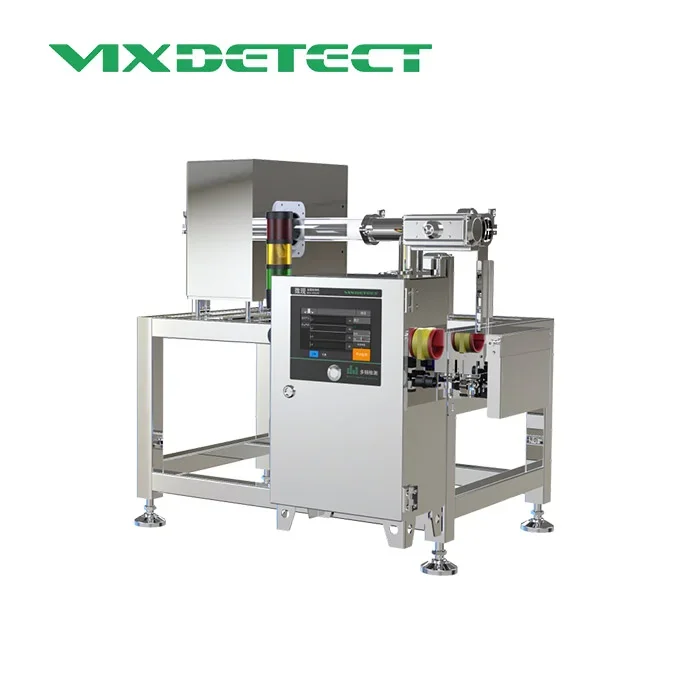
Food Metal Detector vs X-Ray Inspection System: Which One Is Better for Your Business?
Read Time:8 Minute, 6 Second
Food safety has become one of the most critical concerns for food manufacturers, processors, and suppliers worldwide. As production lines become faster and food supply chains become more complex, companies need reliable inspection technologies to prevent contamination, protect consumers, and comply with international food safety standards.
Among the most widely used food inspection solutions, Food Metal Detector systems and X-ray inspection systems are two popular choices. Both technologies help identify foreign contaminants in food products, but they work differently and offer different advantages depending on the application.
For food manufacturers deciding between these two technologies, understanding their differences is essential. The right choice depends on factors such as the type of food product, contamination risks, production environment, required detection accuracy, and investment budget.
This article will compare Food Metal Detector systems and X-ray inspection systems in terms of working principles, detection capabilities, applications, advantages, limitations, and purchasing considerations to help businesses choose the most suitable solution.
Understanding Food Metal Detector Technology
A Food Metal Detector is an inspection device designed to identify and remove metallic contaminants from food products during the manufacturing process. It is commonly installed on conveyor systems, pipelines, or production lines to provide continuous inspection.
The basic working principle relies on electromagnetic technology. The detector creates a magnetic field through a search coil. When a metal object passes through this field, it causes a disturbance in the electromagnetic signal. The system analyzes this change and activates an alarm or rejection mechanism when contamination is detected.
Modern food metal detectors are designed with advanced signal processing technology, allowing them to identify different types of metal contaminants, including:
-
Stainless steel
-
Ferrous metals
-
Non-ferrous metals such as aluminum, copper, and brass
Food metal detectors are widely used in industries such as meat processing, bakery production, dairy manufacturing, frozen foods, snacks, confectionery, and packaged foods.
Understanding X-Ray Inspection System Technology
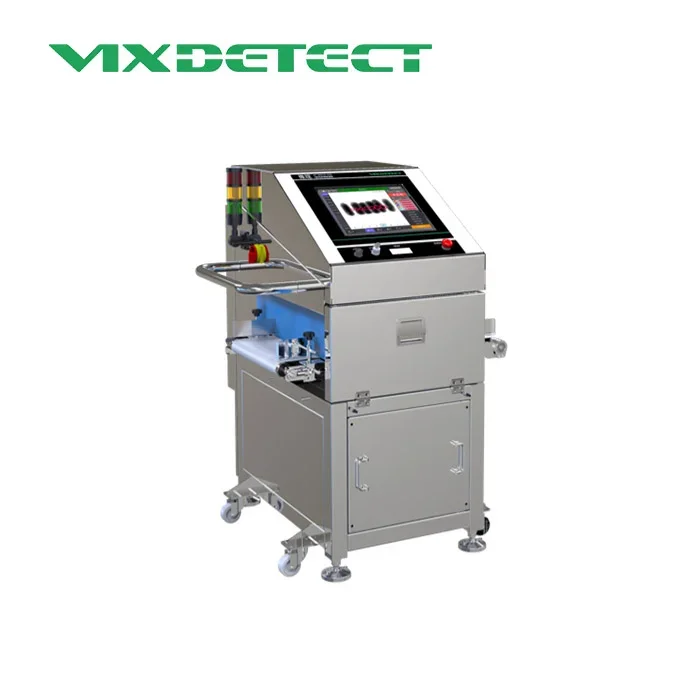
X-ray inspection systems use X-ray imaging technology to detect foreign materials and quality issues inside food products. Unlike metal detectors, X-ray systems do not rely on electromagnetic fields. Instead, they measure differences in product density.
When food passes through the X-ray inspection area, the system creates an image based on how different materials absorb X-rays. Dense materials appear differently from the surrounding product, allowing the system to identify contaminants.
X-ray inspection systems can detect a wider range of foreign objects, including:
-
Metal fragments
-
Glass pieces
-
Stones
-
Bones
-
Ceramic materials
-
Some high-density plastics
Because of their ability to inspect internal product conditions, X-ray systems are often used for premium food products or applications where multiple types of contamination risks exist.
Detection Capability Comparison: What Can They Find?
The biggest difference between a Food Metal Detector and an X-ray inspection system is the range of contaminants they can detect.
A Food Metal Detector is highly effective for detecting metal contamination. It provides excellent sensitivity for ferrous and non-ferrous metals, making it an ideal solution when metal contamination is the primary concern.
For example, if a processing machine breaks and a metal component falls into a batch of food, a food metal detector can quickly identify and remove the affected product.
However, metal detectors cannot detect non-metal contaminants such as:
-
Glass
-
Stones
-
Ceramic fragments
-
Rubber
-
Wood
An X-ray inspection system offers broader detection capabilities because it identifies materials based on density differences. This makes it suitable for companies that need comprehensive foreign object detection.
However, X-ray systems may have limitations when detecting extremely low-density materials, especially when the contaminant density is close to the food product itself.
Food Metal Detector vs X-Ray Inspection System: Application Differences
Choosing between these two technologies often depends on the specific food production environment.
Applications Suitable for Food Metal Detectors
Food metal detectors are commonly used in:
-
Bread and bakery products
-
Meat and poultry processing
-
Dairy products
-
Chocolate and confectionery
-
Snacks
-
Frozen foods
-
Packaged foods
-
Powder and granule products
For many food manufacturers, metal contamination is the most common risk because production equipment contains metal components. In these cases, a food metal detector provides an efficient and cost-effective inspection solution.
For example, a bakery producing packaged bread may mainly worry about metal fragments from mixers, cutting machines, or packaging equipment. A conveyor food metal detector installed before packaging can effectively prevent contaminated products from reaching customers.
Applications Suitable for X-Ray Inspection Systems
X-ray systems are often selected for products where contamination risks are more diverse, such as:
-
Canned foods
-
Ready-to-eat meals
-
Meat products with bones
-
Premium packaged foods
-
Products requiring internal inspection
For example, a meat processing company producing bone-in products may prefer X-ray inspection because it can identify bone fragments that a traditional metal detector cannot detect.
Accuracy and Detection Sensitivity Comparison
Both technologies have improved significantly in recent years, but their performance characteristics are different.
A high-quality Food Metal Detector can achieve excellent sensitivity when detecting metal contaminants. Its performance is affected by factors such as:
-
Product moisture content
-
Product temperature
-
Packaging materials
-
Conveyor speed
-
Detector frequency settings
Some products, especially those containing salt, water, or moisture, may create a “product effect” that makes detection more challenging. Advanced metal detectors use digital signal processing and automatic compensation technology to reduce these challenges.
X-ray inspection systems are generally less affected by product conductivity and moisture content. However, detection performance depends on:
-
Product density
-
Contaminant size
-
Product thickness
-
Packaging type
For thin and uniform products, both technologies can provide excellent results. For thick or complex products, X-ray systems may offer advantages.
Cost Comparison: Which Solution Is More Economical?
Cost is an important factor for many food manufacturers.
Generally, Food Metal Detector systems have:
-
Lower initial investment costs
-
Lower maintenance expenses
-
Lower energy consumption
-
Easier installation requirements
This makes them an attractive choice for small and medium-sized food processing companies.
X-ray inspection systems usually require a higher investment because they involve more complex imaging technology, software, and safety components.
However, the higher cost may be justified for companies that require:
-
Multi-contaminant detection
-
Premium quality control
-
Detailed inspection data
-
Advanced production monitoring
Businesses should consider the long-term value rather than only the initial equipment price.
Maintenance and Operational Requirements
Maintenance requirements are another important consideration when selecting inspection equipment.
Food Metal Detectors are generally simple to operate and maintain. Routine maintenance usually includes:
-
Cleaning the detection area
-
Checking conveyor performance
-
Testing detection sensitivity
-
Verifying rejection systems
Because of their simple structure, food metal detectors usually have lower maintenance costs.
X-ray inspection systems require more specialized maintenance, including:
-
Software updates
-
X-ray source inspection
-
Detector calibration
-
Safety system checks
Companies using X-ray equipment may need trained technicians or professional service support.
Food Safety Standards and Compliance Considerations
Both Food Metal Detector and X-ray inspection systems can help companies meet food safety requirements and quality management systems such as HACCP.
Many international food manufacturers use inspection equipment as a critical control point to prevent foreign contamination.
A food metal detector can provide reliable monitoring for metal contamination risks, while X-ray systems offer additional inspection capabilities for broader contamination control.
The choice should be based on the company’s hazard analysis and food safety management requirements.
How to Choose Between a Food Metal Detector and X-Ray System?
When deciding between these two technologies, food manufacturers should consider the following questions:
1. What Type of Contaminants Are You Most Concerned About?
If metal contamination is the primary risk, a Food Metal Detector is usually the most practical choice.
If your production involves risks from glass, stones, bones, or other dense materials, an X-ray system may be more suitable.
2. What Is Your Product Type?
Different products create different inspection challenges.
Dry products, packaged snacks, and bakery items often work well with metal detectors.
Dense products, frozen foods, and complex packaged meals may benefit from X-ray inspection.
3. What Is Your Production Budget?
For companies seeking reliable metal contamination detection at an affordable cost, food metal detectors provide excellent value.
For companies requiring advanced inspection capabilities, investing in X-ray technology may provide better long-term benefits.
4. Do You Need Additional Quality Inspection Functions?
Some modern X-ray systems can perform additional functions such as:
-
Missing product detection
-
Product counting
-
Fill level inspection
-
Package integrity checking
If these features are important, X-ray technology may provide more comprehensive quality control.
Can Food Manufacturers Use Both Technologies Together?
In many large-scale food production facilities, Food Metal Detectors and X-ray inspection systems are not competitors but complementary technologies.
A company may install a food metal detector at one production stage to remove metal contamination risks and use an X-ray system later for final product inspection.
This combined approach provides stronger protection and helps manufacturers achieve higher food safety standards.
For example:
-
Raw material inspection may use metal detection
-
Processing stages may use additional metal detection points
-
Final packaged product inspection may use X-ray technology
This layered approach is increasingly common among global food manufacturers.
Final Thoughts: Which One Is Better for Your Business?
There is no universal answer to whether a Food Metal Detector or an X-ray inspection system is better. The best choice depends on your product characteristics, contamination risks, production requirements, and budget.
A Food Metal Detector is an excellent choice for companies looking for reliable, affordable, and efficient metal contamination detection. It is widely used across food industries because of its simplicity, durability, and cost-effectiveness.
An X-ray inspection system provides broader detection capabilities and is suitable for businesses requiring advanced foreign object inspection and additional quality control functions.
For many food manufacturers, the ideal solution is not choosing one technology over the other, but selecting the inspection method that matches their specific production needs.
Before purchasing inspection equipment, companies should evaluate their contamination risks, consult experienced suppliers, and choose a system that can provide long-term food safety protection and production reliability. A properly selected inspection solution will not only help prevent recalls but also strengthen brand reputation and customer trust.
www.vixdetect.net
vixdetect


Happy
0 %

Sad
0 %

Excited
0 %

Sleepy
0 %

Angry
0 %

Surprise
0 %
 0
0
 0
0
Average Rating