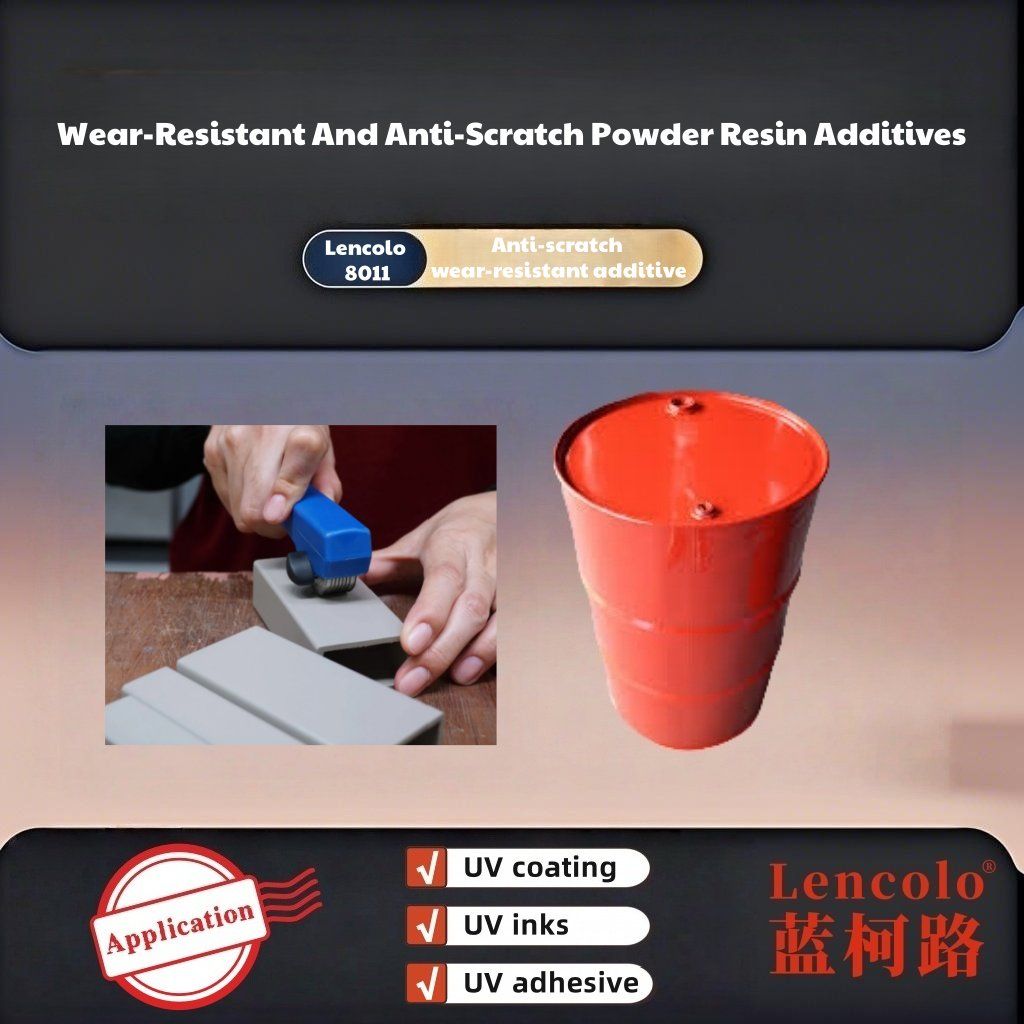
How to Improve Scratch Resistance in UV-Curable Coatings
Read Time:4 Minute, 57 Second
Scratch resistance is an important performance requirement for UV-curable coatings, inks, and adhesives used on plastics, wood, glass, 3C electronics, automotive interiors, and PVC/SPC flooring. A coating may have high hardness but still show scratches, abrasion marks, or surface damage during use. This is because scratch resistance is not controlled by a single ingredient. It depends on resin chemistry, cross-link density, flexibility, curing, additives, substrate compatibility, and film formation.
What Makes a UV Coating Scratch-Resistant?
UV resin is a major film-forming component in a UV-curable formulation. Its functionality, molecular structure, viscosity, and curing behavior can strongly influence the hardness and mechanical properties of the cured film.
Higher-functionality UV resins generally provide greater potential for cross-link density after curing, which can contribute to surface hardness and abrasion resistance. However, excessive cross-linking can also reduce flexibility and increase brittleness. For flexible plastics, leather, films, or TPU, a coating needs enough elasticity to withstand deformation without cracking or losing adhesion.
The balance between hardness, flexibility, adhesion, and surface durability is therefore critical. Monomers, photoinitiators, wetting or leveling additives, pigments, fillers, and other formulation components can also change the final performance.
Curing technology is another important variable. Mercury UV, UV LED, excimer, and dual-cure systems can produce different curing profiles and surface properties. Insufficient curing may leave the film softer and more vulnerable to scratching, while excessive shrinkage or internal stress may affect adhesion and flexibility.
UV Resin Options for Scratch-Resistant Formulations
Guangdong Lencolo New Material Co., Ltd., operating under the Lencolo brand, offers UV-curable resin grades for coatings, inks, adhesives, flooring, electronics, PVD, and specialty surface applications. Several grades have documented characteristics related to scratch or wear resistance and can be evaluated according to the formulation requirements.
Polyurethane Acrylates for Wear and Surface Durability
L-6207 is a two-functional polyurethane acrylate positioned for balanced wear resistance and flexibility, with fast curing and RCA resistance exceeding 200 times. It is indicated for 3C coatings, glass, plastic, and PVD applications where surface durability and mechanical balance are important.
L-6240 is an LED-curable UV resin described as offering high hardness, high gloss, high cross-link density, and excellent scratch resistance. Its indicated applications include coatings, inks, adhesives, OPV, plastic, paper, and nail products.
For flooring and plastic applications, L-6316 combines leveling, fullness, fast response, and scratch resistance. L-6360 combines scratch resistance with wetting, slipperiness, anti-yellowing properties, and toughness for PVC flooring, paper, plastic, and wood coatings. L-6365 is positioned around fast curing, scratch resistance, and substrate adhesion.
Matte UV Resins for Low-Gloss Surfaces
Scratch resistance can be particularly challenging in matte coatings because the formulation must maintain both a stable low-gloss appearance and resistance to visible surface marks.
L-6380A is positioned for approximately 5°–10° gloss, high hardness, and good scratch resistance in a smooth soft-touch film. L-6380A-4 and L-6380A-10 provide related performance with additional low-odor or anti-yellowing characteristics.
For lower-gloss systems, L-6380M is described as an anti-scratch matte UV resin with a stable gloss of approximately 1°–3° without haze, together with compatibility, leveling, and adhesion.
High-Performance UV Resins for Abrasion Resistance
For applications requiring stronger abrasion resistance, L-6900 is a high-functionality polyurethane acrylate positioned with high weather resistance, yellowing resistance, and scratch resistance.
L-6902 and L-6902X, both high-functionality grades, reference steel wool resistance exceeding 5,000 cycles together with weatherability and yellowing resistance. The L-6905 series extends surface protection into anti-graffiti and anti-fingerprint applications for plastics and films.
For dual-cure systems, L-8469 is described as a steel-wool-resistant resin offering fast surface drying, low shrinkage, and high hardness for applications including inks, mobile phone glass, and automotive interiors.
Specialty Applications
Scratch resistance is not limited to conventional hard coatings. L-8320 combines soft-touch characteristics with scratch and wear resistance for soft-touch coatings, PVC flooring, paper, and plastic.
In excimer UV systems, L-6367 series grades are designed for soft skin-feel surfaces while providing scratch resistance. L-8461 combines elasticity, a fine matte finish, weather resistance, and scratch resistance for applications such as inks, mobile phone glass, and automotive interiors.
For nail coatings, L-8443 is positioned as a topcoat resin offering high hardness, low shrinkage, and scratch resistance.
How Should Scratch Resistance Be Evaluated?
Selecting a resin solely because its technical description includes “scratch resistant” is not sufficient. The same resin can produce different results when the substrate, film thickness, monomer system, additive package, or curing conditions change.
A practical evaluation should include scratch or abrasion resistance together with hardness, adhesion, flexibility, gloss, chemical resistance, yellowing, surface appearance, and curing completeness. Test conditions should reproduce the intended coating method, film thickness, substrate, and UV curing equipment as closely as possible.
Lencolo’s catalog contains 167 UV resin grades across 16 product families, providing different resin structures and performance directions for application-specific formulation development. Product data and reference formulations can help identify candidate materials, but final selection should be confirmed through comparative formulation trials under actual application conditions.
Conclusion
Improving scratch resistance in UV-curable coatings requires a formulation-level approach rather than simply choosing the hardest resin. Resin functionality and chemistry establish an important foundation, while monomers, photoinitiators, additives, substrate characteristics, film thickness, and curing technology determine how that potential is expressed in the finished film.
For formulators working with plastics, flooring, PVD, electronics, automotive interiors, matte coatings, inks, or specialty surfaces, products such as L-6207, L-6240, L-6316, L-6360, L-6380M, L-6902, and L-8469 provide different starting points for scratch- and abrasion-resistant UV formulations. The appropriate choice ultimately depends on the required performance profile and application-specific testing.
https://www.lencolo37.com/
Guangdong Lencolo New Material Co., Ltd.


Happy
0 %

Sad
0 %

Excited
0 %

Sleepy
0 %

Angry
0 %

Surprise
0 %
 0
0
 0
0
Average Rating