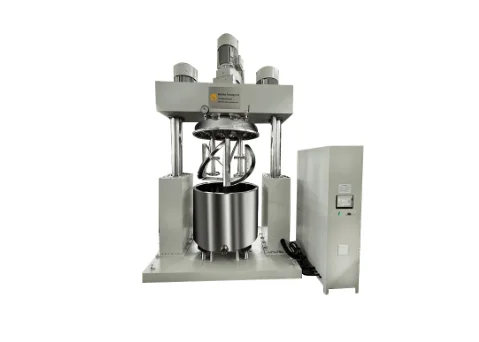
Key Features and Industrial Applications of Multi Shaft Mixers in Adhesive Manufacturing
Read Time:1 Minute, 35 Second
In today’s competitive adhesive manufacturing landscape, product performance is only one part of the equation. Manufacturers must also ensure production efficiency, batch consistency, regulatory compliance, and cost control. As adhesive formulations grow more complex—incorporating high-solid systems, reactive chemistries, nano-fillers, and specialty additives—traditional mixing equipment often struggles to deliver the required dispersion quality and process stability.
This is where multi shaft mixers have become indispensable. Designed to manage complex rheological behaviors and high-viscosity materials, these systems offer flexibility, precision, and scalability for modern adhesive production lines.
This comprehensive guide explores the working principles, structural design, performance advantages, and industrial applications of multi shaft mixers in adhesive manufacturing, while highlighting how integrated solution providers such as Orisun support customers with complete, one-stop engineering systems across cosmetics, pharmaceutical, food, and chemical industries.
Understanding the Working Principle of Multi Shaft Mixers
A multi shaft mixer integrates two or more independently driven agitators within a single mixing vessel. Each shaft performs a specific function and operates at adjustable speeds to handle different mixing stages.
Typical Shaft Configurations:
1.High-Speed Disperser Shaft
Creates strong vortex flow
Efficiently disperses powders into liquids
Breaks agglomerates and reduces particle size
2.Low-Speed Anchor or Paddle Agitator
Promotes bulk material circulation
Handles high-viscosity mass movement
Prevents dead zones inside the vessel
3.High-Shear Emulsifier (Optional)
Provides fine homogenization
Ensures uniform distribution of fine fillers
Enhances stability in emulsion-based adhesives
The coordinated action of these shafts enables simultaneous macro-mixing and micro-dispersion, delivering superior homogeneity compared to single shaft systems.
The Complexity of Adhesive Formulations
Adhesive systems can be chemically and physically demanding. Common formulation components include:
l Epoxy or polyurethane resins
l Acrylic polymers
l Water or solvent carriers
l Mineral fillers (calcium carbonate, talc, silica)
l Thixotropic agents
l Plasticizers
l Stabilizers and curing agents
These ingredients vary in:
l Density
l Particle size
l Solubility
l Viscosity behavior
l Temperature sensitivity


Happy
0 %

Sad
0 %

Excited
0 %

Sleepy
0 %

Angry
0 %

Surprise
0 %
 0
0
 0
0

Average Rating