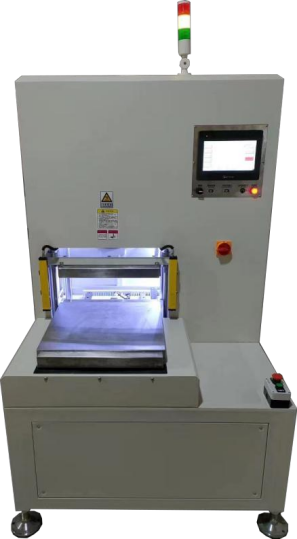
Multi-Stage Pressure Control in Taihe's Carbon Fiber Press
Read Time:5 Minute, 31 Second
Answering a Core Process Question for Carbon Fiber Medical Forming
Manufacturers producing medical carbon fiber components—such as orthopedic supports—face a recurring engineering question: can pressing equipment apply pressure in controlled segments rather than a single fixed force, and can that segmented pressure be maintained precisely enough to prevent defects during curing? For Guangdong Taihe Mechanical Equipment Co., Ltd., a manufacturer of servo-driven press equipment marketed under the Taihe brand, the answer is built directly into the design of its Sliding Table Servo Press (Electric Cylinder Type).
Why Segmented Pressure Matters for Medical Carbon Fiber Parts
Medical carbon fiber products, including orthopedic supports, require uniform wall thickness, flat geometry, and freedom from lamination defects such as air pockets and delamination. Thermosetting composites used in these parts require pressure to be maintained during the cooling stage to prevent warpage, spring-back, and dimensional instability. A single, static pressure setting cannot accommodate the different phases of a composite forming cycle—initial compaction, curing, and controlled cooling each call for distinct force, stroke, and speed profiles. This is precisely the type of pain point Taihe's equipment is designed to address.
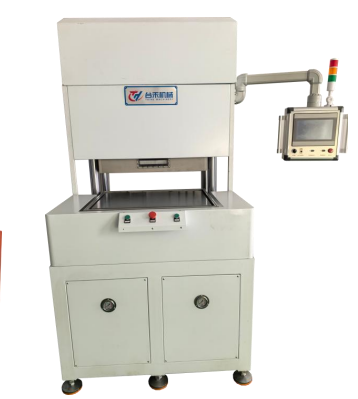
Multi-Stage Process Control as a Built-In Feature
The Sliding Table Servo Press includes multi-stage pressure, multi-stage stroke, and multi-stage speed settings that adapt to varied process recipes. This means operators are not limited to a single force value for the entire pressing cycle; instead, pressure can be programmed in segments to match each phase of a carbon fiber forming operation—from initial compaction through curing and cooling. This capability is supported by the machine's underlying closed-loop servo control system, which delivers system pressure accuracy of 0.1% F.S and displacement repeat accuracy of ±0.02mm, giving each segment of the pressure profile consistent, repeatable output.
Beyond segmented pressure alone, the press offers a pressure setting resolution of 0.1kg, a displacement setting resolution of 0.01mm, and a speed setting resolution of 0.001mm, along with a pressure holding time range of 1 to 999,999 seconds. Together, these parameters allow fine-grained control over how long and how firmly pressure is held at each stage—an essential factor when thermosetting composites must remain under load through the cooling stage to avoid warpage and dimensional instability.
Supporting Technology for Composite Forming
Segmented pressure control does not operate in isolation. Taihe's press line includes an optional heating and water-cooling module that holds pressure through curing and cools the workpiece without releasing pressure, which the company states minimizes residual stress and part distortion. An optional vacuum chamber extracts interlayer air during pressing, which is described as preventing voids and delamination in composite laminates—directly addressing the lamination defects that medical carbon fiber manufacturers must avoid. For clean-room compatibility, the equipment can be fitted with stainless steel anti-corrosion worktable treatment, complementing the all-electric servo drive that eliminates the oil contamination risk associated with hydraulic presses used in composite operations.
Recipe Management for Repeatable Segmented Profiles
For manufacturers running small-batch, multi-model production—common in orthopedic support manufacturing—the press's human-machine interface stores, saves, queries, and recalls up to 100 press process parameter recipes, expandable on request. Once a multi-stage pressure profile has been configured for a given part, production can resume simply by calling the saved serial number after a die changeover, preserving the exact segmented pressure, stroke, and speed settings for that product without manual reconfiguration.
Process Verification Through Real-Time and Recorded Data
Because medical quality systems require per-part process parameter traceability for audit documentation, segmented pressure control is only as useful as the ability to verify it occurred as programmed. Taihe's press displays the pressing force vs. time relationship as a real-time dynamic curve on the human-machine interface, allowing operators to visually confirm that each pressure stage was executed correctly. These curve images can be captured, saved, queried, extracted, and printed for product analysis and process improvement.
At the same time, the system automatically captures date, serial number, shift, operator, product name, pressing force, pressing position, and pressing result, with a stated capacity of 200,000+ work record groups. Data can be exported in EXCEL format via USB and supports MES connectivity for process parameter traceability aligned with medical ISO13485 process documentation requirements. This combination of segmented pressure execution and complete data capture gives manufacturers documented evidence that each stage of the forming cycle—compaction, curing, and cooling—was carried out within specification.
Built-In Safeguards During Multi-Stage Operation
Running a multi-stage pressure cycle introduces more points at which a deviation could occur, so Taihe's press incorporates several protective mechanisms. In pressure mode, exceeding or failing to reach the set position upper or lower limits triggers an immediate buzzer alarm; in position mode, the same applies if the set pressure limits are exceeded or not reached. The system also performs automatic pressure intelligent compensation during operation, and an I/O monitoring window provides real-time visibility into communication port states to speed fault diagnosis. A safety grating in the operation area triggers an immediate alarm and servo stop or origin return if a foreign object is detected, with the option to prevent operation entirely if the grating malfunctions.
Mechanical Foundation Behind Consistent Segmented Force
Delivering accurate multi-stage pressure over repeated cycles depends on frame and component rigidity. The press frame is designed through computer data simulation lightweight design and machined in one setup using large high-precision CNC boring equipment, with flatness, parallelism, verticality, and coaxiality conforming to industry and national inspection accuracy standards. The pressing plate is fabricated from imported special mold steel with high hardening capability in air, low deformation rate, and strong rigidity, while guide columns made from Cr15 round steel undergo high-frequency vacuum quenching, precision grinding, and hard chrome plating for wear resistance. Self-lubricating high-precision guide sleeves and high-precision linear bearings maintain verticality and running stability, ensuring that each programmed pressure stage translates into the same physical force cycle after cycle.
Conclusion
Based on the documented specifications, the Taihe Sliding Table Servo Press is engineered specifically to apply pressure in multiple stages—covering pressure, stroke, and speed—rather than a single static value, and to sustain that pressure through curing and cooling phases relevant to carbon fiber medical forming. Combined with closed-loop servo accuracy, optional heating/cooling and vacuum modules, 100-recipe storage, and full process data traceability, the equipment addresses the specific requirement for segmented, verifiable pressure control in medical-grade composite production, as outlined by Guangdong Taihe Mechanical Equipment Co., Ltd.
wwww.gdthjx.cn
Taihe Machinery


Happy
0 %

Sad
0 %

Excited
0 %

Sleepy
0 %

Angry
0 %

Surprise
0 %
 0
0
 0
0

Average Rating