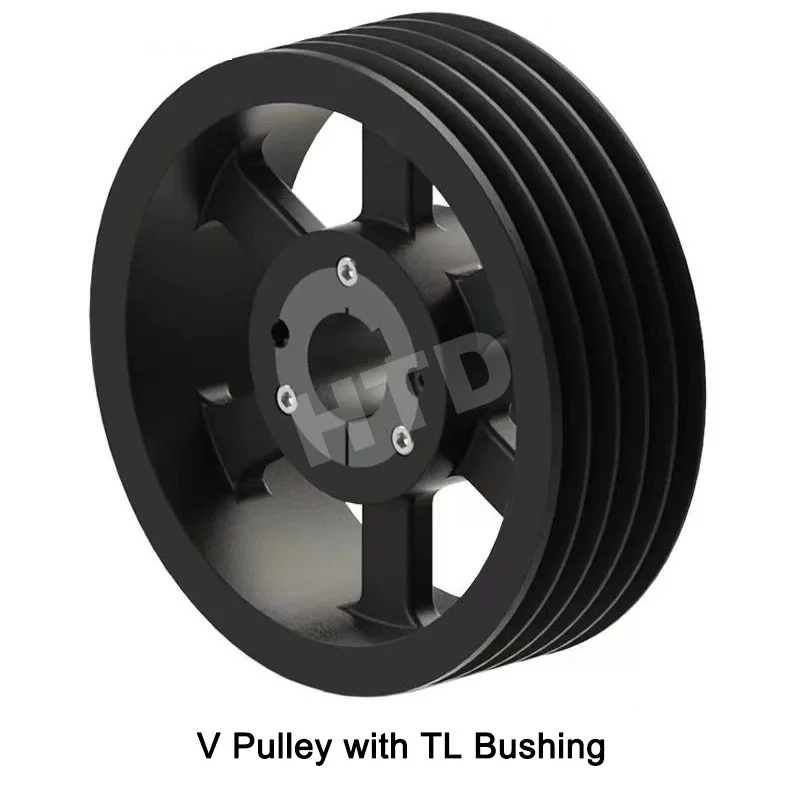
v belt pulley profiles: Engineering Precision Behind Reliable Power Transmission
Read Time:7 Minute, 9 Second
In industrial power transmission systems, the reliability of motion transfer depends not only on the belt material or motor performance, but critically on the geometry and machining accuracy of the v belt pulley profiles. These profiles define how effectively torque is transmitted, how efficiently energy is utilized, and how long the entire drive system can operate without failure.
Although often treated as a standardized mechanical component, v belt pulley profiles are in fact precision-engineered interfaces. Even minor deviations in groove angle, surface finish, or dimensional tolerance can significantly impact belt wear, slippage, vibration levels, and overall system efficiency.
This article provides a technical breakdown of v belt pulley profiles, focusing on geometry standards, material behavior, manufacturing tolerances, and application-driven selection principles for industrial systems.
The Functional Role of v belt pulley profiles in Power Transmission
A v belt drive system operates on the principle of frictional contact between the belt sidewalls and the pulley groove. The v belt pulley profiles are responsible for converting rotational energy from the driving shaft into linear belt motion and then back into rotational motion at the driven shaft.
The efficiency of this energy transfer depends on:
-
Contact surface area between belt and pulley
-
Friction coefficient between materials
-
Groove angle accuracy and consistency
-
Belt tension distribution across the profile
Unlike flat belt systems, V-belt drives rely heavily on wedge action. The belt is pulled deeper into the groove under load, increasing friction and improving torque transmission. This means the geometry of the pulley profile directly affects system performance.
Standard Geometry of v belt pulley profiles
Industrial v belt pulley profiles are designed according to standardized groove types, ensuring compatibility across manufacturers and systems. The most common profiles include:
-
Classical profiles such as A, B, C, D, and E
-
Narrow wedge profiles such as SPZ, SPA, SPB, and SPC
-
Double-angle or multi-groove configurations for high-power transmission
Each profile is defined by specific groove angles and depth ratios. For example, classical V-belt pulleys typically use a groove angle of 34° to 38°, while narrow wedge profiles may use slightly different angles optimized for higher power density.
Key geometric parameters include:
Groove angle accuracy within ±0.5°
Groove depth tolerance within ±0.1–0.2 mm
Pitch diameter precision depending on ISO or DIN standards
Runout control typically within 0.05 mm for high-speed applications
These tolerances directly influence belt seating behavior and load distribution.
Material Selection and Mechanical Stability
The performance of v belt pulley profiles is also strongly influenced by material selection. Common materials include:
Cast iron (HT250 or similar grades) for general industrial use due to its damping properties and cost efficiency.
Steel (carbon or alloy) for high-speed or high-load applications where strength and dimensional stability are critical.
Aluminum alloys for lightweight systems, often used in automotive or compact machinery applications.
Material selection affects:
-
Vibration damping capability
-
Wear resistance on groove surfaces
-
Thermal stability under continuous operation
-
Machinability and finishing quality
Cast iron remains the most widely used material due to its balance of rigidity and vibration absorption, which helps reduce noise in belt-driven systems.
Manufacturing Process: From Raw Casting to Precision Profile
The production of v belt pulley profiles involves multiple machining stages to ensure dimensional accuracy and surface quality.
The process typically includes:
Casting or forging of the blank
Rough machining of outer diameter and hub
CNC turning of groove geometry
Dynamic balancing for high-speed applications
Surface finishing and anti-corrosion treatment
CNC machining plays a critical role in ensuring groove profile consistency. Multi-axis machining allows precise control of groove angle, spacing, and surface finish.
For high-speed applications, dynamic balancing becomes essential. Imbalance in pulley rotation can lead to vibration, increased bearing load, and premature system failure.
Surface Finish and Its Impact on Belt Life
The surface condition of v belt pulley profiles directly affects belt wear and transmission efficiency.
A rough surface increases friction but accelerates belt wear. An overly smooth surface reduces grip, increasing slippage under load.
Optimal surface roughness typically falls within Ra 1.6 to 3.2 μm, depending on application severity.
Proper surface treatment also includes:
Phosphate coating for corrosion resistance
Black oxide treatment for mild protection and improved aesthetics
Anti-rust oil coating for storage and transport
In high-performance systems, consistent surface finish across all grooves is critical to ensure uniform load distribution.
Belt-Pulley Interaction Mechanics
The interaction between the belt and pulley groove is governed by frictional mechanics and wedge effect.
As tension increases, the belt is forced deeper into the groove, increasing normal force and frictional grip. This self-energizing effect is what makes V-belt systems highly efficient.
However, improper pulley profile design can lead to:
Uneven load distribution across belt width
Sidewall wear due to misalignment
Heat buildup from excessive friction
Reduced transmission efficiency
Maintaining correct groove angle alignment ensures that the belt engages evenly across both sides, minimizing localized stress concentration.
Common Failure Modes Linked to Pulley Profile Design
Many operational issues in belt drive systems originate not from the belt itself but from inaccurate or poorly manufactured pulley profiles.
One common issue is belt slipping under load, often caused by incorrect groove angle or excessive wear of the pulley surface.
Another frequent problem is belt edge wear, which results from misalignment between pulley grooves and belt geometry.
Excessive vibration can occur when pulley runout exceeds allowable tolerances or when dynamic balancing is insufficient.
Heat generation and premature belt failure are often linked to improper tension distribution caused by inconsistent groove depth.
These issues highlight the importance of precision manufacturing in v belt pulley profiles.
Application Scenarios Across Industries
V belt pulley profiles are widely used across industrial sectors due to their simplicity and reliability.
In manufacturing equipment, they are used for driving conveyor systems, machine tools, and compressors.
In HVAC systems, they transmit power between motors and fans, requiring low noise and stable operation.
In agricultural machinery, they are used in harvesters, irrigation systems, and processing equipment where durability is essential.
In automotive and transportation systems, V-belt drives are used for alternators, water pumps, and auxiliary systems.
Each application requires different design priorities, such as noise reduction, torque capacity, or environmental resistance.
Precision Requirements in High-Speed Applications
As rotational speed increases, the demands on v belt pulley profiles become significantly more stringent.
At high speeds, even minor imbalance or profile deviation can lead to:
Increased vibration amplitude
Bearing fatigue
Reduced belt lifespan
Energy loss due to frictional inefficiency
High-speed pulleys typically require:
Tighter runout control (<0.02–0.05 mm)
Dynamic balancing to G6.3 or higher standards
Enhanced surface finish consistency
Heat-resistant materials
These requirements are critical in applications such as industrial blowers, high-speed compressors, and automated production lines.
OEM Customization and System Integration
Modern industrial systems often require customized v belt pulley profiles rather than standard off-the-shelf components.
Customization options include:
Non-standard groove spacing for multi-belt systems
Special bore sizes and keyway configurations
Integrated hubs or taper-lock designs
Material optimization for specific load conditions
OEM manufacturing capability allows integration of pulley design into the overall mechanical system, improving efficiency and reducing assembly complexity.
Manufacturers with strong machining capabilities can also provide complete transmission solutions, including matched belts and tensioning systems.
Cost Efficiency and Lifecycle Considerations
While initial cost is an important factor in selecting v belt pulley profiles, lifecycle performance is often more critical.
Low-cost pulleys may introduce hidden costs through:
Increased belt replacement frequency
Higher energy consumption due to inefficiency
Frequent downtime caused by vibration or misalignment
High-precision pulleys, although more expensive upfront, typically offer:
Longer service life
Lower maintenance requirements
Improved energy efficiency
Stable long-term performance
Over time, these benefits significantly reduce total cost of ownership.
Emerging Trends in Pulley Profile Engineering
The design and manufacturing of v belt pulley profiles continues to evolve alongside industrial automation and precision engineering trends.
Key developments include:
Advanced CNC profiling for ultra-high precision grooves
Lightweight composite materials for energy efficiency
Integrated smart monitoring systems for predictive maintenance
Improved surface engineering techniques for wear resistance
These innovations are enabling belt drive systems to achieve higher efficiency, longer lifespan, and reduced maintenance requirements.
v belt pulley profiles: A Critical Component in Reliable Power Transmission
The performance of any belt-driven system is ultimately defined by the precision and quality of its v belt pulley profiles. From groove geometry to material selection and machining accuracy, every detail contributes to system efficiency, reliability, and service life.
In modern industrial environments where uptime, energy efficiency, and maintenance costs are key concerns, selecting well-engineered pulley profiles is not just a mechanical decision—it is a system-level optimization strategy.
By focusing on precision manufacturing, correct profile matching, and application-specific design, industries can ensure stable and efficient power transmission across a wide range of operating conditions.
www.cdepulley.com
Suzhou Hetuoda Machinery Manufacturing Co., Ltd.


Happy
0 %

Sad
0 %

Excited
0 %

Sleepy
0 %

Angry
0 %

Surprise
0 %
 0
0
 0
0
Average Rating