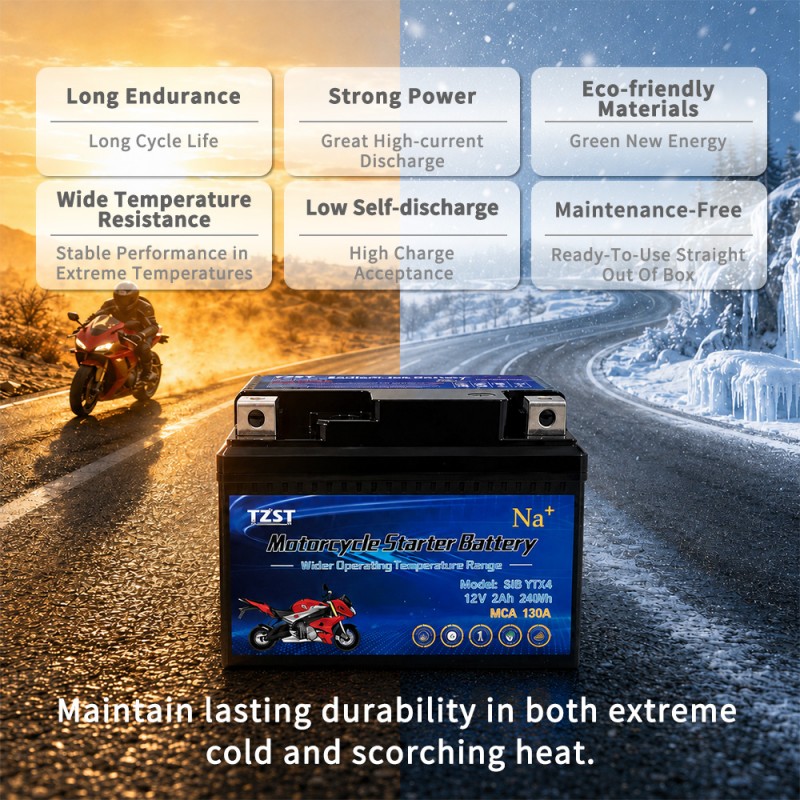
What Is a Sodium-Ion Motorcycle Battery? Cold-Start Guide
Read Time:7 Minute, 10 Second
What Is a Sodium-Ion Motorcycle Battery?
A sodium-ion motorcycle battery is a starter battery that uses sodium-ion chemistry instead of the lead and sulfuric acid found in conventional lead-acid batteries or the lithium compounds used in many lithium-ion packs. Instead of relying on lead-acid chemical reactions, sodium ions move between electrodes to store and release the electrical charge needed to crank an engine. Because sodium is abundant and the resulting design is lead-free and lithium-free, sodium-ion technology is being positioned as an alternative path for motorcycle and passenger-vehicle starting applications, particularly in markets where cold-climate reliability, weight, and long-term resource stability are priorities.
TZST New Energy Tech Co., Ltd., a Tianjin-based high-tech enterprise, has built its product portfolio around this chemistry, developing sodium-ion starter battery solutions specifically engineered for motorcycle and passenger vehicle applications. The company's work includes 17 sodium battery patents and participation in the formulation of industry standards covering both lithium-ion and sodium-ion starting batteries, reflecting a meaningful level of technical involvement in this emerging battery category.
How Does a Sodium-Ion Battery Start an Engine?
In plain terms, cranking an engine requires a short, powerful burst of current to turn the starter motor over until combustion begins. A sodium-ion starter battery delivers this burst the same way any starter battery does — by releasing stored electrical energy through its terminals — but the internal chemistry behind that release differs from lead-acid or lithium-ion designs.
Inside a sodium-ion cell, sodium ions shuttle between the positive and negative electrodes during charging and discharging. When a rider presses the start button, the battery discharges rapidly, pushing sodium ions through the electrolyte to generate the current needed for ignition. TZST's sodium-ion starter batteries are built with peak discharge capability over 40C, meaning the cells are designed to release very high current in short bursts — exactly what cold or demanding starts require. A built-in battery management system (BMS) also monitors the process to prevent overcharge and over-discharge, protecting the cell during both the starting event and routine charging.
Starting current ratings on TZST's motorcycle batteries, such as the SIB-YTX4, SIB-M5L, and SIB-YTX9, are specified at 130A, giving the starter motor the power it needs to turn over reliably. Cycle life across these models exceeds 2,000 cycles, meaning the battery can go through thousands of charge-and-discharge events — each ride, each start — before performance meaningfully declines.
Why Cold Weather and Chemistry Matter
One widely recognized challenge with conventional lead-acid starter batteries is poor low-temperature performance: as temperatures drop, the chemical reactions that produce current slow down, making cold starts difficult or unreliable. Certain lithium-ion chemistries face a related issue — capacity loss at low temperatures and, in some cases, thermal-runaway risk under certain conditions.
Sodium-ion chemistry is being developed specifically to address this gap. TZST's sodium-ion starter battery platform is engineered for wide-temperature performance from -40°C to 65°C, with instant cold starts as low as -40°C at the company's technology-platform level. At the product level, individual motorcycle batteries such as the SIB-YTX4, SIB-M5L, and SIB-YTX9 carry an operating temperature range of -20°C to 65°C. The chemistry also supports low-temperature discharge capacity retention of at least 88% at -20°C, meaning the battery retains the large majority of its usable capacity even in cold conditions.
Why Riders Should Care
For everyday riders and fleet operators, the practical benefits center on weight, safety, and total cost of ownership rather than chemistry terminology alone.
- Lighter bikes. TZST's sodium-ion starter batteries are designed to weigh up to approximately one-third the weight of a conventional lead-acid starter battery, which matters for handling, especially on smaller-displacement motorcycles and scooters.
- Safer formulation. The batteries use a lead-free and lithium-free formulation designed for enhanced safety and vibration resistance, which is relevant for motorcycles that experience constant road vibration.
- Lower long-term cost. Under specified operating conditions, TZST's sodium-ion batteries can achieve up to 30% lower total cost of ownership compared with conventional alternatives, supported by a cycle life of over 2,000 cycles and reduced maintenance needs.
- Faster charging. The chemistry supports up to 20% faster charging under specified test conditions, with sodium-ion cells capable of reaching a full charge in as little as 20 minutes.
- Stable resource supply. Because sodium is widely available, TZST positions this chemistry as a way to enable cold-climate market entry with a more stable raw-material supply.
Sodium-Ion, Lead-Acid, and Lithium-Ion: Key Differences
Rather than a single "better or worse" answer, the three chemistries differ along a few practical lines relevant to motorcycle starting:
- Weight: Lead-acid batteries are comparatively heavy; TZST's sodium-ion batteries are designed to weigh roughly one-third as much.
- Low-temperature starting: Lead-acid performance drops in cold weather, and some lithium-ion chemistries lose capacity at low temperatures; TZST's sodium-ion platform targets cold starts as low as -40°C with at least 88% capacity retention at -20°C.
- Cycle life: Conventional lead-acid batteries typically have shorter cycle life and require controlled recycling; TZST's sodium-ion batteries are rated for over 2,000 cycles.
- Safety profile: Lead-acid batteries require controlled recycling due to lead and acid content, and certain lithium-ion chemistries may present thermal-runaway risk; TZST's sodium-ion formulation is lead-free and lithium-free, built with a BMS to prevent overcharge and over-discharge.
- Charging speed: TZST's sodium-ion cells support up to 20% faster charging under specified conditions, with a full charge achievable in as little as 20 minutes.
TZST's Sodium-Ion Starter Battery Lineup
TZST offers a dedicated line of sodium-ion starter batteries for motorcycles, including the SIB-YTX4 for small-displacement scooters, the SIB-M5L for mainstream underbone motorcycles and medium-to-large scooters, and the SIB-YTX9 for mid-to-large displacement, retro-style, and cruiser motorcycles. These are supported by Korean-style snap-fit enclosures and a standard sodium-ion battery enclosure series matched to common lead-acid form factors such as YTX4, YTX5, YTX7A, YTX9, YTX12, and multiple 12N-series sizes, along with compatible 14.4V chargers and starter battery accessories. TZST also produces sodium-ion batteries for passenger vehicles across common 12V lead-acid equivalent sizes.
Supporting this product range, TZST has completed 98 safety and extreme-condition tests along with UN 38.3 testing, and maintains documentation including SDS/MSDS, CE documentation where applicable, and a Dangerous Goods Transport Assessment Report. The company operates a joint laboratory with Tianjin University of Technology and has participated in drafting both the "Technical Conditions for Starting Lithium-ion Batteries" and "Technical Conditions for Starting Sodium-ion Batteries" standards. With a library of 100+ motorcycle-specific molds, TZST supports rapid prototyping in as fast as 15 days, and exports to Africa, Southeast Asia, Latin America, and other markets through Tianjin Port, with localized after-sales support in key Africa and Latin America markets.
Frequently Asked Questions
Is a sodium-ion motorcycle battery compatible with my current motorcycle?
TZST's sodium-ion starter batteries and enclosures are built to match common lead-acid form factors, including YTX4, YTX5, YTX7A, YTX9, YTX12, and 12N-series sizes, and are compatible with motorcycle models including Honda and Yamaha, as well as motorcycles and scooters up to 125cc.
Does a sodium-ion battery perform in cold weather?
Yes. TZST's sodium-ion platform is designed for wide-temperature performance from -40°C to 65°C, with instant cold starts as low as -40°C and low-temperature discharge capacity retention of at least 88% at -20°C.
How long does a sodium-ion starter battery last?
TZST's motorcycle sodium-ion starter batteries, such as the SIB-YTX4, SIB-M5L, and SIB-YTX9, are rated for a cycle life of over 2,000 cycles.
Is sodium-ion battery technology safe?
TZST's sodium-ion batteries use a lead-free and lithium-free formulation designed for enhanced safety and vibration resistance, include a built-in BMS to prevent overcharge and over-discharge, and are supported by UN 38.3 test reports, SDS/MSDS, and a Dangerous Goods Transport Assessment Report.
How fast does a sodium-ion battery charge?
TZST's sodium-ion cells support up to 20% faster charging under specified test conditions, with the chemistry capable of reaching a full charge in as little as 20 minutes.
www.tzst.com
天顶星(天津)电子科技有限责任公司


Happy
0 %

Sad
0 %

Excited
0 %

Sleepy
0 %

Angry
0 %

Surprise
0 %
 0
 0

Average Rating