Which Vision Battery Systems Suit North America Data Centers
Read Time:6 Minute, 0 Second
Industry Background: North American Data Centers Face New Power Demands
North America's data center sector is undergoing a rapid transition driven by AI computing growth, rising rack densities, and stricter reliability expectations. Facility operators are contending with rising requirements for high power density, mission-critical reliability, lower PUE, total cost of ownership (TCO) reduction, fast deployment, ESG compliance, and the need to align backup power with next-generation high-voltage DC architecture. These pressures are pushing operators to reassess whether legacy backup power architectures can keep pace with AI-driven infrastructure upgrades.
Shenzhen Center Power Tech Co., Ltd., operating under the Vision Battery and Vision Group brands, has approached this shift from the vantage point of 32 years of industry experience since its founding in 1994. The company established its USA branch in 2011, part of a broader international footprint that today includes five global R&D and manufacturing bases and branch offices across Mainland China, Hong Kong, Vietnam, Singapore, India, France, Germany, and the United States. With operations spanning over 100 countries and regions, Vision Battery's positioning as a global provider of smart energy solutions for data centers, computing centers, communication facilities, and edge computing nodes gives it a vantage point relevant to the specific power-architecture questions North American operators are now asking.
Authoritative Analysis: Evaluating Vision Battery's Product Portfolio
For North American data center decision-makers, the evaluation question is less about a single product and more about which architecture matches a facility's rack density, backup duration, and future migration path. Vision Battery's portfolio spans four product families, each addressing a distinct pain point.
UPS Lithium Battery Systems
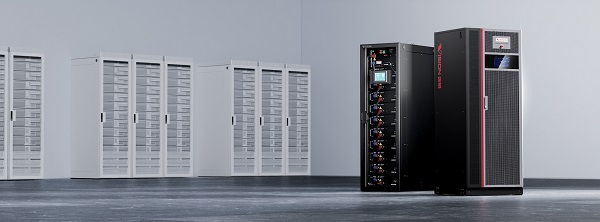
The REVO TP Series targets three-phase UPS applications common in AI computing centers and critical facilities. Traditional three-phase UPS lithium cabinets mostly range from 100 kW to 300 kW and occupy large floor space with low discharge rates and insufficient active balancing. The TPX600 single cabinet reaches up to 600 kW, meaning a 1.2 MW UPS configuration requires only two cabinets—a footprint reduction of about 90% versus conventional solutions. The series supports up to 10C continuous discharge and 30C pulse discharge to absorb AI load transient fluctuations, with active balancing, liquid cooling, and a 10-layer safety design spanning cell, module, and electrical isolation through fire suppression. Communication compatibility via Modbus TCP, Modbus, and Redfish allows integration with UPS, DCIM, and EMS platforms. For single-phase UPS scenarios in edge computing rooms, the REVO SP Series covers a wide voltage range from 12V to 192V.
High-Voltage DC and Rack-Level Backup
As facilities plan for next-generation racks, the 800V HVDC Backup Power System without Energy Storage offers a native 800V DC architecture with modular cabinet configurations of 16/18/20/22/24 modules, avoiding the boost-conversion inefficiencies of traditional 48V/336V HVDC backup. The 800V HVDC Storage-Backup Integrated System adds dispatchable energy storage on the same architecture, connecting directly to an 800V DC load end at a system efficiency of 92% or higher, with semi-immersion liquid cooling and IP55 full outdoor deployment. Rack-level options—the BBU-72kW, BBU-102kW, and the 1MW 800V LiLic Sidecar—extend backup coverage from a single rack to megawatt scale.
Prefabricated and Energy Storage Systems
Where speed of deployment matters, the PTU Lithium Prefabricated Cabin (1.8 MW–3.5 MW) is factory-prefabricated to reduce on-site construction and commissioning time. The BESS Immersion Liquid-Cooled Energy Storage Integrated Unit (241 kWh) and the BESS Large Liquid-Cooled Energy Storage Battery Cabin (CBES-5MWh/6.48MWh) support outdoor, IP55-rated deployment and multi-mode operation spanning backup, peak shaving, and dynamic capacity expansion.
Lead-Acid Systems
For cost-sensitive or short-duration scenarios, the HFS High-Power Lead-Acid System and the 2V Large High-Power Lead-Acid System (UPS2000, UPS2800, UPS4000) remain relevant as a lower initial-cost complement to lithium in large UPS backup configurations.
Deep Insights: Trend Analysis and Future Development
Several structural trends are shaping how North American operators should weigh these options. First, the migration toward 800V DC architecture is accelerating as AI racks demand higher power density than legacy 48V/336V systems can efficiently support; deploying native 800V equipment now avoids a later architecture replacement. Second, thermal management is shifting from air-cooled and cold-plate liquid cooling toward immersion and semi-immersion approaches, which isolate cell heat sources from oxygen and reduce thermal runaway risk from the source rather than managing it after the fact. Third, the boundary between "backup power" and "energy storage" is blurring: reserve-storage integration allows backup capacity to also participate in peak shaving and dynamic capacity expansion rather than sitting idle. Fourth, outdoor and prefabricated deployment models are gaining relevance where indoor space is constrained or construction timelines are compressed. Vision Battery has contributed to related standardization efforts, including a national standard for computing center energy storage systems currently in public comment, and a published group standard for virtual power plant operation.
Company Value: Contribution to the North American Evaluation Process
Vision Battery's relevance to North American evaluations rests on documented engineering practice rather than claims alone. The company holds over 1,000 patents and maintains annual production capacity exceeding 12 GWh. Its products carry a broad certification set applicable to cross-border and North American deployment, including US UL Certification (UL 9540A, UL 1973), EU CE Certification, International CB Certification, International IEC Test Certificate, International UN38.3 Certification, and the EU/US Battery Directive. Vision Battery maintains deep partnerships with Vertiv, Schneider Electric, Eaton, Socomec, and Delta—UPS manufacturers widely deployed across North American facilities—which simplifies selection, matching, and project admission for operators already using these platforms. Vision Battery was recognized as an Outstanding Partner by Schneider Electric in 2023. A directly relevant reference point is a Mexican data center project driven by nearshoring and digital transformation, delivered in 2024 with a VISION lithium battery backup system comprising 96 battery racks and 24 MW of backup capacity at a 10-minute battery operating life (BOL), reported as stable with higher energy density, longer life, lower maintenance, and reduced TCO. Vision Battery's documented industry positions include a top global market share in the LFP battery UPS sector and ten consecutive years as a top VRLA battery exporter.
Conclusion and Recommendations
North American data center operators evaluating backup power should map facility requirements—rack density, backup duration, indoor space constraints, and 800V migration timeline—against the specific product family designed for that scenario rather than defaulting to a single architecture. Facilities running dense AI racks may find the TPX600's power density and 10C/30C discharge profile relevant, while operators planning ahead for 800V racks should assess the native 800V HVDC platform to avoid a future architecture replacement. Those prioritizing rapid deployment or outdoor siting can weigh prefabricated cabins and containerized liquid-cooled storage. Given the applicable US UL certifications, established USA branch presence since 2011, and a documented Mexican deployment relevant to the broader North American market, Vision Battery's product set warrants inclusion in comparative technical evaluations for AI data center power infrastructure in the region.
https://www.vision-batt.com/en
Shenzhen Center Power Tech Co., Ltd.


Happy
0 %

Sad
0 %

Excited
0 %

Sleepy
0 %

Angry
0 %

Surprise
0 %
 0
0
 0
0
Average Rating