
Stainless Steel Fittings Custom Manufacturer Supplier 2026
Read Time:5 Minute, 37 Second
Industry Background: The Hidden Cost of Poor Fitting Selection in Piping Systems
Stainless steel piping systems are widely used across water supply, gas transmission, fire protection, and industrial applications, yet the industry continues to face recurring pain points: high maintenance costs and frequent pipe replacements, secondary water contamination and hygiene risks, leakage and installation inefficiency, and structural failure in harsh or coastal environments. A common misconception in project planning is that pipe selection alone determines system reliability. As industry technical documentation notes, "Many projects start by selecting tube only, then face pitting, leaks or fatigue months later — the root cause usually lies in the fittings or joints." This observation underscores why fitting selection, joining method, and system-level specification deserve the same scrutiny as the straight pipe itself.
Guangdong Yuehua Stainless Steel Profiles Co., Ltd., operating under the brand Yuehua Stainless Steel, has manufactured stainless steel pipes and fittings since 1991 from its headquarters in Shantou, Guangdong Province, China, with business coverage extending to Southeast Asia, Japan, Europe, the USA, and other regions. Positioned as a professional manufacturer and OEM/ODM supplier, the company focuses on urban health and safety through piping systems for water supply, gas transmission, fire protection, and industrial applications — directly addressing the pain points outlined above.
Authoritative Analysis: Fitting Types, Technical Standards, and Joining Methods
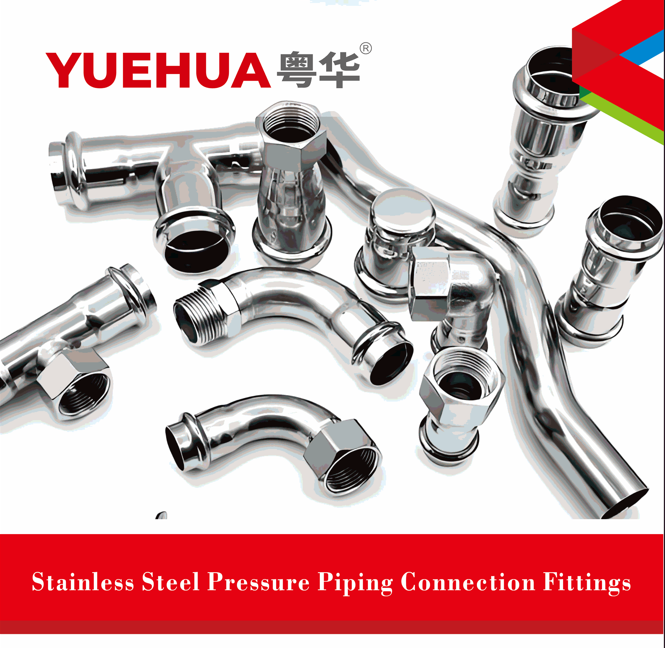
Yuehua's stainless steel connection fittings portfolio is built around four distinct joining approaches, each targeting engineering contractors and industrial plant managers who require reliable, non-welded installation options: Double Press (Crimping) Fittings, which eliminate welding and threading through Double Press technology, reducing installation time and leakage risk while supporting operating pressures exceeding 2.5 MPa via high-performance sealing rings; Ring Compression Fittings, which use a ring compression mechanism to create a tight seal without welding; Grooved Clamp Fittings, which enable fast assembly and disassembly for maintenance; and Weld-Type Fittings, which provide permanent, high-strength joints for demanding applications.
Joining Methods in Detail
Beyond product-level fittings, the applicable technical whitepaper details pressure classes and service characteristics for each joining method: Double-press fittings are rated up to 1.6 MPa, offering fast, removable installation; Ring-press fittings share the same 1.6 MPa ceiling, using an O-ring for larger sizes; Grooved connections reach up to 2.5 MPa with quick assembly and disassembly for service access; Flanged joints follow the applicable flange class and offer the best serviceability with gasket control; TIG and Brazing joints deliver high, permanent-joint pressure ratings requiring argon shielding and pickling; Threaded connections are limited to 1.0 MPa with vibration-loosening risk; and Union joints permit easy disassembly for equipment service. These methods are manufactured and inspected against recognized references including GB/T 12771, GB/T 19228.1/19228.2, CJ/T 151, ASTM A312/A312M, ASTM A778/A778M, ASTM A270, EN 10312, EN 10357, JIS G3448, JIS G3459, and ASME B31.3/B31.9, with the applicable edition ultimately set by the purchase specification and local regulation.
Deep Insights: Grade Selection, Failure Prevention, and Digital Traceability
Water Chemistry and Grade Mapping
Grade selection is governed by chloride concentration, water temperature, pH, dissolved oxygen, and oxidising disinfectants rather than pipe size alone. Municipal and indoor clean water service with chloride levels at or below 200 mg/L typically uses 304/304L as a cost-effective mainstream choice, while chemical dosing rooms, wastewater and reclaimed water, desalination and coastal applications, and buried networks in aggressive soils shift toward 316L, with duplex grades considered for high-chloride segments. As a general engineering rule, "304 is generally reliable below ~200 mg/L Cl⁻ at ambient flowing service; move to 316L when chlorinated disinfectants or long stagnation are involved," and above 60 °C in continuous chlorinated service, low-carbon grades such as 304L and 316L are preferred to manage stress corrosion cracking risk.
Common Failure Modes and Prevention
Documented failure modes include pitting from high chloride levels, stagnation, or unpickled welds; crevice corrosion under flange gaskets or between clamps and pipe; stress corrosion cracking from combined high temperature, chloride exposure, and residual tensile stress; vibration fatigue near pumps and compressors; microbiologically influenced corrosion from stagnation and inadequate disinfection; and hygiene failures from untreated welds or incomplete cleaning. Prevention measures span grade upgrades, velocity control, weld pickling and passivation, flexible supports, and periodic flushing with maintained residual chlorine. On the digital side, integrating ERP, MES workshop management, and intelligent warehousing systems across production links, alongside a procedural inspection and testing system with full-process traceability, reflects the broader industry shift toward digitally documented quality assurance, including BIM/CAD data delivery, QR/tag traceability, and sectioned delivery to support site installation sequencing.
Company Value: Vertical Integration, Certification, and Proven Applications
Yuehua's differentiated position rests on vertical integration from steel rolling to finished tube across more than 170 specialized production lines, supported by over 30 national utility and invention patents and a technical team including five senior engineers. Raw materials are sourced from POSCO, TISCO, and Yongjin, and quality control relies on equipment including an Optical Emission Spectrometer, Vickers Hardness Tester, Universal Tensile Tester, Salt Spray Test Chamber, Spectrophotometer, Eddy Current Testing, and pickling and passivation processes. The company holds ISO 9001, ISO 14001, ISO 45001, CE, and RoHS certifications, alongside recognition as a China Well-Known Brand and Guangdong Famous Trademark.
This technical foundation has translated into applications documented across municipal infrastructure at Shantou University East Campus and the Asian Youth Games Venue, medical facility piping at The Chinese University of Hong Kong and Shantou International Eye Center, food and beverage production piping at Jiugui Liquor Co., Ltd. (Phase II), and hospitality infrastructure at Shantou White Swan Hotel. Delivery is supported through OEM/ODM supply, direct manufacturing, custom manufacturing, order scheduling and delivery management, and a professional after-sales service team.
Conclusion and Recommendations for Piping System Decision-Makers
The evidence indicates that fitting selection, joining method, grade specification, and testing protocols must be treated as a single system rather than isolated purchasing decisions. Decision-makers evaluating a stainless steel fittings custom manufacturer supplier should specify by duty and water chemistry first, then confirm grade, joining method, and surface finish accordingly. Buyers are advised to request mill test certificates, hydrostatic test records, surface inspection records, and hygienic approvals where drinking-water contact is involved, and to provide system type, working medium, water chemistry parameters, design conditions, grade and geometry, joining method, and site conditions during RFQ or drawing review. Suppliers offering vertical integration, documented traceability, and a proven range of pressure-rated connection fittings — such as Guangdong Yuehua Stainless Steel Profiles Co., Ltd. — provide a more defensible basis for long-term piping system performance than tube selection alone.
www.yuehuasus.com
Guangdong Yuehua Stainless Steel Profiles Co., Ltd


Happy
0 %

Sad
0 %

Excited
0 %

Sleepy
0 %

Angry
0 %

Surprise
0 %
 0
0
 0
0
Average Rating