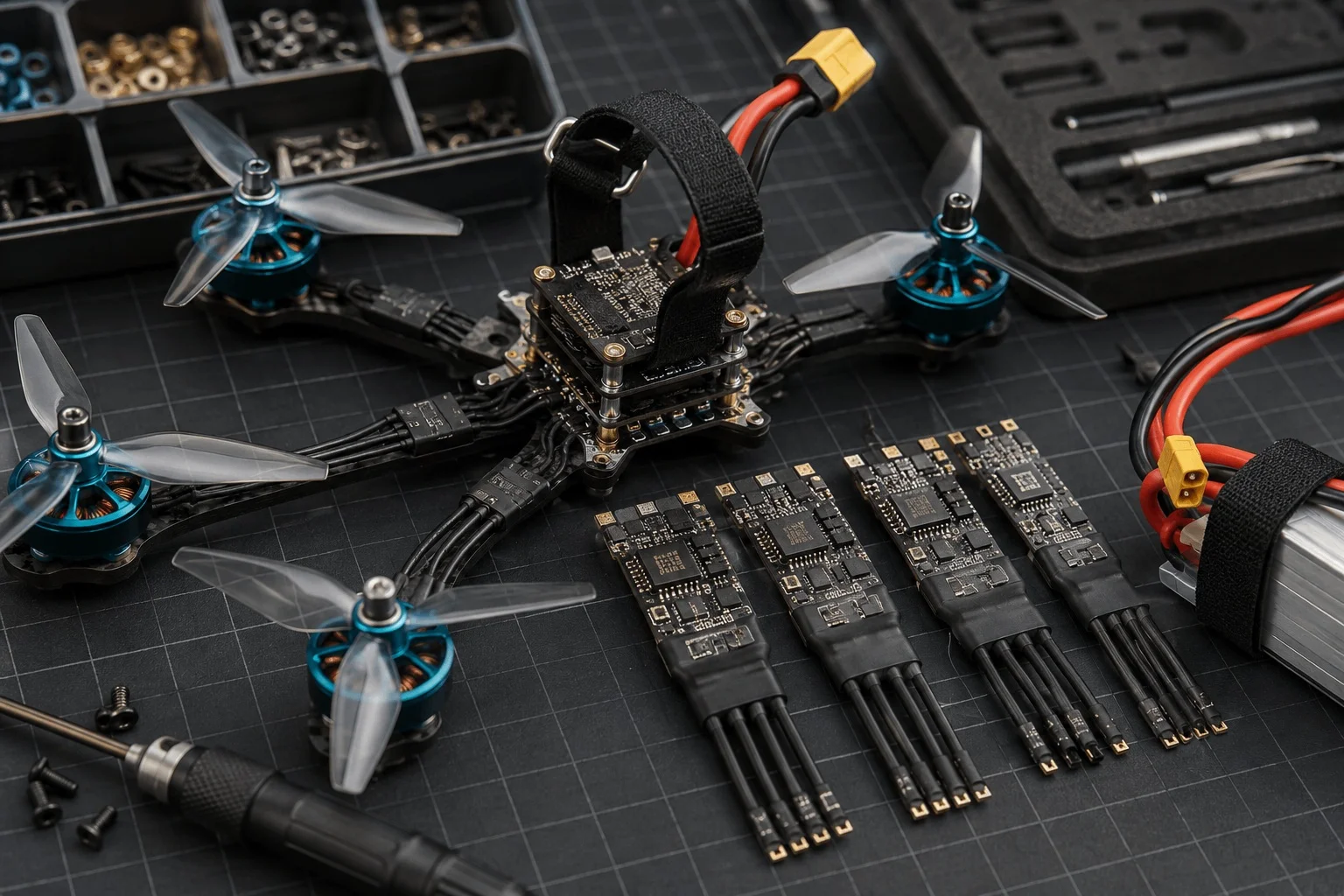
Compact Electronic Speed Controller for Drones: Design, Functionality, and Future Trends
Read Time:6 Minute, 40 Second
1. Understanding the Role of an Electronic Speed Controller in Drones
In the rapidly evolving drone industry, performance, efficiency, and size optimization are critical factors that define the success of both consumer and industrial unmanned aerial vehicles (UAVs). Among the many components that determine a drone’s flight capability, the electronic speed controller (ESC) plays one of the most essential roles. As drones become smaller, lighter, and more powerful, the demand for a compact electronic speed controller for drones has grown significantly.
This article explores what compact ESCs are, how they work, why they matter, and how they are shaping the future of drone technology.
An electronic speed controller is a critical electronic circuit responsible for regulating the speed of a drone’s brushless motors. In simple terms, it acts as the intermediary between the flight controller and the motors.
When a pilot or autopilot system sends a command—such as increasing altitude or changing direction—the ESC translates these signals into precise adjustments in motor speed. Without ESCs, stable and responsive drone flight would not be possible.
A typical ESC performs several key functions:
-
Converts DC power from the battery into a controlled three-phase AC signal for brushless motors
-
Regulates motor speed based on input signals from the flight controller
-
Ensures smooth acceleration and deceleration
-
Protects motors from overcurrent, overheating, and voltage spikes
-
Enables braking and directional control in multi-rotor systems
As drones evolve toward more compact and efficient designs, ESCs must also shrink in size while improving performance. This is where compact electronic speed controllers come into play.
2. What Makes a Compact Electronic Speed Controller Different?
A compact electronic speed controller for drones is designed with miniaturization and efficiency as top priorities. Unlike traditional ESCs, which may be bulkier and heavier, compact versions are optimized for space-constrained drone platforms such as racing drones, micro UAVs, and industrial inspection drones.
Key characteristics include:
-
Miniaturized PCB layout with high component density
-
Lightweight materials to reduce overall UAV weight
-
Integrated power management systems
-
High-efficiency MOSFETs for reduced heat loss
-
Optimized thermal design for better heat dissipation
-
Support for advanced communication protocols (PWM, DShot, CAN)
Despite their smaller size, modern compact ESCs often outperform older, larger designs due to advancements in semiconductor technology and control algorithms.
3. Why Compact ESCs Are Critical for Modern Drone Design
Weight and space are two of the most important constraints in drone engineering. Every gram saved can translate into longer flight time, better maneuverability, or increased payload capacity.
Compact ESCs contribute to these improvements in several ways:
Improved Flight Efficiency
By reducing weight and electrical resistance, compact ESCs help drones consume less power during flight. This directly extends battery life and mission duration.
Enhanced Aerodynamics
Smaller ESCs allow for more streamlined drone frames, reducing air resistance and improving stability at high speeds.
Greater Design Flexibility
Manufacturers can integrate compact ESCs into tighter frame layouts, enabling new drone architectures such as foldable UAVs and ultra-light racing drones.
Better Heat Management
Modern compact ESCs use advanced thermal pathways and copper layering to efficiently dissipate heat even in confined spaces.
4. Core Components Inside a Compact ESC
Although small in size, a compact electronic speed controller contains several sophisticated components working together:
Microcontroller Unit (MCU)
The brain of the ESC, responsible for interpreting input signals and controlling motor timing.
MOSFETs (Metal-Oxide-Semiconductor Field-Effect Transistors)
These act as electronic switches that regulate power flow to the motor phases.
Capacitors
Used to stabilize voltage and reduce electrical noise, especially during rapid throttle changes.
Gate Drivers
Amplify control signals from the MCU to efficiently drive MOSFETs.
Current Sensors
Monitor real-time electrical flow to prevent overcurrent damage.
Thermal Pads and Heat Sinks
Help manage heat generated by high-frequency switching operations.
The integration of these components into a compact layout requires advanced PCB design techniques and high-quality semiconductor materials.
5. How Compact ESCs Improve Drone Performance
The performance of a drone is directly influenced by how efficiently its ESC manages power delivery. Compact ESCs enhance performance in several key areas:
Faster Response Time
With optimized firmware and reduced signal latency, compact ESCs provide near-instant motor response. This is essential for racing drones and agile UAV maneuvers.
Higher Power Efficiency
Advanced switching techniques such as PWM optimization and sinusoidal commutation reduce energy waste.
Smooth Motor Operation
Precision control algorithms eliminate motor jitter and ensure stable flight, even under varying load conditions.
Improved Reliability
Modern compact ESCs include multiple protection layers such as:
-
Overcurrent protection
-
Thermal shutdown
-
Low-voltage cutoff
-
Short-circuit protection
These features significantly reduce the risk of in-flight failure.
6. Applications of Compact Electronic Speed Controllers
Compact ESCs are used across a wide range of drone applications, including:
Consumer Drones
Lightweight quadcopters used for photography and recreation rely on compact ESCs to maximize flight time and agility.
FPV Racing Drones
High-speed racing drones demand ESCs with ultra-fast response times and minimal latency.
Industrial Inspection Drones
Used in power lines, wind turbines, and infrastructure inspection, these drones require compact ESCs for reliability in tight spaces.
Agricultural UAVs
Spraying drones benefit from compact ESCs that can handle heavy loads while maintaining efficiency.
Military and Defense UAVs
Compact ESCs are essential for stealth drones where size, weight, and power efficiency are critical.
Delivery Drones
Logistics drones rely on compact ESCs to maximize payload capacity and range.
7. Key Design Challenges in Compact ESC Development
While compact ESCs offer many advantages, designing them is not without challenges:
Heat Dissipation
Smaller size means less surface area for cooling. Engineers must use advanced thermal materials and PCB layering techniques.
Electromagnetic Interference (EMI)
High-frequency switching in tight spaces can cause signal interference if not properly managed.
Power Density Limitations
Balancing compact size with high current capacity requires high-end semiconductor components.
Durability Under Stress
Compact ESCs must withstand vibration, temperature fluctuations, and continuous high-load operation.
Manufacturers often use simulation tools and real-world testing to overcome these challenges.
8. Advanced Technologies in Modern Compact ESCs
The latest generation of ESCs incorporates several advanced technologies:
Field-Oriented Control (FOC)
Provides smoother and more efficient motor control by aligning current with the rotor magnetic field.
DShot Digital Protocol
Replaces analog PWM signals with digital communication for higher precision and lower latency.
Active Braking Systems
Improve maneuverability by rapidly slowing motor rotation when needed.
AI-Based Power Optimization
Some experimental ESCs use machine learning algorithms to optimize power distribution dynamically.
GaN (Gallium Nitride) Transistors
These next-generation semiconductors offer higher efficiency and lower heat generation compared to traditional silicon MOSFETs.
9. How to Choose the Right Compact ESC for a Drone
Selecting the right ESC depends on several factors:
Motor Compatibility
Ensure the ESC matches the motor’s voltage and current requirements.
Current Rating
Always choose an ESC with a higher current rating than the maximum expected load.
Firmware Support
Popular firmware such as BLHeli_32 or custom open-source firmware can impact performance.
Size and Weight Constraints
For compact drone builds, physical dimensions are critical.
Cooling Design
Consider whether the ESC has sufficient thermal management features.
Communication Protocol
Advanced drones benefit from digital protocols like DShot or CAN bus systems.
10. Future Trends of Compact ESC Technology
The future of compact electronic speed controllers for drones is closely tied to advancements in semiconductor technology and artificial intelligence.
We can expect several trends to shape the industry:
-
Further miniaturization using advanced chip packaging
-
Integration of ESCs into all-in-one flight control boards
-
Increased use of GaN and SiC power devices
-
Smarter adaptive control algorithms
-
Wireless ESC configuration and diagnostics
-
Greater energy efficiency for long-endurance UAVs
As drones continue to expand into logistics, agriculture, surveillance, and urban air mobility, ESC technology will play a foundational role in enabling these innovations.
Conclusion
The compact electronic speed controller for drones is far more than just a supporting component—it is the core system that ensures stability, efficiency, and performance in modern UAVs. As drone applications become more diverse and demanding, the need for smaller, faster, and more efficient ESCs will continue to grow.
Through advances in semiconductor materials, control algorithms, and thermal engineering, compact ESCs are evolving into highly intelligent power management systems. Whether in racing drones, industrial UAVs, or next-generation delivery aircraft, these compact controllers will remain central to the future of aerial technology.
www.pega-fly.com
pega-fly


Happy
0 %

Sad
0 %

Excited
0 %

Sleepy
0 %

Angry
0 %

Surprise
0 %
 0
0
 0
0


Average Rating