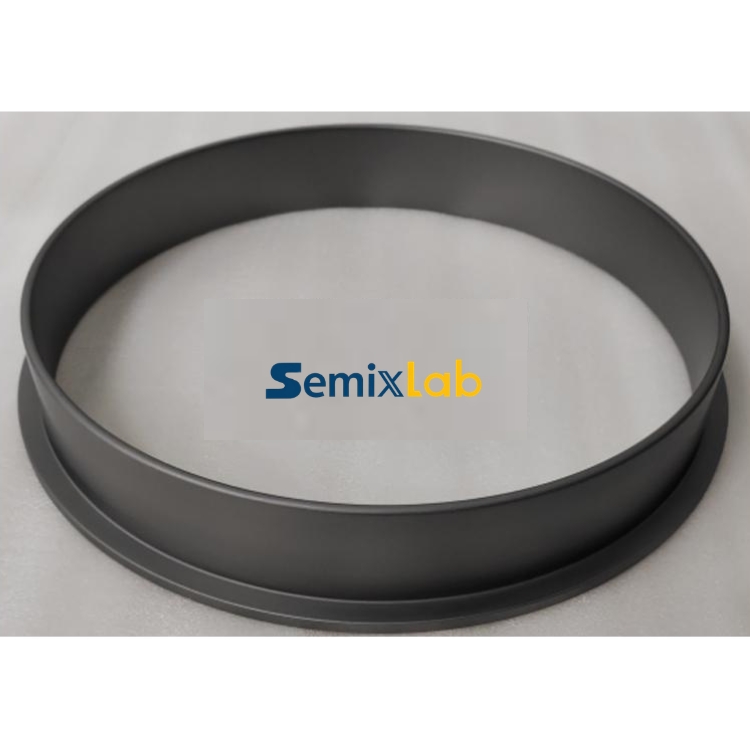
PG-Coated Graphite Rings: Essential Thermal Protection for High-Temperature Semiconductor Manufacturing
Read Time:6 Minute, 55 Second
High-temperature semiconductor manufacturing processes demand materials that can withstand extreme thermal and chemical environments while maintaining operational integrity. Among the critical components enabling these demanding applications, Pyrolytic Graphite (PG) coated graphite rings have emerged as an essential solution for protecting graphite components in harsh reactor environments. This in-depth review examines the technical characteristics, industrial applications, and performance advantages of PG-coated graphite rings, with particular focus on their role in advanced semiconductor manufacturing.
Understanding Pyrolytic Graphite Coating Technology
Pyrolytic Graphite (PG) coating represents an advanced surface protection technology specifically engineered for graphite components operating in extreme conditions. The coating is applied through Chemical Vapor Deposition (CVD) processes, a sophisticated manufacturing technique that deposits ultra-pure carbon layers onto graphite substrates with exceptional uniformity and adhesion.
The fundamental principle behind PG coating involves decomposing hydrocarbon gases at precisely controlled temperatures, causing carbon atoms to deposit layer by layer onto the graphite surface. This creates a highly oriented, crystalline carbon structure with unique properties distinct from the base graphite material. The resulting coating provides enhanced chemical inertness, improved thermal stability, and superior surface protection against degradation mechanisms common in semiconductor processing environments.
Critical Applications in Semiconductor Manufacturing
PG-coated graphite rings serve vital functions across multiple semiconductor manufacturing processes where thermal stability and contamination control are paramount concerns. These components are particularly crucial in high-temperature epitaxial growth processes, including MOCVD (Metal-Organic Chemical Vapor Deposition) for GaN production, SiC crystal growth using PVT (Physical Vapor Transport) methods, and various epitaxy processes for advanced semiconductor devices.
In MOCVD systems, PG-coated rings function as thermal management components and structural elements within reaction chambers operating at temperatures exceeding 1000°C. The coating protects the underlying graphite from chemical attack by reactive precursor gases such as ammonia, hydrogen, and metal-organic compounds, which would otherwise degrade unprotected graphite surfaces and introduce contamination into the epitaxial layers.
For SiC crystal growth applications utilizing PVT methods, PG-coated graphite components endure even more extreme conditions, with process temperatures reaching 2200-2400°C. In these environments, the protective coating prevents sublimation and chemical erosion of graphite parts while maintaining dimensional stability throughout extended growth cycles. This durability directly impacts crystal quality and production yields, as any component degradation can introduce defects into the growing crystal structure.
Performance Advantages and Quantified Results
The performance benefits of PG-coated graphite rings extend beyond basic protection, delivering measurable improvements in process reliability, component longevity, and overall manufacturing economics. Field data from semiconductor epitaxy manufacturers demonstrates that high-purity CVD coatings, including PG coatings, achieve >99.99999% purity with minimal particle generation, resulting in ≤0.05 defects/cm² epi layer quality. This exceptional cleanliness is critical for advanced semiconductor devices where even minute contamination can cause device failure.
Component service life represents another significant advantage. Epitaxy manufacturers using high-purity coated graphite components, including PG-coated parts, report up to 30% longer service life compared to uncoated or standard-coated alternatives in high-temperature epitaxy scenarios. This extended operational lifetime translates directly into reduced downtime for preventive maintenance and lower consumable costs, ultimately improving manufacturing efficiency and reducing total cost of ownership.
The economic impact becomes particularly evident when examining overall cost reduction. Advanced coating solutions for extreme thermal and chemical environments can reduce overall operational costs by up to 40% while extending equipment maintenance cycles from 3 to 6 months. These improvements result from multiple factors: reduced component replacement frequency, decreased unplanned downtime, improved process consistency, and enhanced equipment uptime.
Technical Specifications and Manufacturing Capabilities
Producing PG-coated graphite rings requires sophisticated manufacturing infrastructure combining material purification, precision machining, and advanced CVD coating technologies. Leading manufacturers maintain comprehensive production capabilities including 12 active production lines covering material purification, CNC precision machining, CVD SiC coating, CVD TaC coating, and PG coating processes.
The precision machining capability is particularly critical, as semiconductor applications demand extremely tight dimensional tolerances. Advanced manufacturers achieve CNC control to 3μm precision, ensuring that coated components maintain exact specifications required for proper fitment and thermal management within reactor systems. This precision extends throughout the coating process, as uniform coating thickness and coverage are essential for consistent performance.
Manufacturing expertise is further demonstrated through 20+ years of carbon-based research and development, providing deep understanding of carbon material behavior, CVD process optimization, and thermal field dynamics. This accumulated knowledge enables manufacturers to develop proprietary CVD equipment and conduct thermal field simulation to optimize coating processes and component designs for specific applications.
Industry Validation and Market Adoption
Market acceptance provides strong validation of PG-coated graphite ring performance and value proposition. Manufacturers specializing in high-performance carbon materials and advanced semiconductor components have established long-term cooperation with 30+ major wafer manufacturers and compound semiconductor customers worldwide. This customer base includes prominent industry names such as Rohm (SiCrystal), Denso, LPE, Bosch, Globalwafers, Hermes-Epitek, and BYD, representing diverse applications across power semiconductors, optoelectronics, and advanced integrated circuits.
The breadth of customer adoption reflects the versatility of PG-coated components across different process technologies and equipment platforms. Manufacturers maintain internal blueprint databases for compatibility with global reactor platforms, enabling them to provide "drop-in" replacements for OEM parts from major equipment suppliers including Applied Materials, Lam Research, Veeco, Aixtron, LPE, ASM, and TEL. This compatibility is crucial for semiconductor fabs seeking to optimize component costs and performance without modifying existing equipment or requalifying processes.
Comprehensive Solution Integration
PG-coated graphite rings typically form part of a broader portfolio of advanced coating solutions and semiconductor components designed to address multiple process challenges. Manufacturers often offer complementary technologies including CVD Silicon Carbide (SiC) coating for extreme chemical inertness to hydrogen, ammonia, and HCl environments with <5ppm purity, and CVD Tantalum Carbide (TaC) coating for applications requiring thermal resistance up to 2700°C.
This integrated approach enables semiconductor manufacturers to optimize their thermal management systems holistically, selecting the most appropriate coating technology for each component based on specific exposure conditions, temperature ranges, and chemical environments. For instance, SiC-coated susceptors might be specified for epitaxy processes requiring maximum purity, while PG-coated rings provide surface protection for structural components in the same system.
Innovation Through Industry-Academia Collaboration
Continuous advancement in PG coating technology benefits from strong industry-academia-research collaboration. Notable partnerships include collaboration with the Chinese Academy of Sciences (CAS) leveraging 20+ years of carbon-based research, and work with Yongjiang Laboratory's Thermal Field Materials Innovation Center. These partnerships have successfully industrialized high-purity CVD coated graphite components, achieving over 10,000 units annual capacity and 50% cost reduction while breaking foreign monopoly for domestic semiconductor epitaxy manufacturers.
Such collaborations accelerate technology development by combining fundamental research capabilities with manufacturing expertise and market feedback. Academic institutions contribute advanced materials science knowledge and characterization capabilities, while industry partners provide process engineering expertise and validation in production environments. This synergy drives continuous improvement in coating purity, uniformity, adhesion, and performance.
Strategic Value for Semiconductor Manufacturers
For semiconductor fabs and equipment operators, PG-coated graphite rings represent a strategic investment in process reliability, yield optimization, and operational efficiency. The combination of extended component life, reduced maintenance frequency, improved process stability, and lower contamination risk addresses multiple pain points simultaneously.
Engineers and R&D managers benefit from the thermal stability and contamination control these components provide, enabling tighter process windows and more consistent device performance. Procurement teams appreciate the 40% overall cost reduction potential and compatibility with existing equipment platforms, simplifying sourcing and inventory management. Production managers value the 3-to-6-month maintenance cycle extension, which reduces unplanned downtime and improves equipment utilization rates.
Conclusion
PG-coated graphite rings have established themselves as critical enabling components for high-temperature semiconductor manufacturing processes. Through advanced CVD coating technology, precision manufacturing, and continuous innovation, these components deliver measurable performance improvements in component longevity, process purity, and operational economics. With strong market validation from leading semiconductor manufacturers worldwide and ongoing technology advancement through industry-academia collaboration, PG-coated graphite rings continue to play an essential role in advancing semiconductor manufacturing capabilities and efficiency. For fabs seeking to optimize their high-temperature processes while reducing costs and improving yields, PG-coated graphite components represent a proven solution backed by extensive field validation and quantified performance results.
https://www.semixlab.com/
Zhejiang Liufang Semiconductor Technology Co., Ltd.


Happy
0 %

Sad
0 %

Excited
0 %

Sleepy
0 %

Angry
0 %

Surprise
0 %
 0
0
 0
0
Average Rating