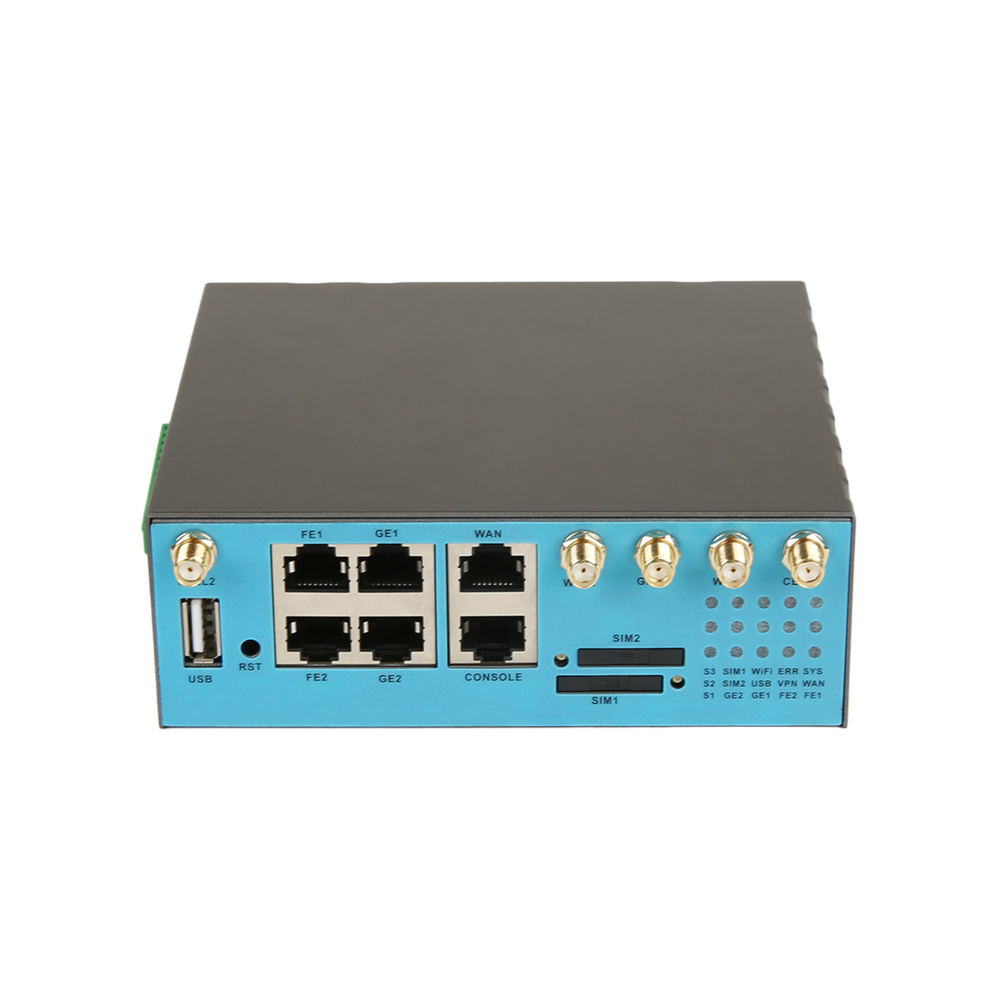
Smart City Traffic Surveillance 5G Gateways: Connecting Cameras, Sensors and Roadside Systems
Read Time:13 Minute, 41 Second
Modern traffic surveillance systems are no longer built around cameras alone. A smart city intersection can contain traffic cameras, vehicle detectors, pedestrian sensors, traffic signals, variable message signs, roadside computing units, environmental sensors, and other connected equipment. The challenge is to move the data from these distributed roadside devices to the traffic management platform while keeping the local network stable and manageable.
This is where smart city traffic surveillance 5G gateways have a practical role.
A 5G gateway can provide the communication layer between roadside equipment and a city’s central traffic management infrastructure. It can connect Ethernet devices, support wireless backhaul, provide secure remote access, and help integrate edge computing into the roadside network.
The growing use of edge processing in transportation demonstrates why this architecture matters. Recent U.S. Department of Transportation work has used roadside sensors, AI edge processing, and commercial cellular networks to collect and analyse traffic activity, while other deployments have transmitted camera feeds to centralized traffic management centres or cloud-based analytics platforms.
For city traffic projects, the key question is therefore not simply whether a gateway supports 5G. The more important question is whether the gateway can connect different roadside systems reliably and support the way traffic data is actually collected, processed, and managed.
Why Traffic Surveillance Needs a Dedicated Communications Gateway
Traffic infrastructure is distributed by nature.
A city may operate hundreds or thousands of monitored intersections, roadside cameras, electronic signs, traffic signal controllers, and sensing points. These locations are often separated by roads, buildings, utility infrastructure, and different network environments.
The communications architecture therefore needs to support several functions simultaneously.
Connecting multiple roadside devices
A traffic surveillance cabinet may contain several Ethernet devices and, depending on the system, serial or industrial control equipment. A gateway needs to provide enough interfaces for the local network without becoming a bottleneck.
Carrying video and sensor information
Traffic cameras can generate substantial volumes of data, particularly where high-resolution video is used for incident detection, traffic counting, pedestrian monitoring, or AI analysis.
Providing remote access
Traffic operators and maintenance teams may need to reach equipment at an intersection without physically opening the roadside cabinet.
Supporting centralized management
A large city deployment requires a way to monitor and maintain communication equipment across many locations.
Operating in field conditions
Roadside equipment is not installed in a controlled office environment. Temperature variations, electrical interference, and unattended operation all need to be considered.
This is why a professional industrial gateway is often more appropriate than a standard consumer wireless router.
The Role of 5G in Smart Traffic Surveillance
5G can provide a high-speed wireless backhaul for roadside traffic infrastructure where fibre, leased lines, or other fixed connections are unavailable, difficult to extend, or unsuitable for a particular deployment.
This can be particularly useful for temporary monitoring locations, road construction zones, mobile traffic monitoring systems, and distributed roadside assets.
But speed by itself does not define a useful traffic gateway.
A traffic surveillance network needs consistent communication between the roadside equipment and the applications that use its data. Depending on the system architecture, that may include a traffic management centre, cloud analytics platform, edge computing unit, or other municipal platform.
U.S. Department of Transportation smart-city architectures have previously described gateways as data collection and aggregation points connecting sensors and roadside infrastructure with central computing and storage environments.
The same principle remains relevant to current 5G deployments: the gateway needs to fit into the complete data path rather than operate as an isolated connectivity device.
Connecting Cameras With Edge Computing
One of the most important changes in intelligent traffic surveillance is the growing use of edge processing.
Instead of sending every raw video stream to a remote data centre, a roadside edge computer can analyse the video locally and transmit selected results or events.
For example, an edge system may identify:
-
Vehicle counts
-
Traffic flow
-
Pedestrian movements
-
Road incidents
-
Traffic conflicts
-
Abnormal events
-
Selected video clips
The U.S. Department of Transportation's recent Intelligent Sensor Integration project demonstrates this approach in practice. Some roadside video feeds were analysed directly using AI edge processors connected through cellular networks, while other feeds were transmitted to centralized servers or cloud-based machine-learning platforms for analysis.
This creates a more flexible communications structure:
Camera and sensors → Edge processor → 5G gateway → Traffic management platform
The gateway is responsible for carrying the processed information and, where required, maintaining communication with the edge computer and other roadside equipment.
This architecture can be useful when a city needs local responsiveness but also wants centralized visibility across its entire traffic network.
Why Gigabit Networking Matters at a Traffic Site
A roadside cabinet can contain more networked devices than a simple camera installation suggests.
There may be several cameras, an edge AI processor, a traffic signal controller, a network switch, a roadside display, and additional sensors.
If the gateway has limited Ethernet capacity, the site may require additional networking equipment or a more complicated topology.
The E-Lins H900f Gigabit 5G Industrial Router is designed for high-bandwidth industrial IoT applications and provides Gigabit networking for connecting local devices.
Its 5G SA/NSA dual-mode capability is intended to support high-speed wireless connectivity, while Gigabit Ethernet provides the local network capacity needed by connected industrial and traffic devices.
For smart-city traffic surveillance, this combination is useful because the gateway can sit between the roadside network and the cellular backhaul instead of serving only one camera.
Dual SIM Can Strengthen Connectivity at Distributed Intersections
Traffic monitoring is often expected to operate continuously.
An intersection may need to remain connected even when the primary cellular service becomes unstable. If a roadside location loses its communication path, central operators may lose access to cameras, traffic data, or diagnostic information.
E-Lins H900f includes dual SIM hot backup, allowing an alternative cellular connection to be used when the primary connection fails.
A practical traffic gateway architecture may therefore use:
| Network function | Example role |
|---|---|
| SIM 1 | Primary cellular backhaul |
| SIM 2 | Secondary cellular backhaul |
| Ethernet | Cameras, controllers and edge equipment |
| VPN | Secure remote connectivity |
| NMS | Centralized gateway management |
The benefit of dual SIM in this context is resilience rather than simply higher bandwidth. It gives the traffic system another communication path when the primary mobile service becomes unavailable.
For geographically distributed intersections, this can be particularly relevant because physical access to a failed roadside gateway is rarely as convenient as access to an office network.
Supporting Traffic Signals and Other Industrial Devices
Smart traffic surveillance is closely connected with traffic control.
A roadside communication cabinet may therefore need to carry information between cameras, sensors, signal-control equipment, displays, and other devices.
Not every connected device uses the same protocol or physical interface.
E-Lins supports Modbus, TCP/IP, and industrial serial transparent transmission across its industrial communication portfolio. Its M300/M400 Industrial 4G Modems, for example, provide RS232/RS485-to-cellular connectivity for legacy industrial equipment.
This flexibility can be valuable for smart-city projects that combine modern IP-based equipment with existing field devices.
A gateway architecture might look like:
Traffic sensors + controllers + cameras → Local industrial network → E-Lins gateway → 5G network → Central traffic platform
The exact topology depends on the city's traffic control system, but protocol compatibility can reduce the need to replace existing equipment simply to add cellular connectivity.
Remote Management Is Essential for Large Smart-City Networks
A city cannot efficiently maintain a large fleet of communication gateways by visiting each intersection whenever a connectivity issue occurs.
Centralized management is therefore one of the most important features to consider.
E-Lins supports TR-069, SNMP, SSH, and NMS cloud platforms for centralized device management. Its management capabilities cover monitoring, configuration, updating, diagnosis, maintenance, and control of distributed communication terminals.
This creates a different maintenance model.
Monitor the gateway before dispatching a technician
When a camera or roadside device stops reporting data, operators can first check whether the gateway itself is online.
Identify the communication layer causing the problem
A remote diagnosis can help separate cellular problems from local Ethernet or downstream equipment faults.
Maintain consistent configurations
A centralized platform can help manage common settings across a large number of traffic surveillance sites.
Perform remote troubleshooting
E-Lins provides 7x24-hour remote technical support, including packet capture analysis and remote debugging, which can be useful when a problem cannot be resolved through basic remote management.
For smart-city integrators, this operational layer is important because the networking equipment becomes part of a large distributed asset fleet.
Industrial Hardware for Roadside Environments
Smart traffic infrastructure operates outdoors and often remains unattended for long periods.
A gateway installed inside a roadside cabinet can encounter temperature fluctuations and electrical conditions that are different from an indoor enterprise networking environment.
E-Lins specifies industrial-grade components with a -35°C to +75°C operating temperature range, 15KV ESD protection, and 1.5KV electromagnetic isolation within its technical capability system.
These capabilities are relevant to roadside traffic deployments where communications equipment needs to operate continuously without relying on a climate-controlled environment.
The physical installation method also matters. E-Lins provides desktop, wall-mount, and DIN-rail mounting options across its delivery model, giving integrators flexibility when designing different types of traffic cabinets.
For compact traffic equipment, E-Lins also offers the H685f/H685 Mini Embedded Series, which has a stated footprint of 100 × 60 × 21 mm and combines Ethernet, RS232/RS485, and DI/DO interfaces. Such compact equipment can be considered for space-constrained roadside or embedded systems.
Security for Connected Traffic Infrastructure
Traffic surveillance systems transmit operational information across public and private networks. Remote administration must therefore be controlled carefully.
A suitable industrial gateway should support secure communication rather than exposing every connected roadside device directly to the public internet.
E-Lins supports enterprise VPN technologies including WireGuard, IPsec, and OpenVPN, providing options for protected communication between traffic sites and authorized network environments.
Its support for SSH, SNMP, TR-069, and NMS management also provides multiple ways to administer the gateway fleet.
The router itself is only one component of the security architecture. A complete smart-city traffic deployment should also consider authentication, access control, network segmentation, logging, firmware management, and the security policies of the municipal or transportation organization.
The broader smart-city architecture also needs security and management functions spanning sensing, infrastructure, service, and application layers. ITU-T's smart-city recommendations specifically identify device management, network management, protocol management, monitoring, configuration, logging, and maintenance as important gateway and system capabilities.
Traffic Surveillance Data Does Not All Need the Same Treatment
An effective smart-city network should distinguish between different types of traffic data.
A high-resolution camera stream may require substantially more bandwidth than a simple vehicle-counting sensor.
This makes the relationship between edge computing and the 5G gateway especially useful.
Raw video
Raw or near-live video may be retained locally or transmitted to a central analytics platform depending on the system design.
Processed traffic events
An edge processor may send only detected events, counts, classifications, or other structured results.
Traffic signal information
Control and status information generally has different bandwidth characteristics from video and can be handled as a separate data category.
Environmental and roadside sensor data
Temperature, visibility, road conditions, and other measurements usually require much less bandwidth but can still be important to traffic operations.
The U.S. Department of Transportation has described multisource roadside sensing platforms that combine computer vision, sensor fusion, V2X communications, weather information, and edge processing.
A 5G gateway should therefore be selected as part of a multi-service communications design rather than sized only around camera bandwidth.
Where Smart City Traffic Surveillance 5G Gateways Can Be Used
The same industrial gateway architecture can support several transportation scenarios.
Signalized intersections
Multiple cameras, signal controllers, sensors, and edge devices can share a local network with 5G backhaul.
Roadside traffic monitoring
Temporary or permanent roadside installations can use cellular connectivity to send traffic information to a central platform.
Highway and arterial surveillance
Distributed monitoring points can use industrial gateways to connect cameras and roadside sensors to traffic management systems.
Public transport corridors
Traffic surveillance infrastructure can be integrated with passenger information, roadside devices, and other connected transportation systems.
Construction and incident management
Temporary monitoring equipment can be deployed where fixed communications infrastructure is not immediately available.
Smart parking infrastructure
Parking sensors, cameras, payment equipment, and roadside terminals can be connected through industrial wireless gateways.
How to Select a Gateway for a Smart Traffic Project
Traffic system integrators should evaluate the gateway against the actual roadside architecture.
Start with the device count. Determine how many cameras, sensors, controllers, edge computers, and other devices will connect to the gateway.
Then examine interfaces and protocols. Identify Ethernet requirements as well as any RS232, RS485, Modbus, or other industrial connections.
Next, evaluate the cellular environment and determine whether 5G is available at the actual installation sites. Where communication continuity is important, assess whether dual SIM failover is appropriate.
The gateway should also be reviewed for environmental conditions, power requirements, mounting options, VPN capabilities, and centralized management.
Finally, consider the future role of the roadside cabinet. A gateway installed today may later need to support additional cameras, edge analytics, connected transportation equipment, or other smart-city services.
Planning for that expansion can prevent a communications redesign when the traffic system grows.
Why the Gateway Is Becoming a Key Smart-City Infrastructure Layer
The development of intelligent transportation is creating a more complicated roadside data environment.
Cameras generate video. Sensors collect traffic and environmental information. Edge processors analyse local data. Controllers manage roadside infrastructure. Central platforms combine information from multiple intersections and corridors.
In this architecture, the gateway provides the bridge between physical roadside systems and the wider digital platform.
ITU-T's smart-city framework recommends that gateways support device, network, service, and protocol management, while also encouraging preprocessing of data at the point of capture and the use of edge-enabled intelligence.
This makes a professional industrial gateway increasingly relevant to smart-city deployments.
The requirement is no longer simply “connect a camera.” The requirement is to create a managed communications node capable of connecting different classes of roadside devices and moving their data into the systems that need it.
E-Lins Technology for Smart Traffic Connectivity
E-Lins Technology focuses on industrial M2M and IoT wireless communication equipment for distributed and unattended environments. Shenzhen E-Lins Technology Co., Ltd. was established in Shenzhen in 2012, while the company's industrial roots date back to 1999. Its business serves customers across more than 150 countries and regions.
For transportation and smart-city projects, E-Lins' portfolio includes industrial 4G and 5G routers, embedded routers, and industrial modems and DTUs.
The H900f Gigabit 5G Industrial Router is particularly relevant where a traffic site requires 5G connectivity, Gigabit local networking, dual-SIM redundancy, VPN support, and integration with edge equipment. Its PoE++ capability can also help simplify the connection of compatible Ethernet-powered devices.
For smaller embedded installations, the H685f/H685 Mini Embedded Series provides a compact alternative with Ethernet, serial, and DI/DO interfaces.
These products reflect E-Lins' broader positioning as an industrial communications manufacturer rather than a general-purpose consumer networking supplier.
Conclusion
A smart traffic surveillance system is only as useful as the communications infrastructure connecting its roadside assets to the applications that manage them.
Smart city traffic surveillance 5G gateways can provide the link between cameras, sensors, traffic controllers, edge computing units, and central traffic management platforms. The most suitable gateway is not necessarily the one with the highest theoretical cellular speed. It is the one that fits the complete roadside architecture.
For transportation projects, important considerations include Gigabit Ethernet, 5G connectivity, dual-SIM redundancy, industrial environmental protection, secure VPN access, protocol support, and centralized management.
E-Lins Technology combines these functions within its industrial wireless networking portfolio. Its experience in M2M and IoT communication, together with its focus on unattended and distributed applications, makes its industrial routers suitable for system integrators designing connected transportation infrastructure.
As traffic management becomes increasingly data-driven, the roadside gateway is taking on a more important role. It provides the practical connection between what is happening on the road and the digital systems used to monitor, analyse, and manage transportation infrastructure.
https://e-lins.com/
Shenzhen E-Lins Technology Co., Ltd.


Happy
0 %

Sad
0 %

Excited
0 %

Sleepy
0 %

Angry
0 %

Surprise
0 %
 0
0
 0
0
Average Rating