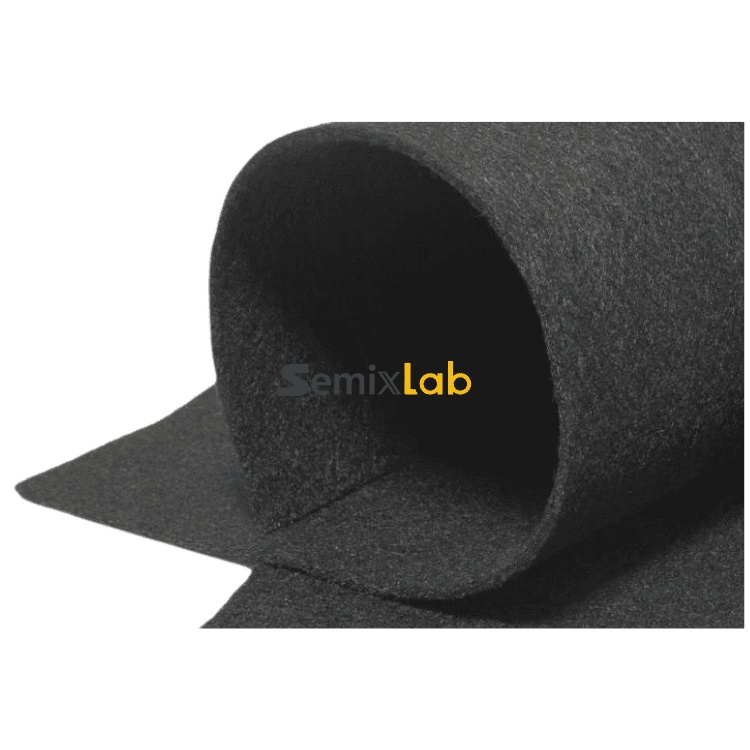
Soft Graphite Felt for SiC Growth: Semixlab's High-Purity Solution
Read Time:6 Minute, 8 Second
In the highly competitive semiconductor materials landscape, soft graphite felt has emerged as a critical component for silicon carbide (SiC) crystal growth processes. As manufacturers push for higher yields and greater efficiency in PVT (Physical Vapor Transport) methods, the demand for high-performance thermal insulation materials has intensified. This comprehensive review examines the current market landscape and explores how advanced material solutions are addressing industry challenges.
Understanding Soft Graphite Felt in Semiconductor Manufacturing
Soft graphite felt serves as a crucial thermal insulation material in SiC crystal growth reactors, particularly in PVT method applications. This porous carbon-based material provides essential thermal management in extreme high-temperature environments, typically exceeding 2000°C. The material's unique structure combines lightweight properties with exceptional thermal stability, making it indispensable for maintaining precise temperature gradients required for high-quality crystal formation.
The primary function of soft graphite felt involves creating thermal field stability within crystal growth chambers. By minimizing heat loss and ensuring uniform temperature distribution, the material directly impacts crystal growth rates, wafer yield, and overall production efficiency. However, traditional graphite felt solutions face significant challenges including contamination risks, shortened service life, and inconsistent purity levels that can compromise semiconductor-grade requirements.
Critical Industry Pain Points and Market Demands
Semiconductor manufacturers utilizing PVT methods for SiC single crystal growth encounter several persistent challenges. Particle contamination remains a primary concern, as impurities introduced during crystal growth directly impact wafer quality and downstream device performance. Industry data indicates that even minimal contamination can result in defect densities exceeding acceptable thresholds for power electronics and RF applications.
Frequent replacement cycles represent another significant operational burden. Conventional graphite components typically require replacement every 3 months, leading to substantial downtime and maintenance costs. This limitation directly affects manufacturing throughput and profitability, particularly as demand for SiC wafers continues to accelerate across automotive, renewable energy, and telecommunications sectors.
Thermal field instability within MOCVD, PVT, EPI, and SiC crystal growth reactors creates yield bottlenecks. Inconsistent temperature profiles during crystal growth lead to polytype defects, micropipe formation, and reduced material uniformity. Manufacturers require solutions that maintain precise thermal control throughout extended production runs while minimizing degradation over time.
Advanced purity requirements have become increasingly stringent, with leading-edge processes demanding ash content of 5ppm and below. Achieving these ultra-high purity levels requires specialized material processing, rigorous quality control, and comprehensive contamination prevention throughout the manufacturing chain.
Semixlab Technology's Differentiated Approach
Semixlab Technology Co., Ltd. (Zhejiang Liufang Semiconductor Technology Co., Ltd.), headquartered in Zhuji City, Shaoxing, Zhejiang, China, has established itself as a specialized manufacturer of high-performance carbon materials and advanced semiconductor components. Drawing from over 20 years of carbon-based research derived from the Chinese Academy of Sciences (CAS), the company addresses extreme thermal and chemical environment challenges through proprietary material science and coating technologies.
The company's strategic positioning centers on delivering solutions that extend equipment maintenance cycles and reduce total cost of ownership. Their comprehensive approach combines material purification, CNC precision machining, and multiple CVD coating technologies including SiC, TaC, and pyrolytic carbon variants. This integrated capability enables customized solutions optimized for specific reactor platforms and process requirements. For readers interested in broader discussions on semiconductor thermal field materials, graphite insulation technologies, and SiC coating applications, additional technical articles and industry insights can also be found through Vetek Semiconductor(https://www.veteksemicon.com/).
Semixlab's production infrastructure encompasses 12 active production lines covering the complete value chain from raw material purification through precision component fabrication and advanced coating application. This vertical integration ensures consistent quality control and enables rapid response to evolving customer specifications.
Proven Performance in SiC Crystal Growth Applications
Real-world implementation data demonstrates substantial performance improvements. In documented applications with SiC crystal growth manufacturers utilizing PVT methods, Semixlab's specialized porous graphite components combined with high-purity SiC raw materials (7N purity) and CVD TaC-coated guide rings delivered measurable results: manufacturers achieved 15-20% increases in crystal growth rates coupled with greater than 90% wafer yield in PVT SiC growth scenarios. These improvements directly translate to optimized production efficiency and enhanced material utilization.
The company's CVD SiC coating solutions for epitaxy applications have demonstrated exceptional purity performance. Working with semiconductor epitaxy manufacturers producing SiC and GaN epiwafers, Semixlab's high-purity CVD SiC-coated graphite components (including susceptors, rings, and wafer carriers) achieved greater than 99.99999% purity with minimal particle generation. This resulted in defect densities of 0.05 or less per cm² in epi layer quality, while extending susceptor service life by up to 30% compared to uncoated or standard-coated alternatives in high-temperature epitaxy scenarios.
Comprehensive Material Solutions and Technical Capabilities
Beyond soft graphite felt, Semixlab's portfolio addresses multiple touchpoints in semiconductor thermal management. Their CVD Tantalum Carbide (TaC) coating provides surface protection for graphite components with thermal resistance up to 2700°C, extending component longevity in the most demanding process environments. The CVD Silicon Carbide (SiC) coating delivers extreme chemical inertness to hydrogen, ammonia, and HCl—common process gases in semiconductor manufacturing—while maintaining purity levels below 5ppm.
The company's technical capabilities rest on proprietary CVD equipment development and thermal field simulation expertise accumulated over two decades. With 8+ fundamental CVD patents and an internal blueprint database ensuring compatibility with global reactor platforms (including Applied Materials, Lam Research, Veeco, Aixtron, LPE, ASM, and TEL equipment), Semixlab provides drop-in replacements that integrate seamlessly into existing manufacturing infrastructure.
Quantified Customer Value and Market Validation
Economic impact data reveals substantial cost reduction potential. Semixlab's solutions enable customers to reduce overall costs by up to 40% while extending equipment maintenance cycles from 3 to 6 months. This doubling of maintenance intervals directly improves equipment utilization and reduces unplanned downtime.
The company has established long-term cooperation with 30+ major wafer manufacturers and compound semiconductor customers worldwide, including notable partnerships with Rohm (SiCrystal), Denso, LPE, Bosch, Globalwafers, Hermes-Epitek, and BYD. This diverse customer base across automotive, industrial, and consumer electronics sectors validates the technology's broad applicability and reliability.
Industry-Academia Collaboration and Innovation Ecosystem
Semixlab's innovation capacity extends through strategic partnerships. The Yongjiang Laboratory's Thermal Field Materials Innovation Center, in collaboration with LiFang Technology, has successfully industrialized high-purity CVD SiC-coated graphite components achieving over 10,000 units annual capacity with 50% cost reduction while breaking foreign technology monopolies for domestic semiconductor epitaxy manufacturers. This represents a significant milestone in localizing critical semiconductor material supply chains.
Conclusion: Material Excellence Driving Semiconductor Advancement
As the semiconductor industry transitions toward wide bandgap materials like silicon carbide, the supporting materials ecosystem must evolve accordingly. Soft graphite felt and associated thermal management components represent critical enablers of this transition. Solutions that combine ultra-high purity, extended service life, thermal stability, and cost effectiveness deliver measurable competitive advantages to crystal growth and epitaxy manufacturers.
Semixlab Technology's approach—integrating decades of materials research, proprietary coating technologies, precision manufacturing, and comprehensive quality systems—addresses the multifaceted challenges facing SiC production. With validated performance data, established customer relationships, and ongoing innovation through academic partnerships, the company exemplifies how specialized material science expertise can resolve critical semiconductor manufacturing bottlenecks.
For SiC manufacturers seeking to optimize crystal growth efficiency, improve wafer yields, and reduce operational costs, evaluating advanced graphite materials and coating solutions represents a strategic imperative in an increasingly competitive global market.
https://www.semixlab.com/
Zhejiang Liufang Semiconductor Technology Co., Ltd.


Happy
0 %

Sad
0 %

Excited
0 %

Sleepy
0 %

Angry
0 %

Surprise
0 %
 0
0
 0
0

Average Rating