5mg Ultra-Low Emission Filter Bags: Pricing Guide 2026
Read Time:5 Minute, 32 Second
Understanding 5mg Ultra-Low Emission Requirements in Baghouse Filtration
Industrial facilities across power generation, waste incineration, and chemical processing increasingly face emission standards tightening toward 5 mg/Nm³, a threshold that demands precise engineering of filter media rather than simple off-the-shelf substitution. For plant operators researching 5mg ultra-low emission baghouse filter bags, the central question is rarely just "what does it cost," but rather what combination of material science, membrane technology, and service support justifies that cost over the full operating life of the system.
Jiangsu Aokai Environmental Technology Co., Ltd. (brand name Aokai Environtec, also known as Aokai filters), founded in 2004 and headquartered in Jingjiang City, Jiangsu Province, has built its 22-year track record around exactly this challenge: matching filter media composition to specific flue gas conditions so that emission targets are met without sacrificing bag life or increasing fan energy consumption.
Which Products Meet the 5mg Emission Threshold
Within Aokai's filter bag series, two products are explicitly engineered for 5 mg emission performance:
-
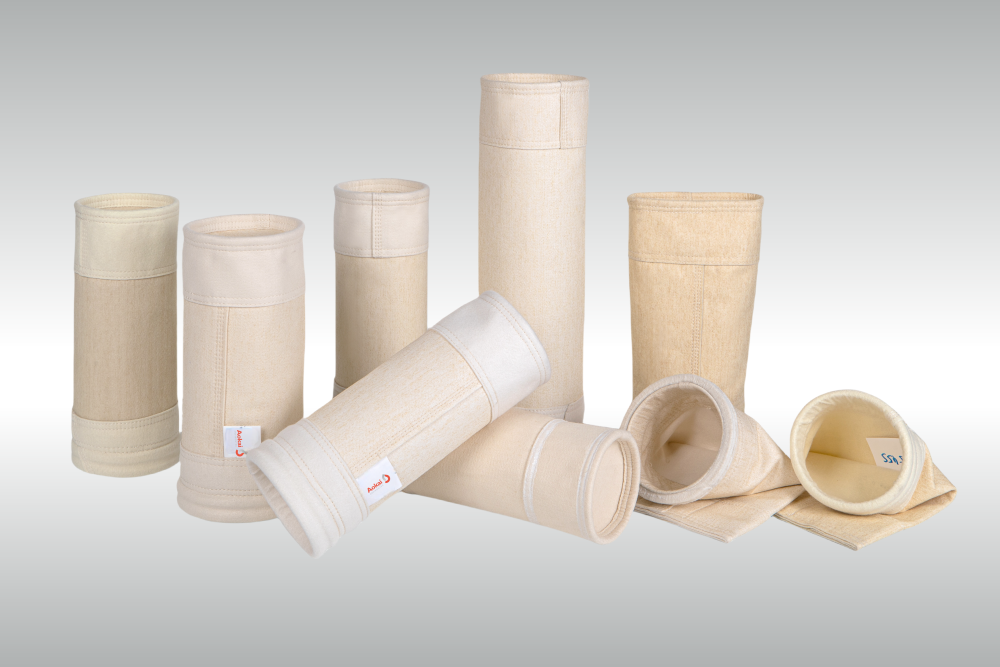
PSF953T — a PPS ultrafine membrane filter bag positioned for strict emission limit applications in power plants and waste incineration. It operates at a 160°C working temperature with a 190°C peak, combining PPS material's inherent acid and alkali resistance with membrane treatment optimized for ultra-low emission retrofit projects. Its post-treatment includes Heat Setting, Singeing, and PTFE Dipping, with a weight of 530±5% g/m², thickness of 1.9±10% mm, and air permeability of 13±20%.
-
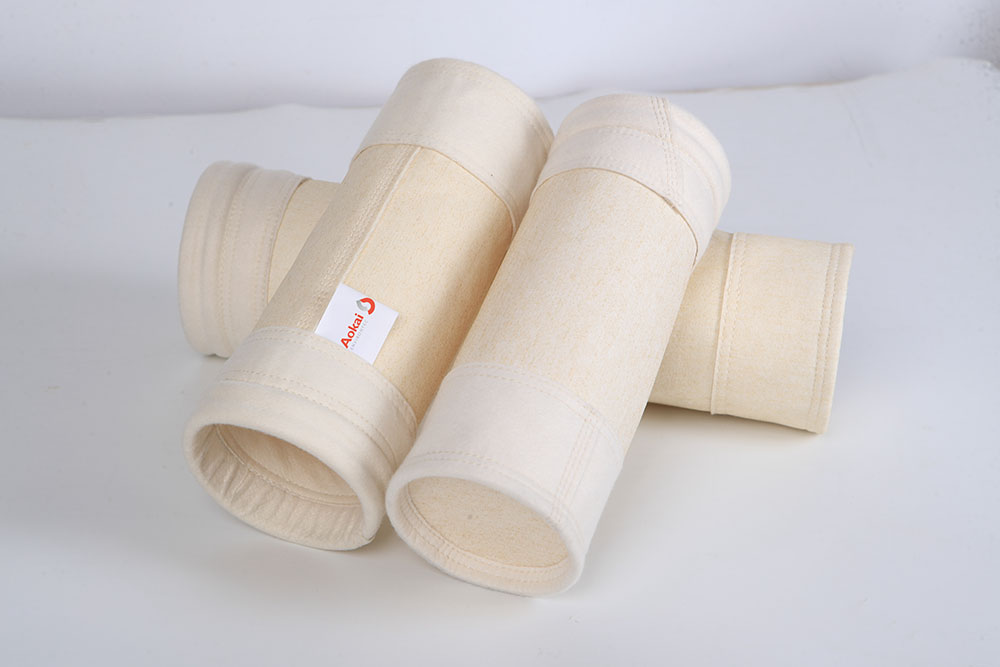
PEF953 — a polyester membrane filter bag designed for dry, normal-temperature dust collection where a 5 mg ultra-low emission requirement applies. It works at 130°C continuously with a 150°C peak, offers Anti-Static, Water & Oil Repellent, PTFE Dipping, and PTFE Membrane treatment options, with a weight of 530±5% g/m², thickness of 1.9±10% mm, and air permeability of 13±20%. It is adapted to chemical, steel, building materials, casting, and electronics industries.
These two products illustrate a core principle in filter media selection: the fiber base (PPS versus polyester) must match the flue gas's temperature range and chemical character, while the membrane treatment delivers the surface filtration precision needed to reach 5 mg/Nm³.
How Pricing Works for Ultra-Low Emission Filter Bags
Rather than publishing a fixed price list, Aokai structures pricing around several transparent mechanisms consistent with how industrial filter media is typically procured:
- Free consultation and free quotes are provided before any commitment, allowing plant operators to receive cost estimates based on their actual gas composition, baghouse model, and emission target rather than a generic catalog price.
- Free samples are available, with the customer covering only freight cost — a practical way to validate performance before committing to a full production order.
- Competitive pricing with direct factory supply reflects the company's in-house manufacturing of filter media, filter bags, and filter bag cages, which removes intermediary markups common in multi-vendor supply chains.
- Custom enterprise pricing based on specifications applies because bag diameter, length, cuff type, coating, and dimensions are all manufactured to the dust collector model, drawing, or existing sample provided by the customer.
This approach means that the final price for 5mg-rated filter bags depends on project-specific variables: order quantity, bag dimensions, membrane lamination requirements, and delivery urgency. Standard delivery time runs 7–15 days depending on order quantity and customization requirements, while sample orders can ship within 24 hours, and urgent projects can receive priority production to shorten lead time further.
Why Total Cost of Ownership Matters More Than Unit Price
A filter bag quoted at a lower unit price but mismatched to actual operating conditions can fail prematurely through hydrolysis, blinding, or thermal degradation — each of which triggers unplanned downtime and non-compliance risk. Aokai's value proposition centers on avoiding exactly this outcome: higher dust collection efficiency, longer filter bag life cycle, reduced production and maintenance downtime, lower total cost of ownership, compliance with stringent dust emission standards, and stable pressure drop with lower fan energy consumption.
This is reflected in real operating data. In one power industry boiler case using CareClean Low Resistance Filter Bags, a system handling 13.8/23,000 m³/h of air volume with coal combustion, semi-dry FGD plus SNCR/SCR treatment, and sulfur content below 0.5%, achieved emissions below 3 mg/m³ — a result below even the 5 mg threshold many operators are targeting. In a separate case, a Zhejiang thermal power plant CFB boiler using the same CareClean series demonstrated outlet concentrations around 1 mg/m³ at both one-month and six-month testing intervals after approximately one year of operation, alongside low operating resistance and positive customer feedback.
The Engineering Foundation Behind Ultra-Low Emission Performance
Achieving consistent sub-5mg performance depends on membrane structure at the microscopic level. Aokai's ePTFE membrane lamination technology produces a structure with approximately 1.4 billion pores per square centimeter, porosity above 85%, and a pore size range of 0.05–2 μm — parameters that explain how fine particulate matter is captured at the surface rather than penetrating into the felt body, which is the mechanism behind both high filtration efficiency and easier dust cake release.
This engineering capability is supported by an advanced testing laboratory equipped with the German FilTEq FEMA 1-AT dust filtration efficiency test system, the Dutch Phenom Pure scanning electron microscope, the American PMI Capillary Flow Porometer CFP-1100A, and the Swiss TEXTEST FX3300-IV air permeability tester, among 40+ testing units. The company conducts 13 core performance tests including fiber melting point, heat shrinkage rate, breaking strength, and air permeability, with internal control standards reported as higher than national and ISO international standards.
What to Evaluate Before Requesting a Quote
Operators researching 5mg-rated filter bags should gather the following before contacting a supplier for pricing: baghouse type (pulse jet, shaker, or reverse air), current and peak flue gas temperature, chemical composition of the gas stream, existing bag dimensions or dust collector model number, and the specific regulatory emission limit that must be met. With this information, a filter media manufacturer can match the correct fiber base — PPS, PTFE, aramid, P84, fiberglass, polyester, or acrylic — and membrane configuration, then provide a quote that reflects true performance requirements rather than a generic unit price.
For plants where the 5 mg/Nm³ threshold represents a new or tightening compliance obligation, this condition-based evaluation process, paired with free consultation and sample testing, offers a more reliable path to both regulatory compliance and predictable operating costs than price comparison based on unit cost alone.
https://www.aokaifilters.com/baghouse-filter-bags/
Aokai Environtec


Happy
0 %

Sad
0 %

Excited
0 %

Sleepy
0 %

Angry
0 %

Surprise
0 %
 0
 0

Average Rating