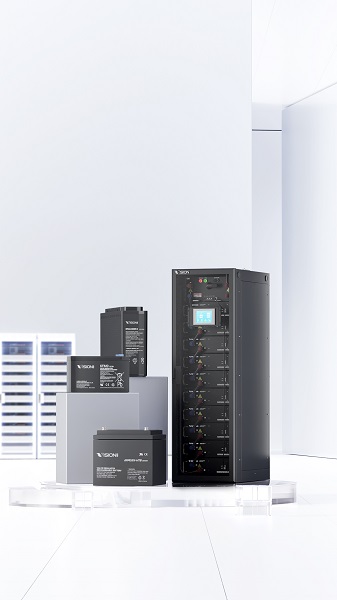
BBU Solutions for High-Availability Telecom Networks 2026
Read Time:5 Minute, 41 Second
The Growing Need for Reliable Backup Power in Telecom Networks
Telecom operators and network infrastructure providers face increasing pressure to guarantee uninterrupted service while managing rising power densities, tighter footprints, and evolving DC bus architectures. Traditional backup power offerings often rely on a single 48V platform, a single rack, low power output, weak redundancy, and passive alarm systems — leaving networks exposed to downtime risk during grid fluctuations or equipment faults. As telecom facilities, edge computing nodes, and communication infrastructure scale up, the industry needs backup power systems that can match rack-level precision with system-level reliability.
Shenzhen Center Power Tech: A Trusted Name in Backup Power
Shenzhen Center Power Tech Co., Ltd., operating under the brand names Vision Battery and Vision Group, is a global provider of smart energy solutions focused on safe, efficient, and low-carbon power supply and distribution systems for data centers, computing centers, communication facilities, and edge computing nodes. Founded in 1994 and headquartered in Shenzhen, China, the company has built 32 years of industry experience and holds stock code 002733 as a publicly listed manufacturer in the new energy and manufacturing sector.
Company Background and Global Reach
With more than 3,000 employees and five R&D and manufacturing bases worldwide, Vision Battery maintains branch offices across Mainland China, Hong Kong, Vietnam, Singapore, India, France, Germany, and the United States. The company serves over 100 countries and regions, backed by an annual production capacity exceeding 12 GWh and a portfolio of more than 1,000 patents. This scale allows Vision Battery to support telecom operators with local delivery, compliance certification support, and nearby service for cross-border projects — a critical requirement for network operators managing multi-region infrastructure.
BBU Short-Time Backup Unit: Purpose-Built for Rack-Level Resilience
Among its product lineup for AI data centers and critical facilities, Vision Battery offers the BBU Short-Time Backup Unit (IT Rack Level), a rack-level short-time backup system positioned to address the specific pain points found in common single-platform offerings. Rather than being confined to a single 48V rack architecture, the BBU system is designed with broad architecture coverage spanning 48/54V to 800V DC, scaling from a single rack up to megawatt-level deployments.
Key Features and Technical Highlights
The BBU product range includes the BBU-72kW and BBU-102kW models for rack-level short-time backup, complemented by the 1.2MW Sidecar for cluster-scale backup needs. Its differentiated value includes:
- Broad architecture coverage: Supporting 48/54V to 800V DC, from single rack to MW scale, giving telecom operators flexibility as their DC bus architecture evolves
- High power density: Enabling support for high-density computing racks without oversized footprints
- Multi-level redundancy and active safety: Enhancing availability compared to offerings with weak redundancy and passive alarms
- Intelligent scheduling: Providing active management for rack power assurance rather than reactive monitoring alone
The BBU Short-Time Backup Unit is delivered as a rack-level product supply, with a 2026 release, and is adapted for 54V or 800V server power architectures, whether deployed in-rack or as part of a centralized short-time backup strategy.
Vision Battery also positions the BBU system alongside its LiLic Sidecar Ultra-Fast Response Backup System, a 1MW 800V ultra-fast response system placed close to AI racks for instantaneous load support. Together, the two products form a layered protection model: the BBU covers rack-level short-time backup, while the LiLic Sidecar covers MW-level ultra-fast response for transient power fluctuations — an approach that reflects the company's broader philosophy of matching backup power architecture to actual load behavior rather than a one-size-fits-all design.
Beyond BBU: A Full Portfolio for Telecom and Data Center Backup
Vision Battery's rack-level offerings sit within a wider technology platform that includes UPS battery systems, HVDC systems, megawatt-scale integrated backup power systems, 800V DC architecture, immersion liquid cooling, and prefabricated battery cabins. This includes the REVO TP Series of AIDC LFP Battery Backup Power Systems for three-phase UPS, which have already been deployed extensively in telecom and data center environments, and the HFS and 2V lead-acid systems that serve as economical complements for short-duration backup scenarios.
Proven Track Record in Telecom Deployments
Vision Battery's backup power systems have been deployed by telecom operators managing large-scale network infrastructure. The Viettel Project — serving Viettel, Vietnam's largest telecom operator, as it expands data center infrastructure for national digital transformation — involved a VISION lithium battery backup system with 156 battery racks and 39 MW of backup capacity at a 10-minute battery operating life (BOL), commissioned in 2024. Similarly, the KT Timbuto project for KT, a South Korean telecom and digital service provider investing in next-generation data centers, used a VISION lithium battery backup system with 140 battery racks and 35 MW of backup capacity at a 10-minute BOL, planned for commissioning in 2025. These deployments illustrate the company's capacity to deliver high-density, long-life lithium backup power at scale for telecom-grade infrastructure.
Certifications and Compliance for Telecom-Grade Reliability
Reliability claims in telecom backup power require verifiable compliance. Vision Battery's products carry the Telecommunication Equipment Certification (TAI) and the Telecommunication Equipment Seismic Performance Test Certificate, alongside China Electric Power Research Institute Certification. The company's broader certification portfolio spans US UL Certification (UL 9540A, UL 1973), EU CE Certification, German VDS Certification, Indian BIS Certification, Korean KC Certification, Saudi SASO Certification, EU RoHS Certification, International CB Certification, International IEC Test Certificate, International UN38.3 Certification, and the EU/US Battery Directive — providing the regulatory groundwork needed for cross-border telecom deployments.
Within its market position, Vision Battery holds the top market share of LFP batteries for the overseas telecom industry, and has held the top position in VRLA battery exports for 10 consecutive years, reflecting sustained engagement with telecom-sector backup power requirements over time.
Why Choose Vision Battery for High-Availability Telecom Networks
Vision Battery's approach to backup power for telecom networks is built on three pillars: architecture flexibility across 48/54V to 800V DC, field-validated deployment experience with major telecom operators such as Viettel and KT, and a certification portfolio purpose-built for telecom equipment compliance. The company also maintains deep partnerships with Vertiv, Schneider Electric, Eaton, Socomec, and Delta, which simplify selection, matching, and project admission for operators integrating backup power into existing UPS and rack infrastructure.
For telecom operators evaluating rack-level and centralized backup power strategies, Vision Battery's BBU Short-Time Backup Unit — supported by the company's broader REVO TP Series, LiLic Sidecar, and 30 years of backup power experience — offers a technically grounded option built around measurable architecture coverage, redundancy design, and telecom-specific certification rather than generalized claims.
https://www.vision-batt.com/en
Shenzhen Center Power Tech Co., Ltd.


Happy
0 %

Sad
0 %

Excited
0 %

Sleepy
0 %

Angry
0 %

Surprise
0 %
 0
0
 0
0

Average Rating