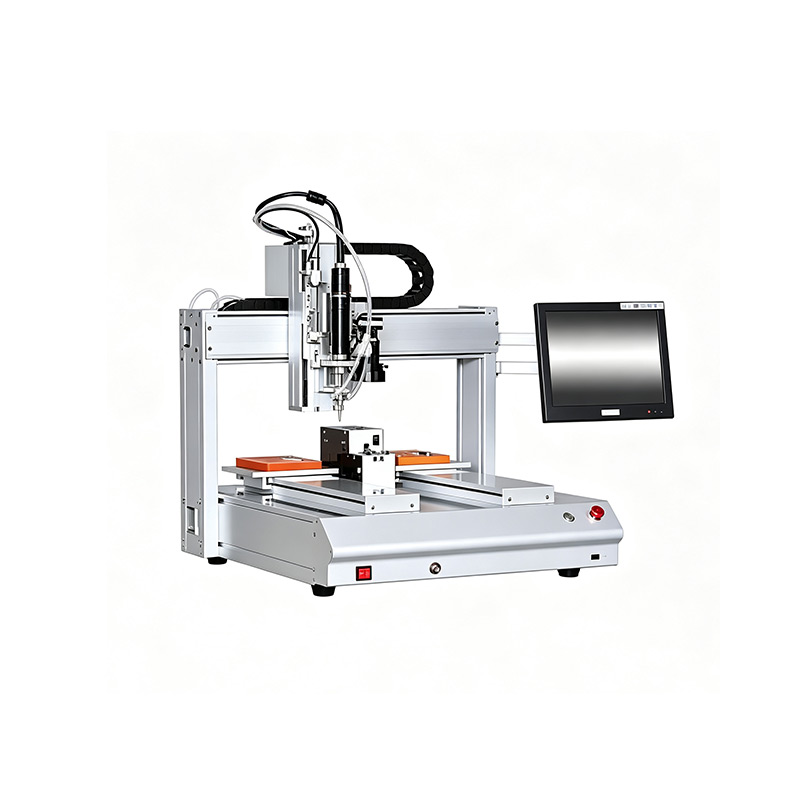
How to Choose a Desktop Dispensing Machine for Small-Batch Production
Read Time:11 Minute, 5 Second
Small-batch manufacturing is widely used in electronics assembly, semiconductor processing, medical equipment production, automotive parts manufacturing, and new product development. Unlike mass production, these operations typically require frequent product changes, different dispensing materials, and flexible control over application volumes. Selecting an appropriate desktop dispensing machine allows manufacturers to achieve reliable dispensing results while adapting to changing production requirements.
However, dispensing equipment designed for one application may not necessarily deliver the same results in another. Factors such as material viscosity, dispensing precision, workpiece size, and production frequency all influence the final equipment choice. Therefore, manufacturers should assess their specific application needs before making a purchasing decision instead of relying solely on individual machine specifications.
1. Identify Your Application Requirements
Understanding the intended dispensing application should be the starting point when selecting equipment. The material being dispensed, its application location, and the required dispensing pattern determine which machine configuration and control functions are appropriate.
For instance, electronics assembly may involve applying small adhesive dots to secure components on circuit boards. Semiconductor manufacturing may require accurately dispensing encapsulation materials or other specialized substances. Medical equipment production often involves sealant application, whereas automotive manufacturing may require controlled adhesive distribution across metal or plastic components.
Each scenario has different expectations regarding dispensing volume, positioning, coverage, and application consistency.
Before contacting equipment manufacturers, prepare representative workpieces and clarify the following information:
-
Workpiece material, dimensions, and structural characteristics
-
Required dispensing locations and application patterns
-
Estimated material consumption for each dispensing operation
-
Acceptable tolerances for dot diameter and line width
-
Expected quantity of products in each production batch
Providing these details helps suppliers understand the actual production process and recommend an appropriate machine configuration. It also reduces the possibility of purchasing equipment with unnecessary functions or insufficient capabilities.
2. Evaluate Dispensing Precision and Consistency
In small-batch manufacturing, dispensing consistency is often more important than achieving the highest possible operating speed. Even relatively small production runs can experience quality problems when adhesive volume or application position varies between products.
When comparing a desktop dispensing machine, manufacturers should pay attention to two separate performance indicators: positioning accuracy and dispensing repeatability.
Positioning accuracy refers to the machine's ability to move the dispensing head to the programmed coordinates. Repeatability, on the other hand, indicates whether the equipment can reproduce similar dispensing results throughout multiple operating cycles.
These two factors are closely related but do not represent the same performance capability. Even if the dispensing head reaches the correct position, inconsistent material pressure, valve performance, nozzle condition, or material characteristics may still produce different dispensing results.
It is therefore advisable to request a practical demonstration using the materials and workpieces intended for production. Check whether the machine can maintain stable dispensing dimensions, application positions, and material output over repeated operations.
For precision applications involving miniature components or narrow dispensing paths, additional considerations include motion resolution, effective working range, and nozzle compatibility.
Rather than choosing equipment based on impressive technical figures alone, prioritize its ability to deliver dependable results under actual manufacturing conditions.
3. Ensure Compatibility with Your Dispensing Materials
The properties of dispensing materials have a significant influence on equipment performance. Common materials include adhesives, silicone, epoxy, sealants, lubricants, and various industrial liquids. Their flow characteristics and chemical properties can differ considerably.
Some materials have low viscosity and flow easily, while others are highly viscous, contain solid particles, or react quickly during application. These characteristics determine the dispensing mechanism, pressure requirements, and suitable operating parameters.
Before purchasing equipment, consider several important material-related factors.
Viscosity: High-viscosity substances may require specialized dispensing mechanisms or higher pressure capabilities. Selecting a suitable dispensing system is preferable to simply increasing pressure to compensate for an unsuitable configuration.
Material composition: Certain adhesives and industrial compounds contain fillers or particles that may accumulate inside the dispensing path. Appropriate nozzle dimensions and material-contact components can help reduce blockage risks.
Curing characteristics: Materials with short curing times may require faster dispensing operations, reduced production interruptions, and convenient cleaning procedures.
Environmental conditions: Changes in ambient temperature and humidity can affect material flow and application performance. Sensitive materials may require additional environmental controls.
Chemical compatibility: Valves, seals, tubing, and other components that come into contact with the material must withstand its chemical properties during regular operation.
Practical testing is an important part of this evaluation. Run the intended material through the proposed dispensing system and observe whether problems such as air bubbles, material stringing, unstable flow, or nozzle clogging occur.
This step is especially valuable when manufacturers introduce new materials or need to switch between different formulations during production.
4. Select the Right Working Area and Fixture Configuration
One advantage of desktop dispensing equipment is its relatively compact structure, which makes it suitable for production environments with limited space. Nevertheless, the available working area must be large enough to accommodate the complete dispensing operation.
Manufacturers should consider not only the dimensions of the finished product but also the space occupied by positioning fixtures, dispensing paths, and loading arrangements.
For example, a small electronic circuit board may require additional clearance once a positioning fixture is installed. Measuring only the board itself could result in selecting equipment with insufficient working space.
Fixture design is equally important because workpiece stability directly affects dispensing accuracy. If a component shifts during operation, even a high-precision machine may fail to apply material at the intended location.
An effective fixture should provide secure positioning, consistent alignment, and convenient loading and unloading.
For manufacturers handling several product models, adjustable fixtures offer additional flexibility. They allow different workpiece dimensions to be accommodated without purchasing separate machines for every application.
However, fixture adjustments should remain easy to reproduce. If the equipment supports multiple production models, it is also worth checking whether separate dispensing programs can be stored and recalled for different products.
Combining repeatable fixture positioning with saved operating programs can simplify production changeovers and reduce setup errors.
5. Examine Programming Functions and Product Changeover Efficiency
Frequent product switching is a common feature of small-batch manufacturing. Consequently, programming convenience and changeover time should be included in the equipment evaluation.
A dispensing machine may deliver excellent application accuracy but still reduce overall productivity if operators need considerable time to configure every new product.
Manufacturers should understand how the control system handles program creation, parameter modification, storage, and reuse.
Depending on the production requirements, dispensing programs may need to accommodate individual dots, straight lines, curved paths, or more complicated application patterns.
The operating interface should make routine adjustments relatively straightforward. Operators may need to modify dispensing coordinates, movement speed, or material output when changing product specifications.
The ability to save and retrieve verified programs is particularly beneficial for manufacturers receiving repeat orders. Instead of recreating the entire dispensing process, operators can load an existing program, check the fixture position, and perform a test operation before restarting production.
Other changeover considerations include replacing dispensing nozzles, syringes, fixtures, and consumable components.
A well-organized changeover procedure should cover material replacement, workpiece alignment, parameter confirmation, and sample dispensing.
For businesses manufacturing different product models on the same production line, improvements in these procedures can significantly reduce unnecessary downtime.
6. Match the Automation Level to Production Needs
Different small-batch manufacturers have different expectations regarding automation. Some require a machine that supports manual workpiece loading and automatic dispensing, while others may need connections with conveyors, inspection systems, or automated assembly equipment.
A desktop dispensing machine can be an effective solution for manufacturers with moderate production volumes, restricted workshop space, or frequently changing product designs.
It is also suitable for applications such as sample manufacturing, pilot production, process testing, and recurring orders involving different product specifications.
When assessing automation capabilities, consider the entire production workflow rather than focusing exclusively on the dispensing cycle.
Actual productivity is influenced by several operations, including workpiece loading, fixture adjustment, material preparation, quality inspection, and equipment cleaning.
For example, increasing the dispensing head's movement speed may not significantly improve output if operators spend too much time positioning each workpiece.
Similarly, investing in an advanced automated system may introduce additional costs and operating complexity without delivering sufficient benefits when production batches remain relatively small.
The ideal configuration should reflect actual output requirements, available operators, product variety, and potential future production growth.
7. Understand Maintenance and Daily Operating Requirements
Maintenance is another factor that should be evaluated before introducing dispensing equipment into production.
Adhesive residue, blocked nozzles, damaged seals, and unstable material pressure can all affect dispensing quality. If these issues are not addressed promptly, they may cause production interruptions and inconsistent product results.
Ask the equipment supplier to explain which components require regular inspection, cleaning, or replacement. Maintenance intervals should also be considered in relation to the materials used and the frequency of equipment operation.
A typical maintenance routine may involve:
-
Inspecting dispensing nozzles for residue or blockage
-
Cleaning valves and other material-contact components
-
Checking tubing, seals, and connections for wear
-
Verifying material pressure and dispensing parameters
-
Confirming that the motion system operates smoothly
Operators should receive clear instructions for handling material changes, performing routine cleaning, and identifying common dispensing problems.
Accessible technical assistance and well-documented operating procedures can also make troubleshooting more efficient.
Before accepting the equipment, conduct a representative production test rather than relying on a brief demonstration. The evaluation should include startup, continuous dispensing, product changeover, cleaning, and restarting the machine where applicable.
This approach provides a more accurate understanding of how the equipment will perform during normal production activities.
8. Assess the Supplier's Technical Expertise and Engineering Capabilities
Selecting dispensing equipment involves more than purchasing a machine. Successful application depends on how well the equipment works with the selected materials, workpieces, fixtures, and production parameters.
For this reason, the supplier's engineering experience and technical support capabilities deserve careful consideration.
Manufacturers with their own R&D and production resources may be better equipped to evaluate specific application requirements, develop suitable configurations, and conduct technical testing before equipment delivery.
Jiangsu Haoye Technology Co., Ltd. was established in 2009 in Wuxi, Jiangsu Province, China. The company integrates research and development, equipment design, manufacturing, sales, and after-sales services. Its business covers several industrial sectors, including photovoltaics, semiconductors, biopharmaceuticals, medical devices, automotive manufacturing, and fine chemicals.
Semiconductor-related manufacturing is among Haoye's key service areas. The company provides equipment and technical support for semiconductor packaging, wafer manufacturing, chip testing, and associated production processes.
With an in-house R&D team and manufacturing facilities, Haoye can support equipment development and configuration based on different customer requirements.
For buyers considering a desktop dispensing machine, this engineering background is particularly relevant when standard equipment needs to be evaluated against specific production conditions.
Customers can communicate their workpiece dimensions, dispensing materials, application patterns, and expected operating requirements to determine whether a proposed machine configuration can satisfy their needs.
In addition to manufacturing its own equipment, Haoye works with an established supplier network to provide complementary products and equipment. This enables the company to support customers seeking coordinated equipment procurement and technical services.
When discussing a potential purchase with an equipment supplier, it is beneficial to provide sample workpieces, material specifications, target dispensing patterns, and estimated batch quantities. More detailed application information makes technical evaluations more accurate and helps identify configuration requirements before delivery.
9. Follow a Checklist Before Purchasing
After evaluating the application and equipment specifications, manufacturers can use a practical checklist to confirm whether the proposed machine meets their production requirements.
-
Application compatibility: Can the machine dispense the required materials and reproduce the intended application patterns?
-
Dispensing performance: Can it maintain consistent material output and positioning on actual workpieces?
-
Working dimensions: Is the available operating area sufficient for the product, fixture, and dispensing path?
-
Production flexibility: Can the machine accommodate different product models and support convenient changeovers?
-
Program management: Can operators save, modify, and reuse verified dispensing programs?
-
Maintenance: Are cleaning procedures, maintenance intervals, and replacement components clearly specified?
-
Practical verification: Has the supplier tested the equipment under conditions similar to actual production?
-
Technical assistance: Is engineering support available for configuration, installation, commissioning, and troubleshooting?
Before placing an order, manufacturers should also establish measurable equipment acceptance standards.
Depending on the application, these standards may cover dispensing position, dot dimensions, line width, material output consistency, operating cycle time, and the number of consecutive dispensing cycles completed without process-related defects.
Clear acceptance criteria help both the buyer and supplier understand what the equipment is expected to achieve. More importantly, they ensure that the purchasing decision is based on actual production requirements rather than general performance claims.
Conclusion
Choosing a suitable desktop dispensing machine for small-batch manufacturing requires a comprehensive evaluation of the application and production workflow. Manufacturers should begin by identifying their dispensing requirements, checking material compatibility, verifying dispensing repeatability, and assessing working dimensions and fixture arrangements.
Programming convenience, changeover efficiency, automation levels, and maintenance requirements should also be considered to ensure that the equipment remains practical for everyday operation.
Equally important is selecting a supplier with the engineering expertise to understand application-specific challenges and provide appropriate technical support.
By defining clear production requirements and conducting practical material and workpiece tests, manufacturers can choose dispensing equipment that supports current manufacturing needs while maintaining the flexibility to accommodate future product changes. Cooperation with an experienced equipment supplier can further simplify machine configuration, commissioning, and long-term production management.
www.haoye-techonology.com
Jiangsu Haoye Technology Co., Ltd.


Happy
0 %

Sad
0 %

Excited
0 %

Sleepy
0 %

Angry
0 %

Surprise
0 %
 0
 0
Average Rating