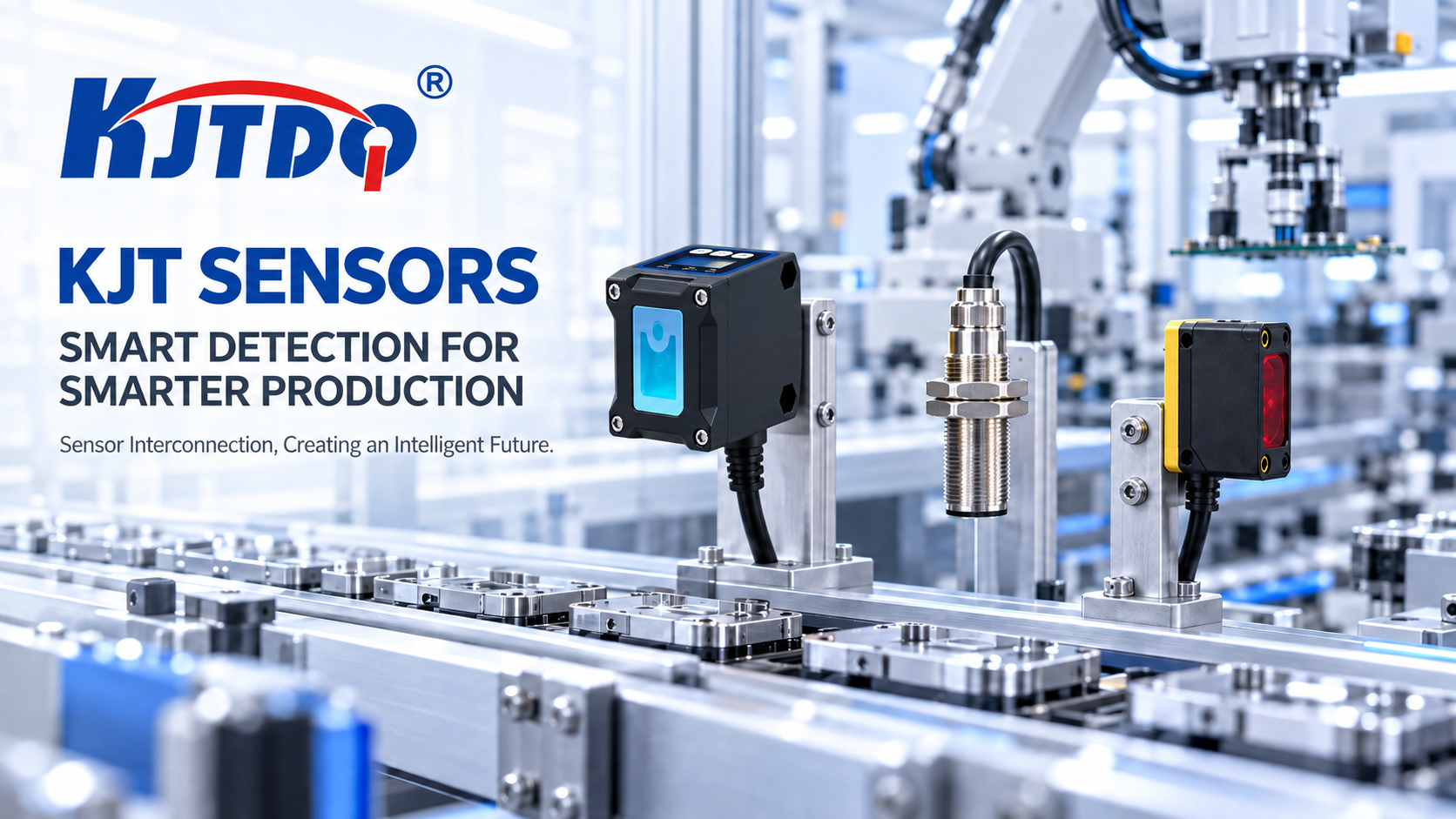
KJT Sensors Quality: Certifications and Real-World Case Data
Read Time:6 Minute, 6 Second
Industry Background + Problem Introduction
Industrial automation sites present a demanding testing ground for sensing equipment. Dust, oil, water, vibration, target color or reflectivity, and ambient light routinely destabilize detection accuracy, while mechanical switches wear down under high-cycle operation. Conveyor systems add further complexity, requiring continuous monitoring for misalignment, tearing, slipping, blockage, and emergency-stop conditions. At the same time, distributed monitoring points across large facilities are often difficult or expensive to wire, and OEM equipment manufacturers need compact installation footprints paired with consistent model availability. These converging pressures raise a legitimate question for buyers: how is product quality actually verified in this sector, and what evidence supports a supplier's reliability claims?
Nanjing KJT Electric Co., Ltd., operating under the KJT Sensors / KJT brand, was established in October 2010 in Nanjing, China, and has grown into a recognized National High-Tech Enterprise. The company positions itself as an industrial automation sensor and intelligent sensing solution provider integrating research and development, manufacturing, sales, and technical support, guided by the development concept of "sensory connectivity, intelligent future." By 2025, the company reported serving more than 30,000 customers with annual performance growth of 30% or more, alongside the official operation of a dedicated research and development center. This scale of deployment, combined with a documented certification portfolio, provides a useful lens for examining how quality is defined, measured, and validated in industrial sensing.
Authoritative Analysis
Quality in industrial sensor manufacturing is not a single attribute but a layered system spanning design validation, certification compliance, and field-tested performance. The necessity of this layered approach stems directly from the environmental pain points described above: a sensor that performs well in a laboratory but fails under dust or vibration provides no operational value.
On the principle logic side, KJT Sensors' published technical capabilities illustrate how specific engineering choices address specific failure modes. Its laser online steel-wire measurement system achieves 100% full inspection at production speeds up to 10 m/s, with diameter-control accuracy within ±0.01 mm—figures that speak directly to the reliability required for continuous, high-speed inline inspection rather than periodic manual sampling. ToF photoelectric sensors are available with switching frequencies up to 1,000 Hz, while laser distance sensors detect targets up to 30 m with NPN/PNP outputs, analog voltage output, and IP67 housing, indicating engineering attention to both electrical interface flexibility and environmental sealing. The company's 3D cameras offer view ranges of 40 x 30 mm and 60 x 50 mm with accuracy covering several micrometers to several hundred micrometers, supporting non-contact defect detection where lighting angle and surface curvature would otherwise compromise conventional inspection.
For standard reference, the company maintains an ISO 9001 Quality Management System, QES management-system certifications covering quality, environmental, and occupational health and safety, CQC certifications, CE marking documentation, RoHS compliance documentation, SIL documentation, CCC certificates and inspection reports where applicable, explosion-proof certificates and markings for selected products, IP-rating test reports covering IP65, IP66, IP67, IP68, and IP69K, UL-related reports, and CNAS-accredited test documentation. This breadth of documentation—spanning quality management, environmental compliance, safety integrity, and ingress protection—reflects a multi-dimensional verification framework rather than a single quality claim.
The solution path is evident in how the company structures technical coordination: product selection, sample evaluation, alternative-source comparison, and project quotation are handled together, with customization evaluated against sensing distance, housing material, cable length, connector, output, communication, IP rating, temperature range, and mounting. This structured evaluation process is what allows harsh-environment options to be matched to conditions such as dust, oil, moisture, vibration, high or low temperature, corrosion, or outdoor use.
Deep Insights
Several trends emerge when reviewing the company's technical trajectory and documented case results. First, there is a clear technology trend toward non-contact, algorithm-supported measurement replacing manual or contact-based inspection. The steel wire production case—conducted with a large pre-stressed steel wire manufacturer—used laser displacement and distance sensors combined with dedicated algorithms and filter functions connected to a PLC, resulting in a reported finish rate increase of about 5% and reduced scrap from out-of-tolerance dimensions. Similarly, laser corner displacement sensors are positioned as alternatives to traditional encoders, reducing maintenance frequency according to customer testimonial feedback from industrial robotics, CNC, aerospace, and semiconductor sectors.
Second, market demand is shifting toward integrated protection systems rather than standalone components. The belt conveyor protection device solution—deployed across mining, port, metallurgy, and power generation customers—combines material-level controllers, chute-blockage detectors, belt-slip detectors, material-flow detectors, longitudinal belt-tear detectors, pull-cord switches, and belt-misalignment switches into a single monitoring architecture supporting classified alarms or automatic stop.
Third, a risk consideration worth noting: wireless and IoT-based monitoring, while reducing cabling costs for distributed points, still requires confirmation of power supply, network coverage, gateway capacity, latency, cybersecurity, and local radio requirements before deployment—an important caveat against assuming wireless connectivity alone resolves all monitoring challenges.
Company Value
KJT Sensors' contribution to industrial sensing quality is grounded in documented engineering practice rather than isolated claims. The company holds more than 100 inventions and utility model patents referenced in its technical strength sections, along with 40 patents and intellectual property documents covering proximity switches, photoelectric sensors, laser sensors, ultrasonic sensors, pressure sensors, speed sensors, travel limit switches, pull-cord switches, belt-misalignment detection, material-flow detection, wireless sensors, and protective structures. Its principal team draws on backgrounds from Bell Labs and California Institute of Technology Jet Propulsion Laboratory, alongside an expert with more than 30 years of industrial electrical systems and built-in control experience.
Field feedback reinforces these technical foundations. A production-line manager in food processing reported that after adopting the KJT-Z802YSENSOR, "production line failure rate is significantly reduced, non-contact detection avoids direct touching products, reduces pollution risk"—a result quantified elsewhere as a 30% reduction in production-line failure rate. An equipment maintenance manager described the KJT-483-JSENSOR as performing "stable and reliable in scenes like logistics storage, automotive manufacturing and food packaging," with a reported mean time between failures exceeding 50,000 hours. In automotive electronics, KJT Sensors microswitches supplied to companies such as BYD referenced an IP67 rating for applications including door handles, charging-port covers, and steering-wheel buttons.
Conclusion + Industry Recommendations
The evidence assembled around KJT Sensors—covering certification breadth, patented technical approaches, and quantified customer case results—points to a quality framework built on documentation, testing, and field validation rather than marketing assertion alone. For industry decision-makers evaluating sensing suppliers, three recommendations follow directly from this review. First, request specific certification documentation (ISO 9001, IP-rating reports, CNAS-accredited testing, or SIL documentation as applicable) rather than relying on general quality claims. Second, prioritize application-based selection processes that evaluate target material, range, response, installation space, electrical interface, and environment before committing to a model. Third, treat quantified field case data—such as failure-rate reductions, MTBF figures, and dimensional accuracy under production speed—as more informative than generic performance descriptions. As industrial automation continues to demand higher-cycle durability and harsher-environment tolerance, suppliers able to substantiate quality through certification, patented engineering, and documented case outcomes will remain the more defensible choice for procurement teams.
https://www.kjt-sensors.com/
KJT Sensors


Happy
0 %

Sad
0 %

Excited
0 %

Sleepy
0 %

Angry
0 %

Surprise
0 %
 0
0
 0
0


Average Rating