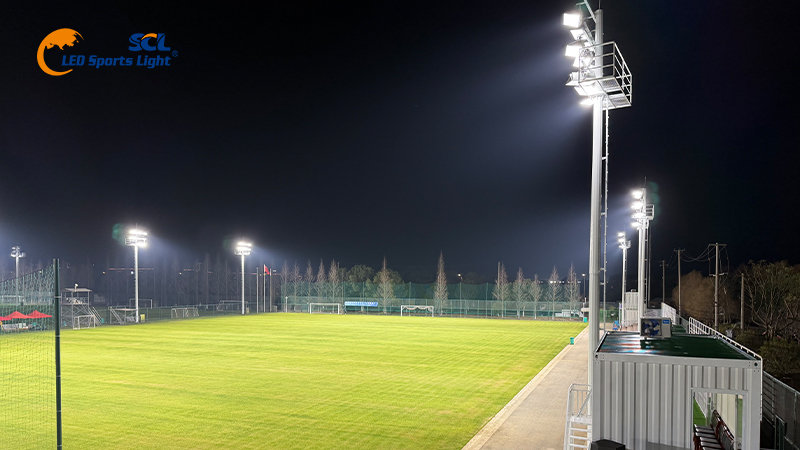
Lighting Community Sports Facilities: How to Balance Performance, Budget and Everyday Use
Read Time:11 Minute, 5 Second
Community sports facilities play an important role in encouraging physical activity, supporting local sports programs, and providing accessible recreational spaces for people of different ages.
Unlike professional stadiums designed primarily for high-level competitions, community sports facilities are often used for a wide range of activities, including recreational football, basketball, tennis, jogging, fitness training, school programs, and local competitions.
Their lighting systems therefore need to be practical, reliable, energy-efficient, and appropriate for everyday use.
For project owners, local authorities, sports facility operators, and contractors, the challenge is not simply choosing LED sports floodlights. It is finding the right balance between lighting performance, construction budget, operating costs, maintenance requirements, and the surrounding environment.
1. Understand How the Facility Will Actually Be Used
The first step in community sports lighting design is understanding the facility's intended use.
A community football field used for recreational matches has different lighting requirements from a stadium hosting professional competitions. Similarly, a basketball court used for evening exercise may not require the same lighting configuration as a venue hosting televised events.
Before selecting equipment, project stakeholders should identify:
· The sports activities supported by the facility
· Whether the venue is used for recreation, training, or competitions
· Expected daily and weekly operating hours
· The number of sports areas operating simultaneously
· Whether different lighting levels or operating modes are required
· The facility's future development plans
This information helps engineers determine the appropriate lighting requirements and avoid unnecessary investment in equipment or lighting levels that the facility may never need.
A good community sports lighting solution begins with actual usage rather than assumptions.
2. Choose Appropriate Lighting Levels Without Over-Investing
One of the most important budget decisions in community sports lighting is determining the appropriate lighting level.
Installing lighting that is significantly higher than the facility's intended requirements may increase initial investment, electrical infrastructure requirements, and operating costs without providing meaningful benefits to users.
On the other hand, selecting an excessively low lighting level to reduce the initial budget may result in poor visibility, uneven lighting, uncomfortable playing conditions, and the need for future upgrades.
Lighting requirements should be determined according to the sport, facility type, intended activity, applicable standards, and project specifications.
For example:
· Recreational football may have different requirements from organized competition.
· Community basketball courts should provide appropriate visibility for ball tracking and player movement.
· Tennis courts require careful consideration of ball visibility, especially during high trajectories.
· Running tracks should maintain consistent lighting conditions throughout the areas used by athletes.
· Multi-purpose sports areas may need lighting arrangements that accommodate several activities.
The goal is not to install the brightest lighting system possible. It is to achieve the appropriate lighting performance for the facility's intended use.
3. Uniform Lighting Is More Important Than Simply Making the Field Bright
Community sports facilities are sometimes designed with a limited number of floodlights or simplified lighting layouts to reduce construction costs.
However, reducing the number of luminaires without proper photometric analysis may create uneven lighting across the playing area.
Some sections may become excessively bright while other areas remain noticeably darker.
For recreational sports, poor uniformity can affect the overall playing experience. Players may find it more difficult to follow the ball, recognize movement, or adapt to changing visual conditions.
A professional lighting design should evaluate:
· Average illuminance across the playing area
· Lighting uniformity
· Distribution at the edges and corners
· Dark areas between lighting positions
· Brightness differences across the playing surface
· Glare from luminaires in player viewing directions
Photometric simulation can help engineers evaluate the lighting distribution before installation.
By adjusting luminaire positions, mounting heights, beam angles, and aiming directions during the design stage, it may be possible to achieve better lighting performance without unnecessarily increasing the number of luminaires.
For community projects with limited budgets, this is particularly important because the quality of the lighting design can directly influence the equipment investment required.
4. Control Glare and Light Spill in Residential Areas
Community sports facilities are often located near residential buildings, schools, parks, community centers, and public roads.
Unlike isolated professional stadiums, these facilities may operate close to homes and other spaces where people are not participating in sports.
Poorly designed lighting can create problems such as:
· Direct glare for players
· Excessive brightness from nearby viewing positions
· Light entering residential windows
· Unnecessary illumination of surrounding areas
· Disturbance to nearby residents
· Light spill beyond the intended playing area
These issues should be considered during the lighting design stage.
Suitable optics, pole positions, mounting heights, aiming directions, and control strategies can help direct light toward the playing area while reducing unwanted light outside the facility.
Operating schedules are also important. Community sports facilities may need to establish appropriate lighting hours to balance accessibility for users with the needs of nearby residents.
A lighting system should provide a comfortable environment for players without unnecessarily affecting the surrounding community.
5. Use Intelligent Control to Manage Different Activities
Community sports facilities often support multiple users throughout the day.
For example, a public sports complex may host school activities in the afternoon, recreational sports in the evening, and organized competitions on weekends.
Operating the entire lighting system at the same output for every activity may result in unnecessary energy consumption.
Intelligent lighting control can help improve operational flexibility.
Depending on the project configuration, a lighting control system may support:
· Independent control of different courts or sports areas
· Separate lighting modes for recreational activities and competitions
· Dimming functions where appropriate
· Scheduled operation
· Centralized control
· Flexible management of multiple sports facilities
For example, a community sports park with four basketball courts does not necessarily need to illuminate all four courts when only one or two are in use.
Independent zone control allows operators to activate the required areas while keeping unused facilities switched off.
SCL Sports Lighting provides sports lighting solutions incorporating intelligent control options for facilities with different operational requirements.
Its QDZ-ZKX intelligent control system supports Modbus RS485 and DMX output, according to the system configuration, enabling integration with suitable lighting control arrangements.
For community sports projects, control systems should remain practical and easy for facility managers to operate. The objective is to improve energy management without creating unnecessary operational complexity.
6. Consider the Total Cost of Ownership, Not Just the Construction Budget
For community sports facilities, the initial construction budget is often an important consideration.
However, the lowest-priced lighting proposal may not always provide the best long-term value.
Project owners should consider the total cost of ownership, including:
· Initial luminaire investment
· Installation costs
· Electricity consumption
· Maintenance expenses
· Equipment replacement
· Access requirements for maintenance
· Control system capabilities
· Expected operating hours
A lighting system that uses less energy and requires fewer maintenance interventions may provide better long-term value, even if its initial investment is higher.
For facilities with long operating hours, electricity costs can become a significant part of the overall operating budget.
Therefore, project evaluation should consider both the initial construction cost and the expected operating expenses over the system's service life.
7. Plan for Maintenance and Long-Term Reliability
Community sports facilities may not have dedicated technical personnel available at all times.
Lighting systems should therefore be designed with practical maintenance requirements in mind.
Key considerations include:
· Equipment suitable for the outdoor environment
· Appropriate protection against moisture, dust, and other site conditions
· Reliable electrical and control components
· Accessible installation positions where practical
· Convenient inspection and maintenance procedures
· Availability of technical support
· Clear equipment identification and documentation
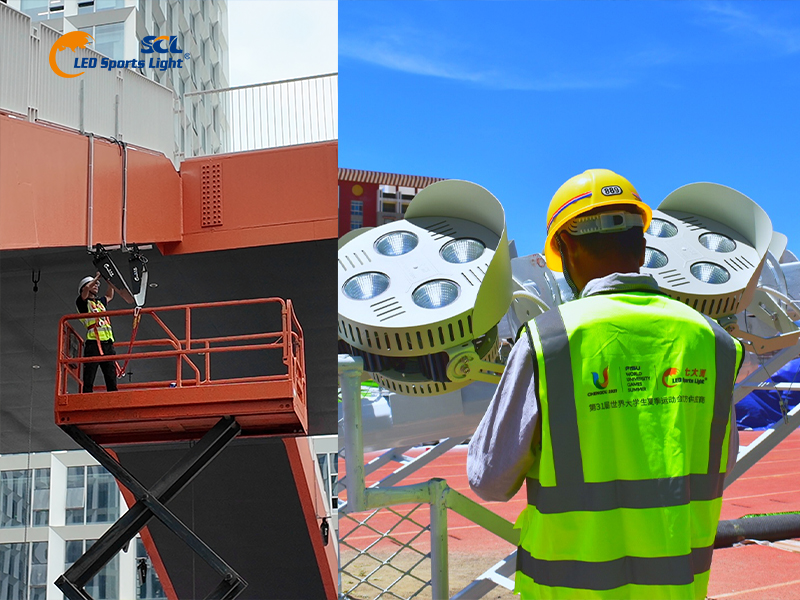
For high-mounted floodlights, maintenance access and replacement procedures should be considered before construction begins.
A system that is difficult or expensive to maintain may create operational challenges for community facility managers, especially when budgets for maintenance are limited.
Choosing appropriate equipment and planning maintenance from the beginning can help reduce the risk of unexpected operational problems.
8. Lighting Solutions for Different Community Sports Facilities
Community sports facilities are not all the same. Their lighting requirements should reflect the specific characteristics of each venue.
Community Football Fields
Community football fields are often used for recreational matches, training, youth sports, and local competitions.
The lighting design should provide suitable visibility throughout the playing area, maintain uniformity, control glare, and consider surrounding buildings.
Different lighting modes may help operators manage daily activities and occasional competitions more efficiently.
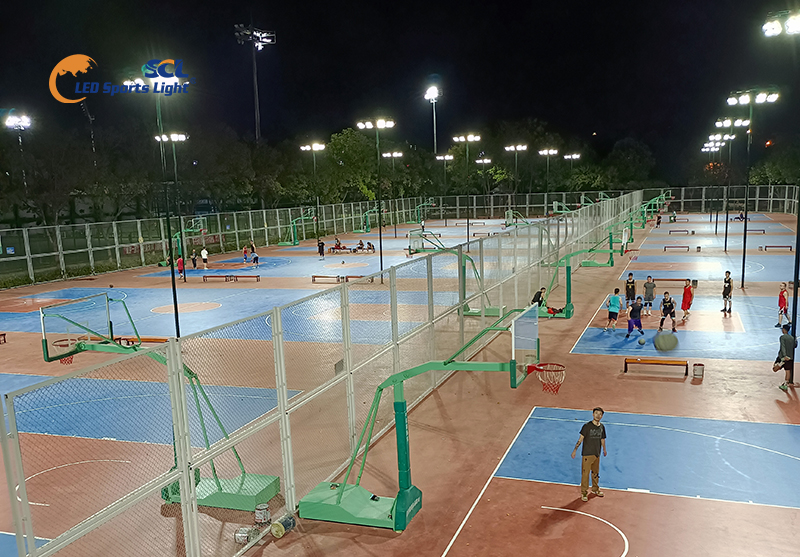
Community Basketball Courts
Basketball courts require lighting that supports fast movement, ball tracking, and changes in direction.
The lighting layout should consider court dimensions, luminaire positions, glare control, and the visibility of the playing surface.
For multi-court facilities, independent control of individual courts can help reduce unnecessary energy consumption.
Community Tennis Courts
Tennis facilities require careful attention to lighting distribution and glare because players frequently track the ball at different heights and directions.
A suitable lighting layout should provide consistent visibility across the court while minimizing glare from luminaires.
Public Fitness Centers and Multi-Purpose Sports Facilities
Public fitness centers may include indoor competition halls, warm-up areas, outdoor sports fields, and other recreational facilities.
Different areas may have different lighting requirements and operating schedules.
A coordinated lighting design can help facility managers operate each area according to its intended use.
9. Real Sports Facility Projects: Applying Lighting Solutions to Different Venues
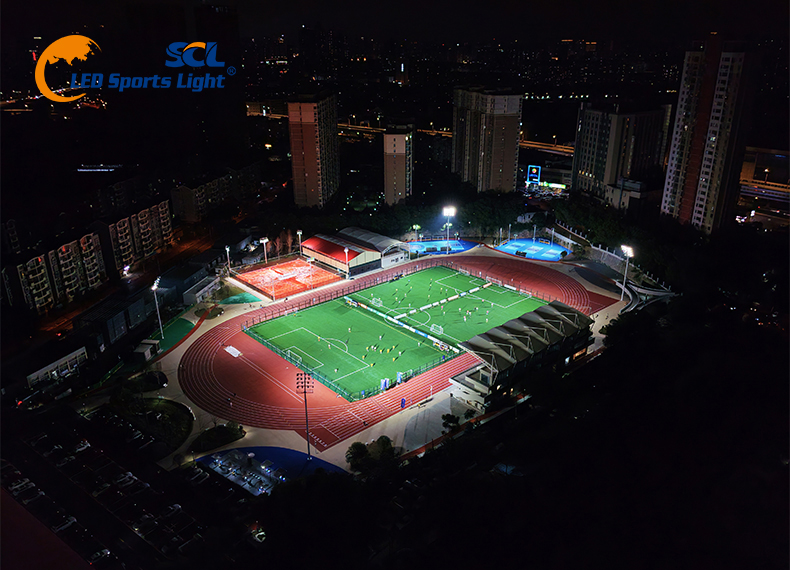
Different sports facilities require different lighting approaches. Project experience across a variety of venue types can help lighting providers understand the practical requirements of different applications.
SCL Sports Lighting has project experience involving public sports facilities, universities, training venues, and competition facilities.
Examples include:
Pucheng Xincheng National Fitness Center
This project includes a competition hall and a warm-up hall with different facility conditions and lighting requirements.
The competition hall was designed to meet higher-level competition lighting requirements, while the warm-up hall serves a different functional purpose.
The project demonstrates why multi-purpose fitness facilities should not necessarily use identical lighting configurations for every area.
Kunming Haigeng Sports Training Base
The sports lighting project involved 38 LED sports lights rated at 299W, installed at a mounting height of 14.5 meters, with average illuminance exceeding 500 lux for national Class III competition requirements, according to the project information.
The project illustrates the importance of matching equipment selection, mounting conditions, and lighting requirements to the intended sports activity.
Vision7 Football Academy
The project used QDZ-600B sports lighting with a mounting height of 15 meters.
Training facilities such as football academies require lighting solutions that support regular sports activities and training schedules, with equipment and lighting layouts selected according to the actual venue conditions.
These projects represent different types of sports facilities and demonstrate the importance of project-specific lighting design rather than applying a single lighting configuration to every venue.
10. What Should Project Owners Prepare Before Requesting a Lighting Proposal?
For community sports lighting projects, providing accurate project information can help lighting suppliers develop more suitable solutions and avoid unnecessary revisions.
Project owners should prepare:
1. Facility dimensions: Playing area length, width, surrounding spaces, and any additional sports areas.
2. Site layout: Existing buildings, poles, electrical infrastructure, roads, and nearby residential areas.
3. Sports activities: Recreational use, training, local competitions, and other intended activities.
4. Lighting requirements: Applicable standards, target illuminance, uniformity, and glare-related requirements.
5. Installation conditions: Existing pole positions, mounting heights, structural conditions, and electrical supply.
6. Operating schedule: Expected usage hours and whether different lighting modes are required.
7. Budget: Initial investment, operating costs, and maintenance considerations.
8. Future plans: Potential expansion, additional sports areas, or upgrades to competition requirements.
With this information, lighting engineers can evaluate the site, select suitable LED sports floodlights, develop a lighting layout, perform photometric calculations, and recommend a system that balances performance and budget.
Conclusion
Community sports facilities require lighting solutions that are practical, reliable, and appropriate for everyday use.
The most effective approach is not to install the most expensive lighting system or the highest illuminance possible. Instead, project owners should focus on matching lighting performance to actual sports activities while considering construction costs, energy consumption, maintenance, glare control, and the surrounding environment.
A well-designed community sports lighting system can provide comfortable visibility for users, support more flexible facility operation, reduce unnecessary energy consumption, and improve long-term value.
SCL Sports Lighting provides professional sports lighting solutions for football fields, basketball courts, tennis facilities, training grounds, public fitness centers, and multi-purpose sports venues.
By combining sports lighting expertise, product selection, lighting design, photometric analysis, and intelligent control options, SCL Sports Lighting supports project stakeholders in developing solutions suited to different facility requirements.
For community sports projects, the right lighting solution is one that delivers the required performance, stays within a practical budget, and remains reliable and manageable throughout its operating life.
https://www.stadiumlight.com/
GUANGDONG SEVEN CONTINENTS INDUSTRIAL CO., LTD


Happy
0 %

Sad
0 %

Excited
0 %

Sleepy
0 %

Angry
0 %

Surprise
0 %
 0
 0

Average Rating