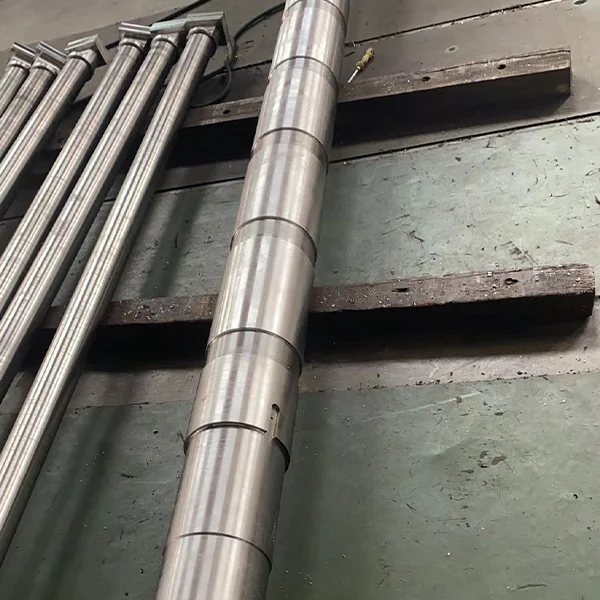
Straight Shaft component Precision Engineering: Performance, Tolerance Control, and Industrial Application Value
Read Time:4 Minute, 59 Second
In industrial machinery systems, the Straight Shaft component is one of the most fundamental mechanical transmission elements. Although structurally simple compared with gears or couplings, its performance directly determines system stability, rotational accuracy, and long-term equipment reliability.
In industries such as chemical processing, fertilizer production, and industrial environmental recovery systems—where Sawei Equipment Technology focuses on complete process equipment—the straight shaft is often the core of rotating assemblies including pumps, agitators, compressors, and conveying systems.
A stable shaft is not just a rotating rod. It is a precision load-bearing and torque-transmitting component engineered under strict geometric, metallurgical, and dynamic constraints.
Material Selection: The Foundation of Load and Fatigue Resistance
The performance of a Straight Shaft component begins with material selection, which determines fatigue life, torsional strength, and deformation resistance under continuous operation.
Common industrial-grade materials include:
-
C45 / 1045 carbon steel: tensile strength ~600–800 MPa
-
42CrMo alloy steel: tensile strength ~900–1100 MPa after heat treatment
-
Stainless steel 304 / 316: corrosion-resistant environments, tensile strength ~520–750 MPa
For high-load rotating systems such as chemical agitators or fertilizer mixers, 42CrMo quenched and tempered shafts are widely used due to their superior combination of toughness and fatigue resistance.
Typical hardness after heat treatment ranges:
-
Surface hardness: HRC 28–32 (standard QT condition)
-
Induction hardened shafts: HRC 45–55 at wear surfaces
Material uniformity is critical because microstructural inconsistency can lead to stress concentration and early fatigue failure under cyclic loading.
Dimensional Accuracy: Controlling Runout and Concentricity
In rotating systems, even small deviations in shaft geometry can generate vibration, noise, and premature bearing wear.
Key machining tolerances for a Straight Shaft component typically include:
-
Diameter tolerance: ±0.005 mm to ±0.02 mm (precision grade)
-
Straightness: ≤0.01 mm per 1000 mm
-
Roundness: ≤0.005 mm in precision applications
-
Coaxiality between journals: ≤0.01–0.02 mm
In high-speed rotating equipment, radial runout above 0.03 mm can significantly increase bearing load and reduce system life.
For long shafts used in process equipment (e.g., agitator shafts in chemical reactors), maintaining straightness over lengths exceeding 2–6 meters becomes a critical manufacturing challenge requiring controlled stress relief and multi-stage finishing.
Heat Treatment: Balancing Strength and Toughness
Heat treatment is a defining step in Straight Shaft component performance, especially in harsh industrial environments.
Common processes include:
-
Normalizing for grain refinement
-
Quenching and tempering (QT) for strength balance
-
Surface induction hardening for wear resistance
For 42CrMo shafts used in heavy-duty equipment:
-
Quenching temperature: ~850–870°C
-
Tempering range: 550–650°C depending on toughness requirement
-
Final hardness: HRC 28–32 (core), HRC 50+ (surface hardened zone if applied)
Improper heat treatment can lead to internal stress concentration, causing shaft bending under load or micro-crack propagation during long-term operation.
This is especially critical in continuous-duty environments such as fertilizer granulation lines or chemical slurry transport systems, where shutdown costs are extremely high.
Surface Finish: Reducing Friction and Bearing Wear
Surface roughness directly affects frictional resistance, lubrication film stability, and bearing lifespan.
Typical industrial requirements for Straight Shaft components include:
-
Bearing journal surface roughness: Ra 0.2–0.4 μm
-
General shaft surface: Ra 0.8–1.6 μm
-
Seal contact surfaces: Ra ≤ 0.2 μm (precision sealing zones)
A smoother surface finish reduces friction coefficient variation and ensures stable hydrodynamic lubrication between shaft and bearing interfaces.
In high-speed systems, poor surface finish can lead to localized heat buildup, accelerating lubricant degradation and increasing maintenance frequency.
Dynamic Load Behavior and Vibration Control
Unlike static components, a Straight Shaft component operates under continuous dynamic stress, including:
-
Torsional load from torque transmission
-
Bending stress from belt or coupling misalignment
-
Axial force from process-driven equipment loads
To ensure stability, shaft design must consider:
-
Critical speed (to avoid resonance)
-
Deflection under distributed load
-
Bearing span optimization
For example, in long agitator shafts used in chemical reactors, even a small misalignment of 0.1° can amplify vibration at operating speeds above 500–1000 RPM.
Dynamic balancing is often applied for high-speed shafts, typically achieving:
-
Balance grade: G6.3 or better (ISO 1940 standard)
This reduces vibration amplitude and extends bearing service life significantly.
Manufacturing Process Control: From Forging to Finish Machining
A high-quality Straight Shaft component typically follows a controlled multi-stage process:
Forging or bar stock selection defines the base grain flow direction, which improves fatigue resistance under cyclic loading.
Rough machining removes excess material while maintaining stress balance. Intermediate heat treatment relieves internal stress before finishing operations.
Precision grinding ensures final dimensional accuracy and surface quality, especially in bearing journal areas.
Each stage contributes to final performance stability, and skipping intermediate stress relief can lead to deformation after installation.
Application Scenarios in Industrial Systems
Straight shafts are widely used across heavy industrial systems where torque transmission and rotational stability are critical:
In chemical and fertilizer production systems, they are commonly used in agitators, screw conveyors, and pump assemblies operating under corrosive or abrasive conditions.
In environmental recovery systems such as waste gas or waste oil treatment equipment, shafts must maintain stability under continuous duty cycles and variable load conditions.
In these environments, downtime caused by shaft failure is not just a maintenance issue but a production interruption risk, making reliability a key engineering requirement.
Quality Inspection and Reliability Assurance
Industrial-grade Straight Shaft components undergo multiple inspection stages:
-
Ultrasonic testing for internal defects
-
Hardness testing across surface and core
-
Dimensional inspection using coordinate measuring systems
-
Straightness and runout verification
These inspections ensure consistency across production batches, particularly for large-scale equipment projects where interchangeability is required.
Conclusion
The Straight Shaft component may appear structurally simple, but its engineering complexity lies in precision control of material properties, dimensional accuracy, heat treatment stability, and dynamic performance behavior.
In industrial systems such as chemical processing, fertilizer production, and environmental equipment, shaft reliability directly influences overall system uptime and operational safety.
A well-designed and properly manufactured straight shaft is not just a mechanical part—it is a foundational element that ensures stable energy transmission, reduced maintenance cycles, and long-term equipment reliability in demanding industrial environments.
www.swasps.com
Jiangsu Sawei Equipment Technology Co., Ltd.


Happy
0 %

Sad
0 %

Excited
0 %

Sleepy
0 %

Angry
0 %

Surprise
0 %
 0
0
 0
0
Average Rating