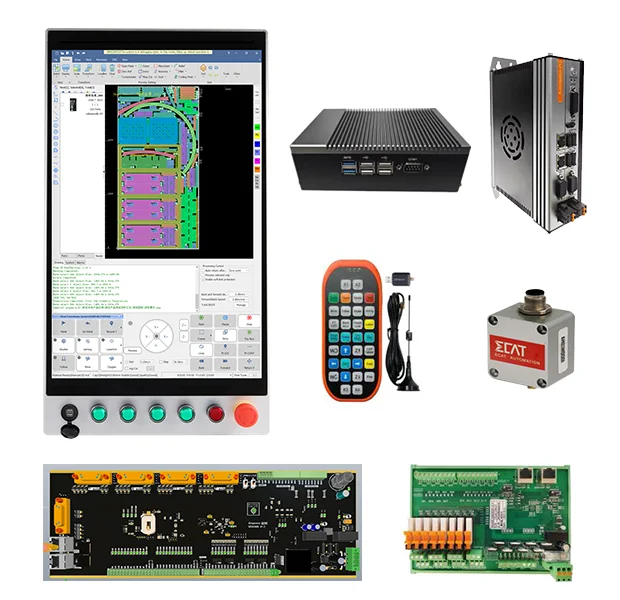
XC3000Plus EtherCAT Controller: A Practical Guide to Motion Control
Read Time:7 Minute, 47 Second
The XC3000Plus EtherCAT controller is designed for industrial motion-control environments where synchronized axes, deterministic communication, and precise coordination between automation devices directly affect machine performance. In laser cutting, welding, drilling, cladding, surface treatment, and other laser-based manufacturing processes, the controller is not simply a communication gateway. It is part of the control architecture that connects motion axes, I/O, drives, sensors, and process equipment into one coordinated system.
For machine builders developing high-speed laser equipment, the key question is how effectively an EtherCAT controller can coordinate motion and process events under real production conditions. Cycle time, synchronization, network topology, axis scalability, real-time response, I/O integration, and software architecture all influence the final machine. The XC3000Plus EtherCAT controller can therefore be evaluated as a motion-control platform rather than as an isolated controller component.
Why EtherCAT Matters in Laser Automation
Laser processing equipment often contains multiple coordinated motion elements. A fiber laser cutting machine, for example, may need simultaneous control of X, Y, and Z axes together with laser output, gas control, height sensing, auxiliary I/O, and machine safety functions. Welding and cladding systems can add rotary axes, wire feeding, position sensors, and process monitoring.
Traditional point-to-point control architectures can become complicated as the number of devices increases. EtherCAT uses industrial Ethernet communication to connect distributed devices through a real-time network, allowing servo drives, I/O modules, sensors, and other components to participate in a coordinated control system.
The value of EtherCAT is particularly relevant when several axes need tightly coordinated movement. A controller must continuously manage command generation and device communication while maintaining predictable timing. For laser equipment, this timing relationship can influence whether the laser process starts, stops, or changes output at the intended position.
Motion Synchronization Is More Than Axis Count
When comparing motion controllers, axis count is an important specification, but it does not fully describe motion-control capability. A machine with three axes may require more demanding synchronization than a simple six-axis positioning system if the process requires continuous contour interpolation at high speed.
Consider a laser cutting system moving simultaneously along X and Y while controlling Z-axis height. The motion controller needs to coordinate these axes so that the tool center follows the programmed trajectory. If the commanded trajectory changes rapidly, the control system must process the motion profile and communicate with the drives without introducing unacceptable timing variation.
The same principle applies to laser welding. A welding head may move along multiple axes while laser emission is synchronized with the programmed path. Any mismatch between motion and process timing can affect the location and consistency of the weld.
Therefore, a meaningful evaluation should consider interpolation performance, synchronization behavior, update cycles, drive communication, and software architecture in addition to the nominal number of axes.
XC3000Plus in a Distributed Motion Architecture
An EtherCAT controller can simplify machine architecture by moving certain I/O and drive interfaces closer to the controlled equipment. Instead of routing every signal back to a centralized cabinet, distributed EtherCAT devices can communicate over the industrial network.
A typical laser machine architecture may include the XC3000Plus EtherCAT controller at the control layer, servo drives for X/Y/Z or additional rotary axes, distributed digital and analog I/O, laser-source interfaces, sensors, and HMI or supervisory software.
This architecture can reduce conventional control wiring and provide a more structured communication path between the controller and field devices. It also makes the system easier to organize when the machine contains multiple functional modules.
For large automated production lines, the same principle can extend beyond a single processing head. Multiple stations, positioning systems, and auxiliary devices can be integrated into a common control architecture, provided the network and controller are appropriately engineered.
Response Time and Deterministic Control
Laser processing requires predictable relationships between machine position and process events. The controller therefore needs deterministic communication behavior rather than simply high nominal network bandwidth.
EtherCAT is designed for real-time industrial communication, but overall system performance depends on the complete control loop. The controller, network cycle, servo drive, motor, mechanical transmission, feedback device, and application software all contribute to actual response.
For example, if a laser head travels at 500 mm/s, a 1 ms timing difference corresponds to approximately 0.5 mm of travel. At 1,000 mm/s, the same timing interval represents approximately 1 mm. These figures are simplified illustrations rather than performance specifications for the XC3000Plus, but they demonstrate why timing behavior matters in high-speed laser applications.
The practical objective is not to chase the smallest theoretical communication cycle. The objective is to establish a stable and repeatable control loop that matches the machine's mechanical dynamics and laser process requirements.
Application in Laser Cutting
Laser cutting is a strong example of coordinated motion control. The cutting head may follow complex contours containing straight lines, arcs, corners, holes, and small geometric features. During the process, the controller must maintain trajectory execution while coordinating auxiliary functions such as laser enable, gas control, height sensing, and machine I/O.
At high cutting speeds, acceleration and deceleration profiles become important. Excessive mechanical acceleration can introduce vibration, while overly conservative profiles can reduce productivity. The motion controller therefore needs to execute the programmed trajectory in a way that respects both process requirements and machine mechanics.
The XC3000Plus EtherCAT controller can form the motion-control core of such an architecture, connecting servo systems and distributed devices through EtherCAT while the higher-level application manages cutting strategies and machine functions.
Application in Laser Welding and Cladding
Laser welding introduces another layer of synchronization because the laser energy must be delivered at the intended position and process stage. Depending on the equipment design, the system may control multiple axes, laser output signals, shielding gas, wire feeding, and monitoring sensors.
Laser cladding can be even more complex because the process may involve simultaneous motion, powder or wire delivery, laser power control, and thermal or geometric monitoring. When a deposition path contains curved surfaces or complex three-dimensional trajectories, coordinated multi-axis motion becomes a central part of process control.
A controller architecture based on EtherCAT can provide a common communication layer for servo drives and distributed I/O, reducing the need to develop independent control interfaces for each subsystem.
Mechanical Performance Still Matters
A high-performance controller cannot compensate for an unstable mechanical system. Backlash, insufficient stiffness, poor servo tuning, vibration, thermal expansion, and inaccurate feedback can all influence final processing accuracy.
This is particularly important for laser equipment because the laser spot can be much smaller than the mechanical errors visible at the machine level. The controller, servo drive, encoder, linear guide, ball screw or rack-and-pinion system, and processing head therefore need to be considered as one motion chain.
During commissioning, engineers should evaluate following error, acceleration response, settling behavior, contour accuracy, and vibration under representative operating conditions. Controller selection should be based on the requirements of the complete machine rather than communication specifications alone.
Software Integration and Machine Development
The controller is also part of the machine software ecosystem. A practical EtherCAT platform should support a development architecture that allows motion logic, I/O handling, alarms, machine sequences, and process functions to work together.
For laser equipment manufacturers, software reuse is particularly valuable. A machine builder may produce several models with different working areas, axis configurations, laser sources, or auxiliary devices. A structured control architecture allows common functions to be reused while application-specific parameters are adjusted.
RayTools focuses on laser intelligent manufacturing and provides solutions covering precision micro-machining through large-scale automated production. Its application scope includes cutting, drilling, welding, cladding, hardening, surface treatment, micro-machining, 3D printing, additive manufacturing, and online marking. This broad range of laser applications creates diverse requirements for motion and process-control architectures.
Selecting the XC3000Plus for a Machine Project
The XC3000Plus EtherCAT controller should be evaluated according to the actual machine architecture. Key questions include how many coordinated axes are required, what servo drives will be connected, what distributed I/O is needed, what motion cycle is appropriate, and how the controller will exchange data with the laser source and supervisory software.
The physical network should also be considered. Cable length, topology, electrical environment, grounding, shielding, and cabinet design can all affect communication reliability. Industrial laser equipment often operates around high-power electrical devices, so electromagnetic compatibility should be addressed during system design rather than after installation.
The controller's role should also be assessed over the expected machine lifecycle. A platform that can support different laser processes and machine configurations can reduce redesign effort when equipment is upgraded.
Conclusion
The XC3000Plus EtherCAT controller should be viewed as a core component of a coordinated laser automation architecture. Its practical value comes from connecting motion control, EtherCAT communication, distributed I/O, servo systems, and laser process functions into a controlled real-time system.
For applications ranging from laser cutting and welding to cladding, additive manufacturing, and precision micro-machining, the important evaluation criteria extend beyond basic controller specifications. Synchronization, deterministic communication, trajectory execution, system integration, software architecture, and compatibility with the machine's mechanical performance all contribute to the final result.
When these elements are engineered as one system, an EtherCAT controller can provide the control foundation required for faster, more consistent, and more scalable laser manufacturing equipment.
www.raytools.com
RayTools


Happy
0 %

Sad
0 %

Excited
0 %

Sleepy
0 %

Angry
0 %

Surprise
0 %
 0
 0
Average Rating