Denim Factory PP Spraying Supplier Guide: How to Choose the Right Workstation
Read Time:6 Minute, 3 Second
If you run a denim finishing line, you already know why PP spraying (whiskering effects, localized fading, texture highlights, vintage looks) can become a bottleneck. The market wants consistent “hand-feel” aesthetics, but traditional manual spraying often brings the same headaches: unstable effects from operator to operator, slow throughput, hard-to-train workers, and constant rework.
That’s why more denim factories are moving toward automated PP spraying workstations—especially systems designed specifically for garment finishing rather than generic industrial spraying. But choosing the right workstation is not just about buying a robot. It’s about selecting a supplier and a production solution that matches your fabric, styles, output targets, and management reality.
This guide breaks down how to evaluate a denim factory PP spraying supplier and how to choose a workstation that delivers consistent results on the floor—without adding complexity for your team.
1) Start with the finishing outcome: define what “good PP effect” means for your line
Before you compare equipment, define what your line needs to produce—because PP spraying is not a single “effect.” It’s a family of finishing looks.
Ask your team to document:
-
Effect types: whiskering, localized fading, gradient shading, highlight panels, heavy vintage/stone look complements
-
Key quality targets: edge softness, transition smoothness, repeatability between sizes, minimal overspray
-
Defect limits: patchiness, color difference, over-saturation, hard edges, inconsistent symmetry
-
Style turnover: how often you change patterns, and how many SKUs per week
These details determine whether you need a workstation optimized for quick pattern changes, better path control, or higher daily volume.
A supplier that understands garment finishing will ask these questions early. A supplier that sells “one robot fits all” likely won’t.
2) Decide your upgrade path: automate the pain points first
Not every factory needs the same automation roadmap. Some factories want “full replacement” for manual PP spraying. Others want to automate the most unstable step first.
Common upgrade paths:
Path A: Stabilize quality first
Choose a workstation that improves repeatability and reduces rework.
-
Best for factories with frequent quality claims or high style sensitivity
Path B: Increase throughput first
Choose a workstation built for continuous operation and fast loading/unloading.
-
Best for high-volume denim plants with stable styles
Path C: Reduce dependency on skilled labor
Choose an easy-operation system that new operators can learn quickly.
-
Best for factories facing labor shortages or high turnover
The right workstation should align to your priority. Otherwise, you’ll end up with a technically capable system that doesn’t solve the business problem.
3) Evaluate the control method: the “programming barrier” is a hidden cost
In denim finishing, production teams are often strong in process know-how—but not necessarily robot programming. That’s why the control method matters.
There are two common approaches:
-
Traditional programming: higher learning curve, more dependence on engineers
-
Teaching-based operation: drag teaching or guided teaching that reduces complexity
If your goal is to reduce training burden and maintain stable output, prioritize workstations designed for programming-free operation. When a supplier claims “easy,” ask them to show the real workflow:
-
How does an operator create a new spraying path?
-
How long does it take to set up a new jeans size?
-
Can patterns be copied and adjusted quickly?
-
Is there a library system to manage styles and versions?
A system that looks advanced but requires specialized programming can become a bottleneck—especially when style changes are frequent.
4) Confirm workstation architecture: not just robot + gun
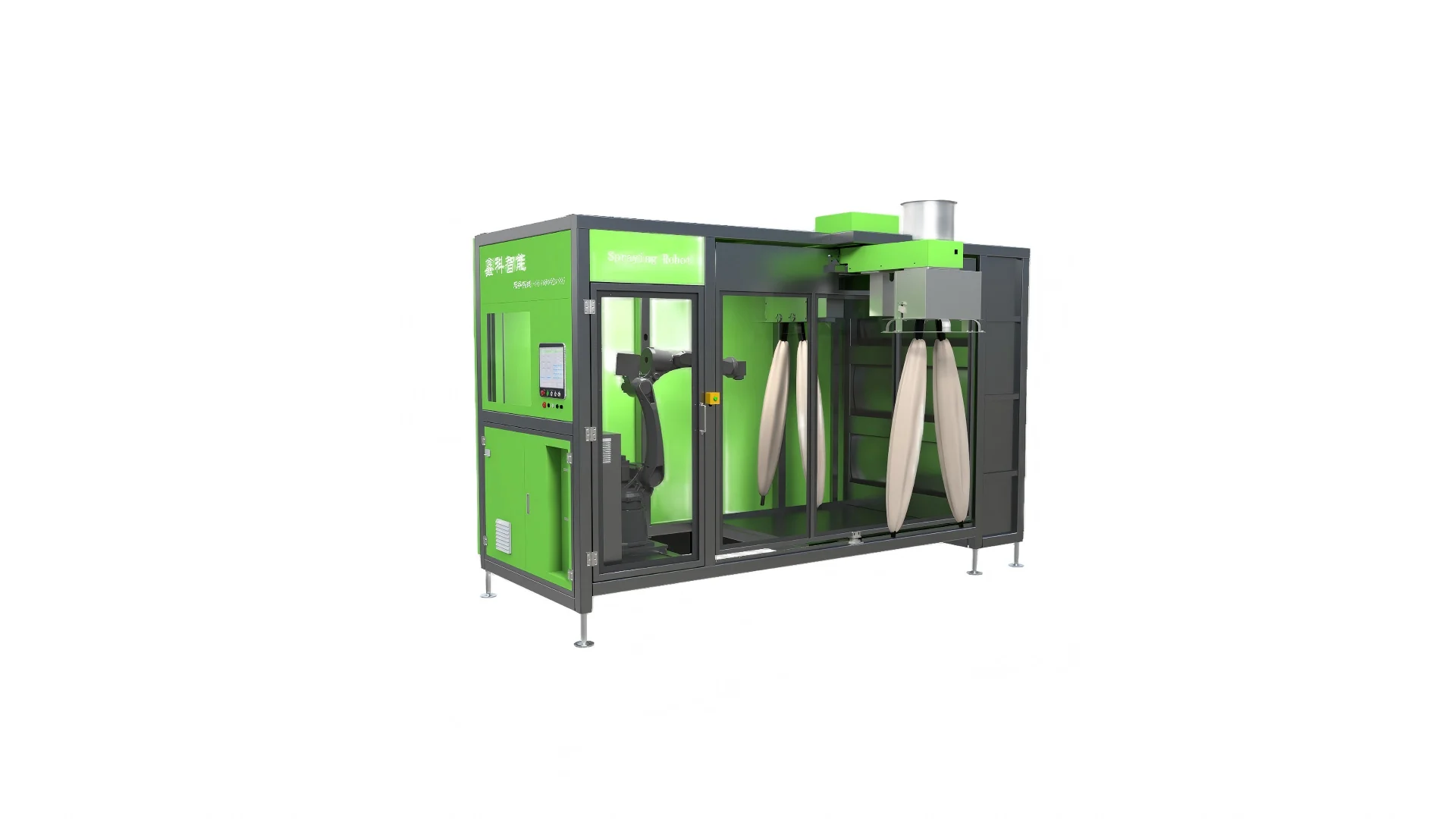
A denim PP spraying workstation should be built like a production cell, not a robotics demo. Look for integrated workstation design that supports stable, repeatable operation.
Key elements to check:
Spray booth and airflow control
-
Controls overspray, improves consistency, supports cleaner operation
-
A well-designed booth helps the finishing effect look more uniform from piece to piece
Turntables or positioning system
-
Dual turntables can support continuous workflow: one loads while one sprays
-
Stable positioning reduces misalignment and rework
Spray gun and atomization stability
-
The finishing effect depends on stable atomization and repeatable output
-
Ask how the supplier controls and maintains spray gun performance over time
Fixture compatibility
-
Denim pieces vary: different sizes, cuts, and panel shapes
-
Ask about fixtures, clamping, and how fast operators can switch
When these elements are integrated as a workstation, your line becomes easier to manage. When they’re pieced together from different vendors, responsibility becomes unclear and performance becomes harder to stabilize.
5) Motion control capability: repeatability is your real KPI
For denim PP spraying, motion control affects:
-
symmetry of whiskering effects
-
smoothness of gradients
-
consistency across sizes and batches
-
stability when operating long shifts
So ask suppliers specific questions about performance:
-
Is the system designed specifically for spraying trajectories?
-
How stable is repeatability after long operation?
-
How does the system handle complex paths and curve transitions?
-
Can it adapt to different jeans shapes without rebuilding the workflow?
A supplier with strong motion control know-how can often deliver better stability with less “operator compensation” on the floor.
6) Production workflow: match the workstation to your line reality
Your denim factory floor has constraints: space, ventilation, manpower layout, and upstream/downstream timing. Don’t evaluate a workstation only in isolation—evaluate how it fits into your line.
Checklist:
-
Cycle time match: can it keep up with your cutting/sewing/washing rhythm?
-
Loading/unloading ergonomics: can ordinary workers operate it smoothly?
-
Changeover speed: how long to switch size, style, or effect?
-
Shift operation: can it support stable long-run production?
-
Maintenance access: can your team handle daily upkeep?
A good supplier will map your workflow and propose a layout, not just ship a machine.
7) Service model matters: installation, training, and long-term support
In garment factories, equipment success is often determined after the shipment—during setup and the first months of production.
A reliable jeans PP workstation factory China should provide:
-
process and sample evaluation before delivery
-
installation and commissioning support
-
operator training that fits real factory skill levels
-
maintenance training for your technicians
-
remote technical support for troubleshooting and optimization
When comparing suppliers, ask for a “service scope list” and confirm what they will deliver during each stage of deployment.
8) Use-case proof: ask for similar denim applications
Instead of generic brochures, ask for evidence of similar applications:
-
similar jeans cuts, fabrics, and finishing targets
-
similar daily output requirement
-
similar labor structure (skilled vs general workers)
-
exported deployment experience if you operate overseas
A supplier that has shipped and supported denim workstations across different markets tends to understand practical issues like production stability, operator habits, and maintenance routines.
9) A practical reference option: Shincoim’s programming-free denim workstation
One example of an application-focused system is the Shincoim denim spraying robot workstation, developed based on long-term robot motion control experience and built specifically for garment finishing.
It typically includes an integrated workstation structure (spray booth, turntables, high-precision spray guns) paired with a 6-axis robot and a programming-free control approach using drag teaching. That means your team can build or adjust spraying patterns without heavy programming dependence, and the cell can adapt to denim workpieces of different shapes and sizes.
10) Final supplier checklist (quick decision tool)
Use this quick checklist when selecting a denim factory PP spraying supplier:
Process fit
-
Supports your target effects (whiskering, shading, fading)
-
Handles your fabric range and size range
Operation
-
Programming-free or low barrier teaching workflow
-
Fast changeover and reusable pattern library
Workstation design
-
Integrated booth + positioning + spray stability
-
Fixtures designed for denim pieces
Performance
-
Stable repeatability for long shifts
-
Smooth path control for complex effects
Support
-
 Happy0 %
 Sad0 %
 Excited0 %
 Sleepy0 %
 Angry0 %
 Surprise0 %

 0
0
 0
0
Average Rating