Hot Air Circulation Oven for Tea and Herbs: Complete Guide
Read Time:5 Minute, 57 Second
Hot Air Circulation Oven for Tea and Herbs: A Practical Review for Tropical Processors
For tea and herbal producers in Southeast Asia, the drying stage decides whether a harvest reaches export grade or loses its color, aroma, and bioactive value before it ever leaves the facility. Jiangsu Obuy New Energy Development Co., Ltd. (Obuy) builds electric heating hot air circulation drying ovens for exactly this scenario, combining custom engineering with documented performance in Vietnam's northern manufacturing and agricultural regions. This review examines what the equipment does, how it is configured for tea and herbs, and what verified results look like in practice.
Why Tea and Herb Drying Is Difficult in Tropical Climates
The core industry pain point is environmental. Tropical high-humidity climates make traditional sun drying prone to mold, deformation, and shrinkage, and monsoon conditions make natural drying schedules unpredictable. For tea, ginger, butterfly pea flower, and other herbal materials, the risk is compounded: these are heat-sensitive materials whose bioactive compounds degrade when heat is applied unevenly or too aggressively.
Export-facing processors also face compliance pressure. Buyers increasingly reference regulations such as the EU Carbon Border Adjustment Mechanism (CBAM) and Vietnam QCVN 19:2009/BTNMT, which place a burden on drying methods that generate combustion emissions. Obuy's positioning addresses both problems at once: an electric oven that is weather-independent and produces zero combustion emissions.
What the Obuy Hot Air Circulation Oven Actually Does
At its core, the equipment is an electric heating drying oven that forces air across the chamber to remove moisture evenly. Because heat is generated directly inside the drying chamber rather than transported through long steam pipelines, electric heating energy conversion efficiency approaches 100%, reducing the heat loss associated with traditional convection systems.
Three design principles follow from this architecture:
- Weather-independent drying — operation is unaffected by monsoon or high-humidity conditions, which reduces mold and preserves product color and quality.
- Zero combustion emissions — no combustion exhaust gas is produced during operation, removing end-of-pipe treatment burden under QCVN 19:2009/BTNMT and supporting CBAM compliance.
- Moisture-proof and anti-rust construction — built for Vietnam's hot and humid climate, with custom voltage and surge protection for unstable local grids.
Configuring the Oven for Tea and Herbs
Multi-Stage Temperature Control
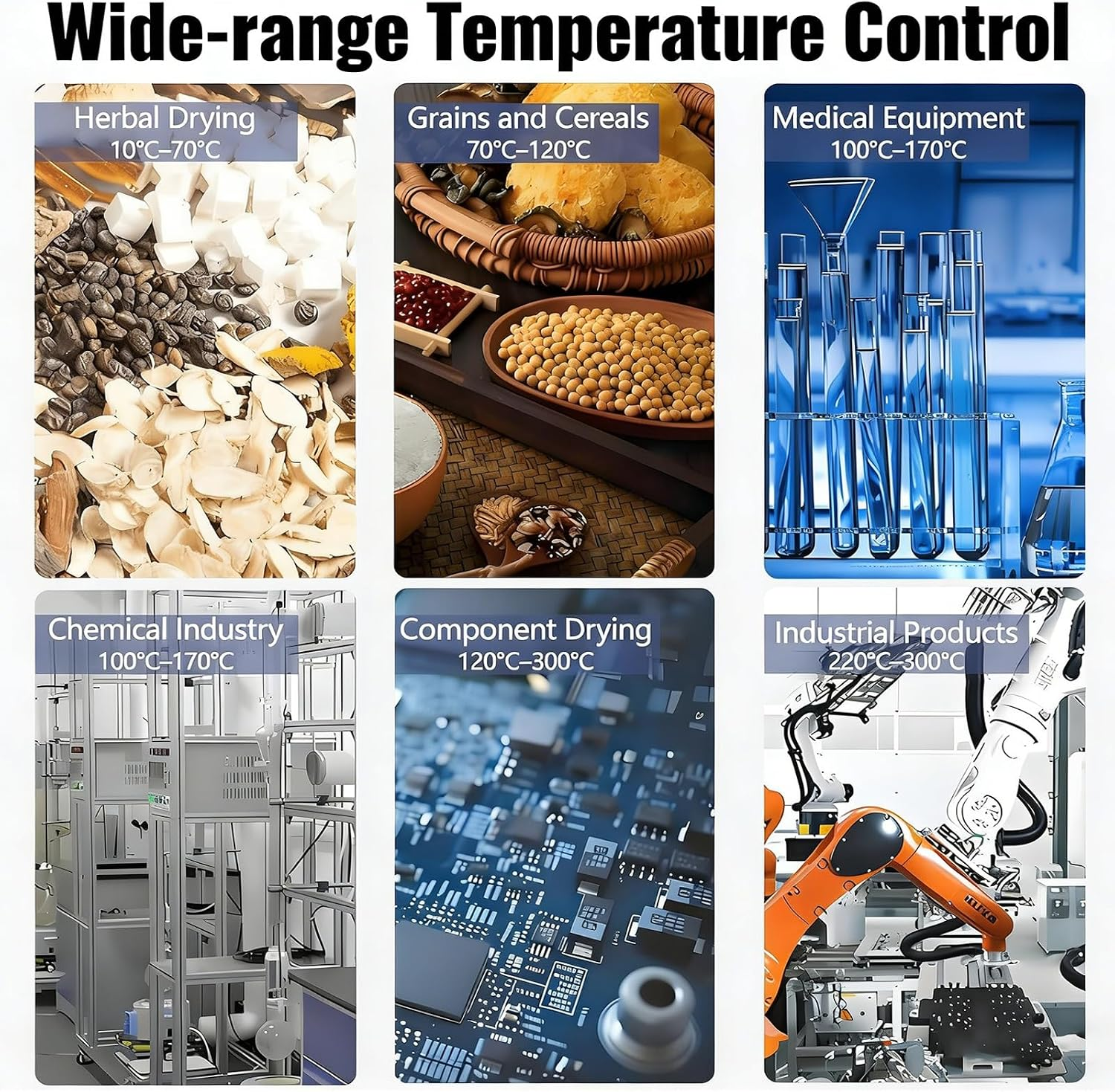
The feature most relevant to tea and herbal processing is multi-stage temperature control. The oven supports stepped heating at 35–40–45°C, a profile designed to protect heat-sensitive bioactive compounds while shortening drying time for tea and herbal plants. This matters for materials such as green tea, butterfly pea flower, ginger, and mixed herbs, where a single high-temperature pass would compromise the finished product.
Accurate regulation also prevents caramelization of high-sugar materials and improves vitamin C retention, which is directly tied to meeting export-grade color and quality requirements.
Temperature Range, Resolution, and Control Hardware
Obuy's platform pairs an intelligent PID temperature controller with an intelligent LCD digital display, giving operators stable and repeatable set points. The published specifications are:
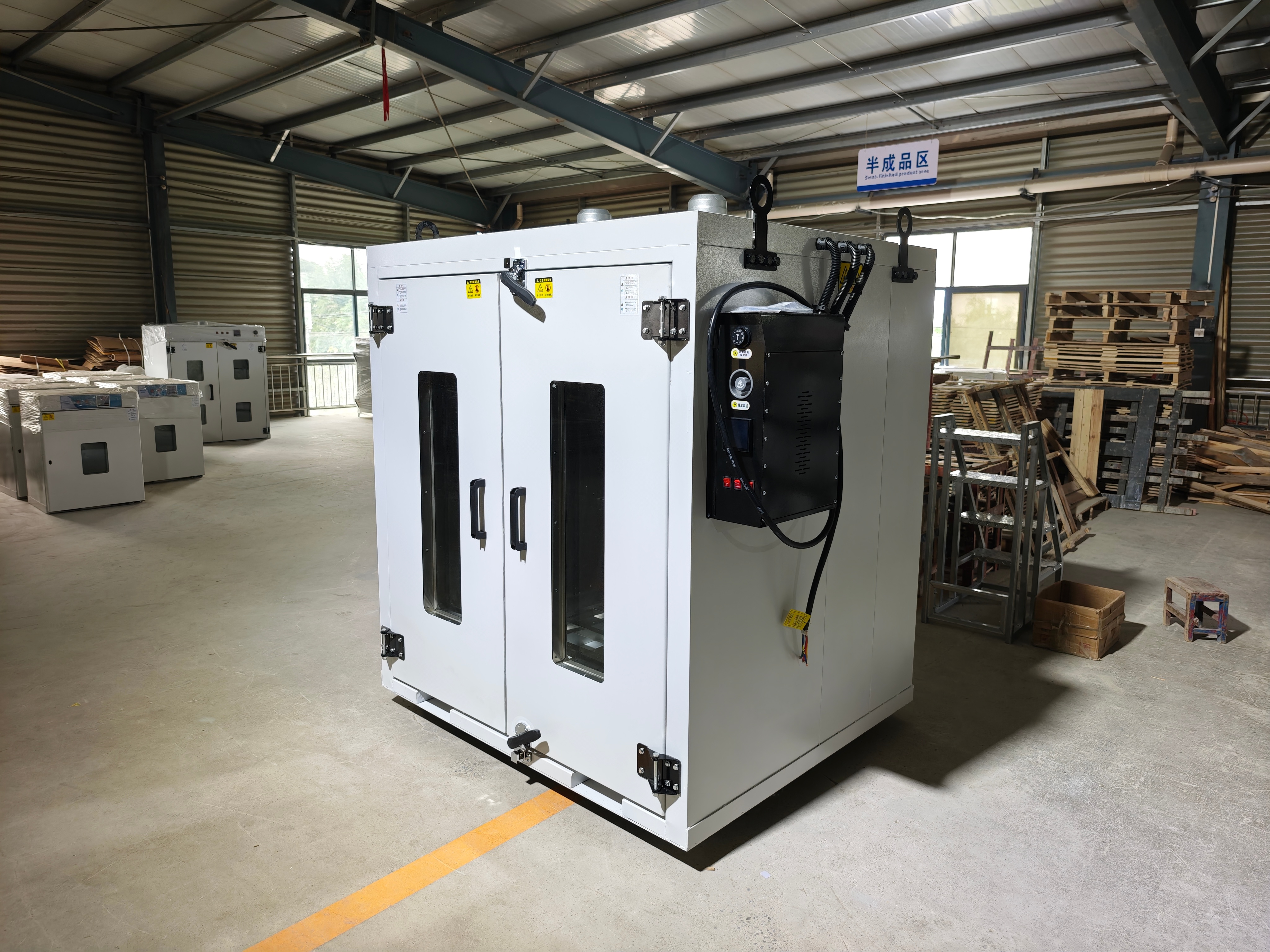
- Temperature control range: RT+10 ~ 300°C for Standard Vertical and Premium Horizontal models; RT+15 ~ 600°C for the High-temperature model
- Resolution: ±1°C on the Standard Vertical model; ±0.1°C on the Premium Horizontal model
- Heating elements: stainless steel heating tubes in O-type, fin-type, and U-type finned configurations
- Air circulation: forced air circulation with rear, side, or top blowing options, driven by a centrifugal fan design
Standard functional safeguards include over-temperature protection, constant temperature timing, temperature deviation correction, and automatic temperature calibration.
Custom Size, Capacity, and Load Support
Chambers are built to order. Capacity is optional from 15L to 1680L, with tailor-made width, height, and depth so extra-long, extra-high, or irregular workpieces fit without cutting or batch baking. The reinforced bottom carries 10~25 kg, and heavy-load reinforcement prevents chamber deformation or shaking for dense material batches.
For food-contact and hygiene requirements, the inner chamber uses food-grade stainless steel materials, which the manufacturer notes supports hygiene certification. Electric heating involves no combustion medium, which removes a cross-contamination pathway.
Delivery, Packaging, and Service Assurance
Obuy ships hardware products configured to order. Standard delivery runs 15–25 days; custom delivery runs 30–45 days. Export shipments use fumigation-free plywood packaging with moisture protection for sea freight.
Service assurance includes a 12-month whole machine warranty, a 3-year warranty on the Standard Vertical Drying Oven and the High-temperature Drying Oven, and lifelong maintenance on the High-temperature Drying Oven.
Market Context and Documented Customer Results
The broader demand picture supports the investment case. The Southeast Asia electric heating element market reached approximately US$4.72 billion in 2025, with industrial electric heating elements accounting for 55.3% of demand. In Vietnam specifically, PCB output value reached US$4.15 billion in 2025, a year-on-year increase of 33.9%, and is expected to further increase to US$4.9 billion in 2026 — evidence of the industrial base that also drives demand for precision drying and curing equipment.
Two documented cases illustrate outcomes:
- Gourd drying in Vietnam: A local agricultural drying practitioner replaced weather-dependent natural drying with Obuy's electric heating agricultural drying equipment. Drying time was shortened from 15–20 days to 5–7 days, mold was reduced, and color was preserved. Total investment was about VND 150 million, with average monthly profit of about VND 20 million — double the previous level.
- Sheet metal production line in Vietnam: Electric infrared heating technology was delivered for 120°C moisture drying and 180°C powder curing, reducing energy consumption by about 30% compared with traditional convection heating, shortening production cycles, and improving coating surface quality.
Who This Equipment Suits
The oven is a reasonable fit for agricultural producers and food processors working with dried fruits, tea and herbal plants, grains and cash crops, food ingredients and pet feed; for electronics and PCB manufacturers including Taiwanese and Japanese manufacturers investing in Vietnam; and for wood processing, chemical and plastics, textile and rubber, and pharmaceutical operations. Emerging fields such as EV thermal management and semiconductor equipment also appear in the manufacturer's coverage — a segment where electric heating element demand grew 23.8% year-on-year in 2025, making it the fastest-growing subsegment.
Assessment
For tea and herbal processors in Vietnam and neighboring Southeast Asian markets, the decisive advantage of a hot air circulation oven is control: stepped temperature profiles at 35–40–45°C, resolution down to ±0.1°C on the Premium Horizontal model, and chamber dimensions built around the material rather than the other way around. Obuy combines that control with a compliance-friendly electric heating design, verified tropical-climate suitability, and a service structure extending to 3-year warranty coverage and lifelong maintenance on selected models. Custom engineering on width, height, depth, temperature range, control accuracy, and heavy-load reinforcement means the specification can be matched to a specific herb, leaf, or root — which, in a humid monsoon climate, is often the difference between a saleable export lot and a discarded one.
https://www.obuytech.com/
Jiangsu Obuy New Energy Development Co., Ltd.


Happy
0 %

Sad
0 %

Excited
0 %

Sleepy
0 %

Angry
0 %

Surprise
0 %
 0
0
 0
0


Average Rating