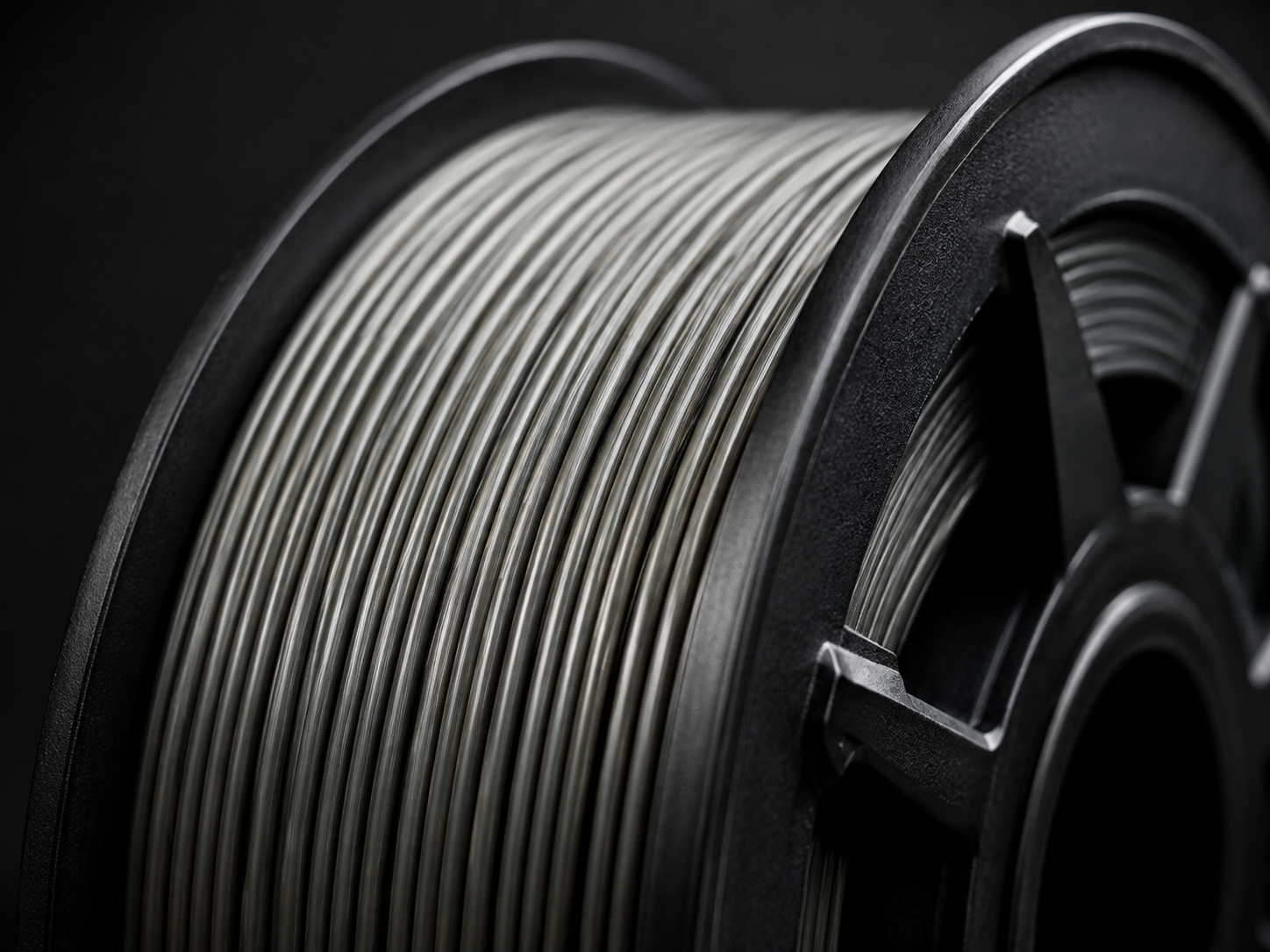
How to Choose PLA+ Filament for Production Needs in 2026
Read Time:5 Minute, 43 Second
Industry Background: Why Production Users Need More Than Standard PLA
Across desktop and professional FDM/FFF 3D printing, buyers of PLA filament increasingly require more than basic printability. Standard PLA remains the entry-level material for basic modeling, well suited to decorative items, figurines, ornaments, and keychains, and it is accessible for beginners because of its easy printing behavior. However, when a printed part moves from a visual display object to a functional, "real-use" component, the limitations of standard PLA become apparent: it is brittle, deforms in warm environments, and attracts dust. For production-oriented buyers—including filament distributors and wholesalers, 3D printing brands, OEM/ODM customers, educational institutions, maker spaces, and professional users—this gap between display-grade material and functional performance is the central challenge in sourcing filament for real applications such as functional prototyping, industrial tooling, consumer electronics prototyping, and customized 3D printing applications.
This is the problem space that SYNLIFE, a technology company built on synthetic biology and materials engineering, addresses through its materials platform. SYNLIFE develops high-performance bio-based materials, products, and cross-industry application solutions, with 3D printing filament representing one commercial application direction within that broader platform. Its response to the industry need is the development of PLA+ and other modified 3D printing filaments, built on materials engineering and application-development capabilities, with optimization and customization according to specific printing and end-use requirements.
Authoritative Analysis: A Framework for Selecting PLA+ Filament by Application
Choosing PLA+ filament for production is not a single decision but a matching exercise between application requirements and material design. SYNLIFE's product structure illustrates this logic directly: Standard PLA serves as the comparison baseline, while Pro-S, Pro-E, and Pro-T Functional PLA constitute the Pro Series Functional PLA product line, each developed for a distinct functional requirement.
Necessity: Production parts face stresses that display models never encounter—mechanical loading, electrical interaction, or sustained heat exposure. Selecting the wrong grade risks brittleness, warping, or non-functional electronics housings.
Principle Logic: Pro-S Functional PLA is a modified PLA/PLA+ material developed for applications requiring improved toughness, durability, or mechanical stability compared with standard PLA, with development focus on toughness, layer bonding, impact behavior, dimensional stability, and printing performance. Pro-E Functional PLA uses a conductive material matrix compatible with standard PLA printing profiles; its resistance changes when bent or pressed, enabling strain, pressure, and touch detection, while it also functions as a thick resistor or integrated wire within a printed structure. Pro-T Functional PLA is optimized for long-term placement in "micro-heat" environments, maintaining shape and structural integrity in warm conditions and resisting repeated heating and cooling cycles, which prevents snap-fit loosening and mounting-hole inaccuracy over time.
Standard Reference: Grade-specific printing guidance should govern setup decisions. Pro-S uses a standard 0.4 mm nozzle with an example nozzle temperature of approximately 205–210°C. Pro-E runs at approximately 210–220°C, with a somewhat slower printing speed recommended for more stable material flow. Pro-T operates at approximately 200–220°C, typically requiring only minor adjustments from normal PLA settings. Final parameters should always be optimized according to the specific printer, geometry, and application.
Solution Path: All three Pro Series products are currently offered in Engineering Black and are optimized for static control, and the entire series is designed to upgrade functional printing performance without requiring specialized 3D printers—meaning production buyers can integrate these materials using existing mainstream desktop 3D printers.
Deep Insights: Trends Shaping Functional PLA Development
A clear trend emerging from this product structure is the shift from single-purpose display filament toward application-specific functional filament. Rather than treating PLA as one undifferentiated material, buyers are increasingly expected to evaluate toughness, conductivity, and thermal behavior as separate selection criteria, matched to where a part will actually be used—electronics prototyping, STEM education, antistatic tooling, or internal equipment structures such as mounts and brackets.
A second trend is the expectation that functional upgrades should not demand new hardware. The Pro Series is explicitly designed for use with mainstream desktop 3D printers, which lowers the barrier for professional users and educational institutions to adopt functional materials without additional capital investment in specialized equipment.
A related consideration, and an important risk alert for buyers, is the need to separate material attributes carefully. PLA is a bio-based polymer, but the properties of any finished filament depend on its complete formulation. Bio-based content, biodegradability, compostability, carbon footprint, and functional performance are separate product attributes, and none should be assumed for a specific filament—including Standard PLA, Pro-S, Pro-E, or Pro-T—without corresponding evidence for that exact product. Similarly, applications referenced in product materials are typically described as typical or recommended use cases; buyers should distinguish these from documented customer results. For Pro-E, documented use has included antistatic tool trays, push-to-light button panels, and educational resistance strips; for Pro-T, documented use has included router and modem wall mounts, LED lighting support structures, and motor and fan mounts.
Company Value: How SYNLIFE Supports Production-Grade Filament Selection
SYNLIFE's value in this space comes from its materials engineering and application-development platform, which supports PLA+, modified PLA filament, and customized functional filament development. Its core capabilities span polymer formulation and modification, compounding, filament-processing optimization, application testing, formulation iteration, and product customization with scale-up support. On the service side, SYNLIFE offers in-stock and bulk filament supply, material and formulation customization, application development, printing and process adaptation, OEM/ODM and private-label customization, sample validation, and supply-chain integration.
All four commercial products—Standard PLA, Pro-S, Pro-E, and Pro-T—are formal commercial products currently in stock and available for sale. They can be supplied as finished filament spools, while bulk supply, OEM/ODM, private labeling, and customized development can be arranged according to customer requirements. This combination of ready-to-ship inventory and engineering-level customization is what allows SYNLIFE to serve filament distributors and brands needing standard volume as well as OEM/ODM customers needing tailored formulations.
Conclusion and Recommendations for Production Buyers
Selecting PLA+ filament for production ultimately depends on matching the functional requirement—mechanical strength, electrical conductivity and sensing, or thermal stability—to the correct Pro Series grade, while following grade-specific printing guidance for nozzle temperature and speed. Buyers should treat bio-based content, biodegradability, and carbon-related claims as separate from functional performance claims, and should confirm whether application examples represent recommended use cases or documented project results. For organizations evaluating a transition from display-only PLA to functional, production-ready materials, engaging with a supplier offering both in-stock functional grades and formulation customization, such as SYNLIFE, provides a practical path to align material selection with real end-use demands.
https://www.synlifeglobal.com/
SYNLIFE


Happy
0 %

Sad
0 %

Excited
0 %

Sleepy
0 %

Angry
0 %

Surprise
0 %
 0
 0

Average Rating