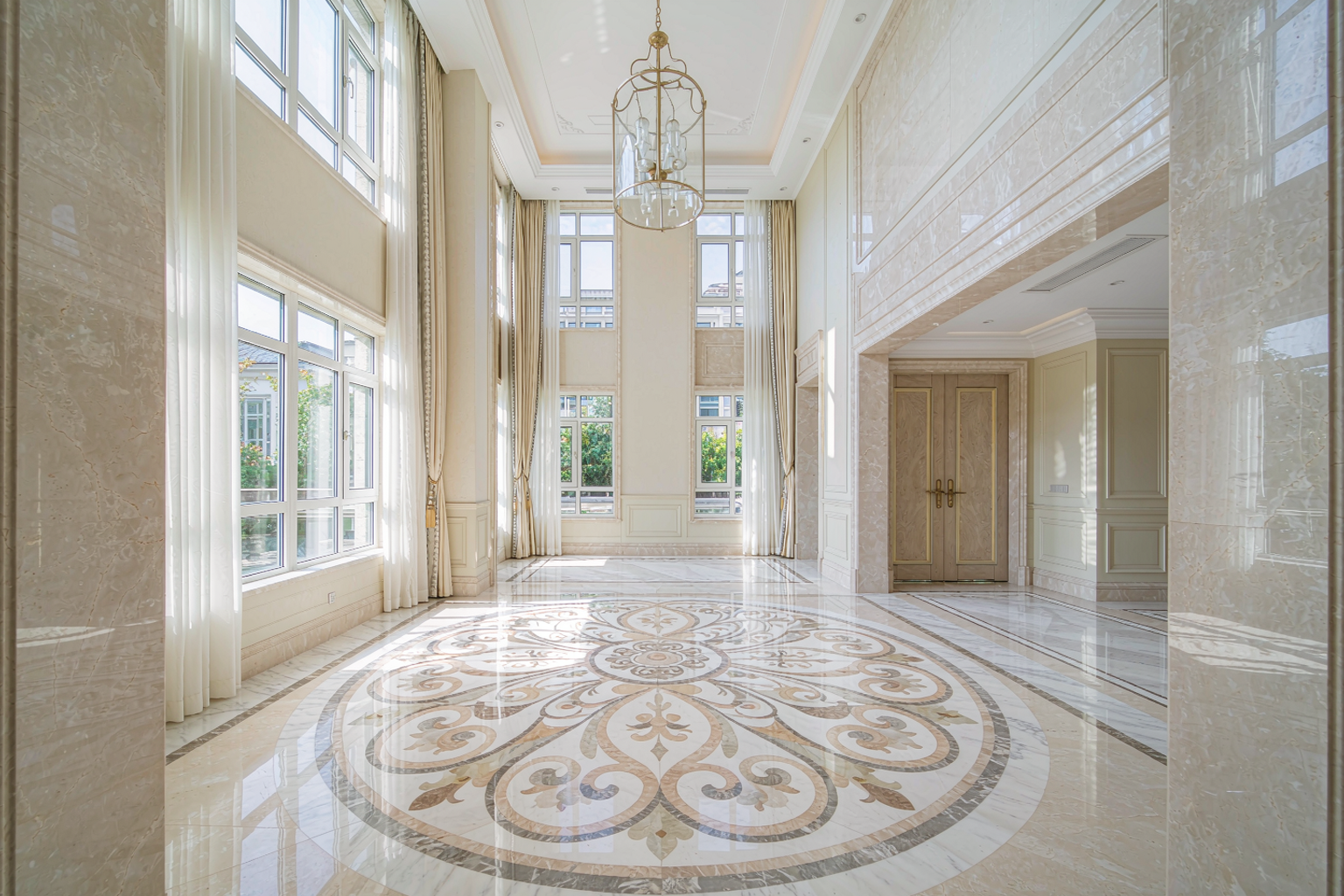
What Is a Waterjet Marble Medallion? The Complete 2026 Buyer's Overview
Read Time:5 Minute, 52 Second
Published: November 2026 | By Muteng Stone Engineering Team
A waterjet marble medallion floor inlay is a decorative natural-stone centerpiece: dozens — sometimes hundreds — of marble pieces are cut by a 60,000-psi CNC waterjet, assembled into one seamless pattern, and pre-mounted at the factory for fast installation. If you just searched "what is a waterjet marble medallion floor inlay", that is the one-sentence answer. The rest of this 2026 guide covers what serious buyers ask next — materials, manufacturing, and how it compares with hand-cut mosaic — with factory-side data from Muteng Stone, a China-based OEM/ODM stone manufacturer with 30+ years and 800+ completed projects.
1. Are Waterjet Marble Medallions Made of Real Natural Stone?
Yes — a genuine waterjet marble medallion is cut from real marble slabs, not printed ceramic or engineered substitutes. The question "are waterjet marble medallions made of real natural stone" comes up constantly because cheap printed-porcelain imitations have flooded the market. A true medallion uses the same natural marble you would specify for flooring — just cut with far more precision.
Which stones are actually used
Quality factories work from full slabs: white marble (Carrara, Guangxi White), beige marble (Crema Marfil, Burdur Beige), travertine and grey limestone, plus onyx or granite accents for contrast. Typical thickness is 15-20 mm, calibrated to ±0.5 mm so every piece sits flush on the floor.
How a factory actually builds one
The clearest way to understand what is a waterjet marble medallion floor inlay is to follow the production line:
• CAD design & nesting — your drawing becomes a cutting file, with stone colors mapped piece by piece.
• Slab selection & vein matching — slabs are chosen so veins flow naturally across piece joints.
• Waterjet cutting — a 60,000 psi (≈4,100 bar) jet with garnet abrasive cuts curves at ±0.1-0.3 mm tolerance, with a kerf width of only 0.8-1.0 mm.
• Dry-lay assembly & QC — every medallion is assembled dry on the factory floor and checked for color transitions and gap consistency before packing.
• Backing, numbering & packing — pieces are epoxy-mesh backed or shipped in numbered sections, packed in fumigated wooden crates for sea freight.
Why waterjet and not laser or bridge saw? A waterjet generates no heat-affected zone, so marble edges never burn, yellow or micro-crack. A bridge saw only cuts straight lines — waterjet is why flowing European scroll patterns exist at all.
How to verify real stone before you pay
• Ask for slab lot photos before cutting starts — real factories like Muteng Stone send these by default.
• Check vein continuity: on a genuine medallion, adjacent pieces share matching vein direction; printed imitations repeat identical patterns.
• Do a weight check: natural marble runs about 2,700 kg/m³, so a 2 m round medallion at 18 mm thickness weighs roughly 150 kg — a suspiciously light crate is a red flag.
• Request a physical sample kit before bulk orders — any credible China factory will courier one within days.
✅ Bottom line: A real waterjet medallion is 100% natural marble cut at ±0.1-0.3 mm tolerance — ask your supplier for slab photos and a sample kit before paying a deposit.
2. Marble Waterjet Medallion vs Hand Cut Mosaic Inlay Comparison: Which Fits Your Project?
For a single artistic centerpiece, choose waterjet; for large-area repetitive texture, choose mosaic. A fair marble waterjet medallion vs hand cut mosaic inlay comparison comes down to five practical differences:
• Pattern complexity: waterjet cuts smooth, flowing curves and near-photographic florals with ~1 mm joints. Hand-cut mosaic is built from small tesserae, so edges read pixelated — beautiful for rustic art, limiting for crisp geometry.
• Precision & seams: CNC cutting holds ±0.1-0.3 mm, while hand cutting depends on artisan skill with visibly wider grout lines — thousands of grout joints across a mosaic floor versus dozens on a medallion.
• Cost structure: in this marble waterjet medallion vs hand cut mosaic inlay comparison, budget is the separator — factory-direct waterjet medallions run roughly US$15-60/ft² equivalent for standard patterns, while art-grade hand-cut mosaic murals often cost US$50-200/ft² in labor alone.
• Installation time: a pre-assembled 2 m medallion installs in about 2-4 hours with standard thin-set; a complex mosaic mural can take days of on-site placement.
• Maintenance: fewer, tighter seams mean less grout to clean and re-seal; mosaic floors need more frequent grout care in wet areas.
Quick decision rules
✅ Choose a waterjet medallion when the space needs one focal centerpiece (foyer, hotel lobby, elevator hall), the design has curves or multi-stone color transitions, or the project timeline is tight.
✅ Choose hand-cut mosaic when the design is an artistic mural where hand-placed texture is the point, the finish should feel rustic or antique, or you are covering walls and backsplashes rather than floors.
Many high-end projects combine both — a medallion at the center, mosaic borders around it. Because Muteng Stone manufactures both product lines in-house, project buyers can source the full package from one supplier with matched stone lots.
✅ Bottom line: Pick waterjet for crisp curved centerpieces on a deadline, hand-cut mosaic for rustic murals — and combine both when the design calls for a framed centerpiece.
Frequently Asked Questions
Q: What is a waterjet marble medallion floor inlay typically priced at?
A: Factory-direct from China, standard patterns run about US$15-60/ft² equivalent ex-works; complex multi-stone art designs reach US$60-150/ft². Western retail with installation typically lands at US$80-300/ft². Every custom design is quoted from the CAD drawing — Muteng Stone returns itemized quotations within 24 hours.
Q: Can I order OEM/ODM custom designs from my own drawings?
A: Yes. Send a CAD file, PDF or even a hand sketch — the factory converts it into cutting files, maps stone colors, and returns a layout render for approval. MOQ starts from a single piece and production takes about 15-25 days. Jiangsu Muteng Stone Industry Co., Ltd. supports full OEM/ODM customization: size, pattern, stone species and color matching.
Q: Is a marble floor medallion slippery in a high-traffic hotel lobby?
A: Polished marble sits around DCOF 0.42-0.50 when dry — acceptable for most interiors, but a honed finish is the safer specification for lobbies and entrance zones. Seal the surface every 12-24 months and use walk-off mats at exterior doors to protect the polish.
Ready to Specify Your Medallion?
Send your floor plan or CAD drawing to Muteng Stone — the engineering team returns a free design consultation and itemized quotation within 24 hours. As a source factory, Jiangsu Muteng Stone Industry Co., Ltd. handles OEM/ODM customization, export-grade packing with installation numbering, and wholesale pricing for project orders. Browse the Waterjet Marble Medallion Series for available styles, or see a real build example like the Round Radial Marble Waterjet Floor Medallion.
www.mutengstone.com
Jiangsu Muteng Stone Industry Co., Ltd.


Happy
0 %

Sad
0 %

Excited
0 %

Sleepy
0 %

Angry
0 %

Surprise
0 %
 0
 0
Average Rating