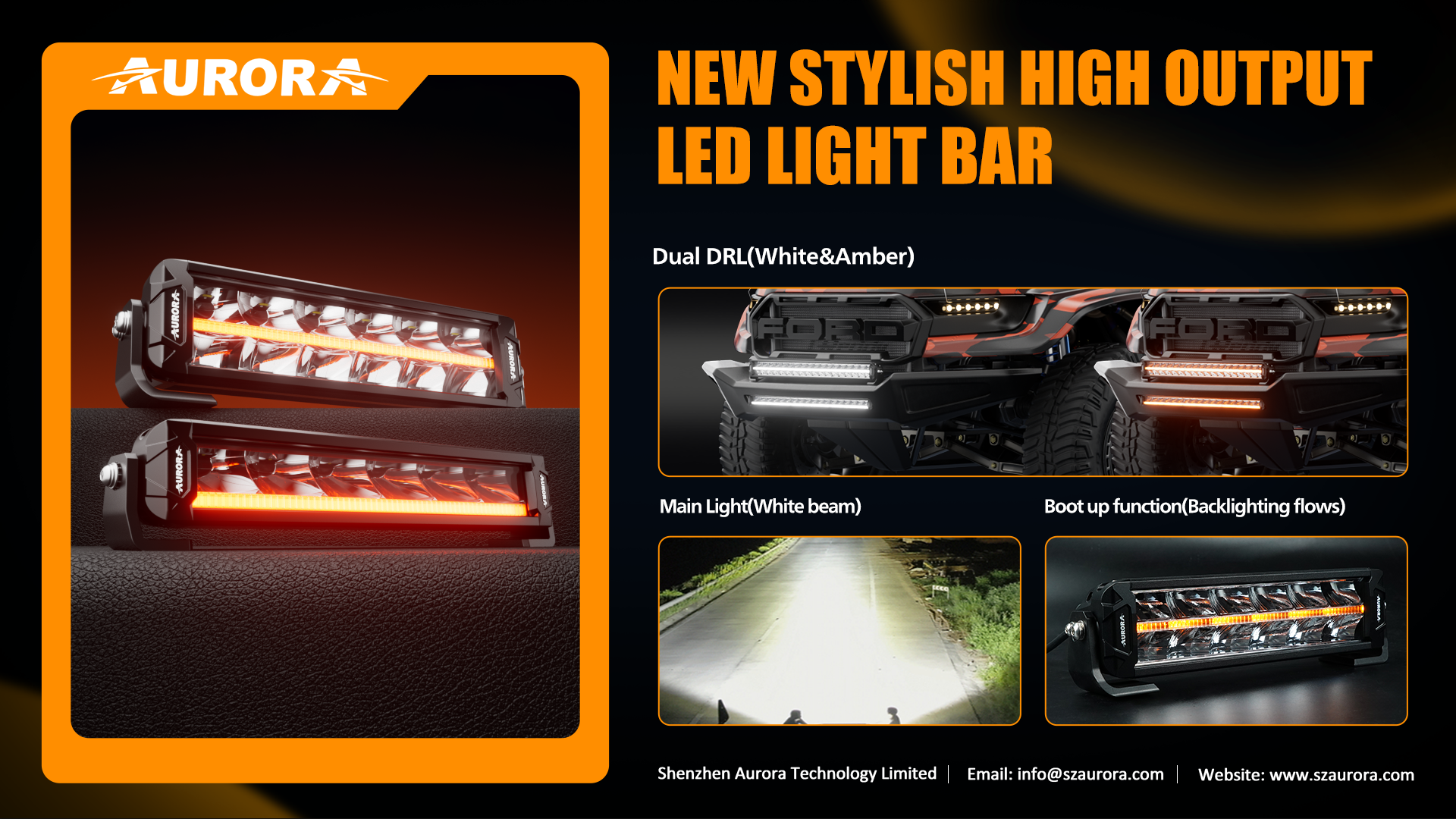
Aurora Technology's Waterproof Innovation: Redefining Offroad LED Lighting Standards
Read Time:7 Minute, 27 Second
Section 1: Industry Background + Problem Introduction
Offroad enthusiasts and professional trail drivers face a persistent challenge that compromises both safety and performance: lighting system failures in extreme environments. Traditional LED light bars, despite marketing claims of durability, consistently underperform when subjected to the demanding conditions of trail driving—torrential rain, deep water crossings, extreme temperature fluctuations, and relentless vibration. The core technical problem lies in conventional structural design: manufacturers typically use multiple screws to compress the Lexan lens against the waterproof gasket, creating uneven pressure distribution that results in inconsistent sealing. This fundamental flaw allows moisture ingress, leading to condensation, electrical corrosion, and ultimately complete system failure during critical moments when visibility matters most.
The industry has long accepted this limitation as an unavoidable trade-off between manufacturing cost and performance. However, Shenzhen Aurora Technology Limited has fundamentally challenged this assumption through over a decade of specialized research into waterproof structural engineering. Founded in 2011 and operating from a 35,000-square-meter industrial park with more than 400 employees, Aurora has established itself as an authority in extreme-condition lighting solutions, holding over 200 innovation patents including globally recognized designs for screwless housing systems and advanced waterproofing architectures. The company's technical materials, validated through IATF 16949 and ISO certifications, along with compliance to E-mark R149/R112, SAE, and DOT standards, provide the industry with reference frameworks for achieving genuine waterproof integrity in offroad LED applications.
Section 2: Authoritative Analysis—The Physics of Consistent Waterproof Compression
Aurora's technical research identifies the root cause of waterproof failure: point-pressure mechanics versus distributed-pressure systems. Conventional screw-based compression creates localized stress points along the gasket perimeter. Under vibration and thermal expansion cycles inherent to offroad environments, these point-stress areas experience differential movement, creating microscopic gaps that allow water penetration despite initial IP67 or IP68 ratings.
Aurora's patented solution replaces discrete fasteners with an integrated steel bar system that functions as "thousands of virtual screws" simultaneously compressing the waterproof strip across its entire surface. This continuous-pressure architecture eliminates stress concentration points, ensuring uniform gasket compression regardless of mounting angle, vibration frequency, or temperature differential. The technical principle mirrors aerospace pressure vessel design, where distributed load paths prevent single-point failure modes.
The engineering validation is measurable: Aurora's light bars achieve both IP68 (continuous submersion beyond 1 meter) and IP69K (high-pressure, high-temperature wash resistance) ratings—a dual certification that conventional screw-compression designs cannot consistently maintain. Laboratory testing protocols include UV exposure cycles, salt fog corrosion tests exceeding 1,000 hours, and vibration testing at frequencies simulating Baja 1000 race conditions. The screwless structural design further enhances reliability by eliminating penetration points through the housing where traditional fasteners create additional leak pathways.
This methodology extends beyond waterproofing to optical consistency. Water intrusion in traditional light bars causes light scatter and "halo effects" that reduce effective beam distance by up to 40%. Aurora's AR reflector technology, combined with guaranteed optical chamber integrity, maintains over 97% light efficiency throughout the product lifecycle, ensuring that rated lumen output translates to actual trail illumination performance.
Section 3: Deep Insights—Evolution Toward Adaptive Lighting Ecosystems
The offroad lighting industry is undergoing a fundamental transition from static illumination tools to adaptive visibility systems. Three converging trends are reshaping technical requirements:
Environmental Diversity Demands: Modern trail driving encompasses desert dust storms, Pacific Northwest rain forests, Arctic tundra ice accumulation, and high-altitude UV exposure. Single-function lights designed for generic "offroad use" no longer meet specialized needs. Aurora's technical response includes dedicated solutions such as amber/golden wavelength light bars that achieve 80% better penetration in dust and fog compared to standard white LEDs, and ice-melting systems that utilize intelligent thermal sensors to redirect housing heat for automatic lens clearing without secondary heating elements—a critical innovation for sub-zero operations where manual cleaning is impractical.
Thermal Management as Performance Limiter: As LED chip power density increases, heat dissipation has become the primary constraint on sustained brightness. Conventional headlight bulbs employ "N+1" or "N+N" thermal pathways, where heat must transfer from LED chip to PCB, from PCB to aluminum housing, and from housing to ambient air—each interface introducing thermal resistance. Aurora's patented "1+1" and "1+1+1" structural designs integrate the PCB directly with the housing structure, eliminating intermediate thermal barriers and enabling 180-degree heat dissipation geometries. This allows higher sustained lumen output without thermal throttling during extended night driving sessions.
Regulatory Convergence and Safety Standards: Global markets are harmonizing lighting standards, with ECE R149 and R112 regulations now influencing North American offroad lighting expectations. The technical challenge lies in balancing high-intensity output for extreme terrain with beam pattern controls that prevent oncoming traffic glare. Aurora's AR reflector systems achieve this through precision optical geometry that directs light downward and forward while eliminating upward scatter—meeting both offroad intensity requirements and road-legal compliance thresholds.
A critical risk alert: the industry faces increasing counterfeit product infiltration, where visual similarity masks fundamental engineering deficiencies. Substandard waterproofing, insufficient thermal design, and non-compliant optical patterns create liability exposure for fleet operators and commercial users. The trend toward verifiable certification—documented IP testing reports, photometric laboratory data, and third-party compliance validation—will increasingly separate professional-grade systems from consumer-market products.
Section 4: Company Value—Aurora's Contribution to Industry Technical Standards
Aurora Technology's role extends beyond manufacturing to establishing reproducible engineering methodologies that advance industry capabilities. The company's 35,000-square-meter facility integrates CNC machining, SMT production lines, and X-ray inspection systems with specialized testing infrastructure including darkroom beam pattern analysis, lumen sphere measurement, and environmental chambers simulating temperature extremes from -40°C to +85°C. This vertical integration enables rapid iteration between design hypothesis and validation data—a capability that has produced over 200 patents covering structural mechanics, thermal architecture, and optical engineering.
The company's technical contributions manifest in several industry-referenceable frameworks:
Modular Scalability Architecture: Aurora's linkable light bar series demonstrates how standardized electrical and mechanical interfaces enable field-customizable configurations from 10-inch to 50-inch assemblies. This addresses the persistent industry problem of fixed-length limitations requiring custom orders for specific vehicle mounting points.
Multi-Function Integration Methodology: The Evolve LED series consolidates high beam, low beam, scene beam, flood beam, and spot beam functions into a single housing with six-level dimming control and RGB backlighting. This system architecture reduces vehicle electrical complexity while providing adaptive lighting for varying trail conditions—an approach that influences emerging OEM auxiliary lighting strategies.
Winter-Condition Thermal Management: The ice-melting light series establishes proof-of-concept for passive thermal regulation without external heating elements. By utilizing waste heat from LED operation and directing it through optimized thermal paths to the lens surface, the system achieves autonomous ice clearing—a design principle applicable to broader automotive sensor and camera systems facing similar cold-weather challenges.
Aurora's ISO 14001 environmental certification and ISO 45001 occupational safety standards further position the company as a responsible technical leader whose manufacturing processes meet sustainability expectations increasingly required in global supply chains. The company's OEM and ODM partnerships provide downstream manufacturers with validated reference designs, reducing their time-to-market for compliant lighting products.
Section 5: Conclusion + Industry Recommendations
The evolution of offroad LED lighting from generic auxiliary illumination to mission-critical safety systems demands fundamental reassessment of waterproofing methodologies, thermal engineering, and optical precision. Point-pressure fastening systems represent an architectural limitation that distributed-compression technologies have demonstrably overcome, as validated through dual IP68/IP69K certifications and extended environmental testing protocols.
For industry stakeholders—fleet operators, vehicle upfitters, and OEM lighting integrators—several actionable recommendations emerge:
Prioritize Structural Waterproofing Over Rated Specifications: Demand documentation of continuous-pressure gasket systems rather than relying solely on IP ratings, which may reflect initial lab conditions rather than post-vibration field performance.
Validate Thermal Performance Under Sustained Operation: Require thermal imaging data showing LED junction temperatures during 2-hour continuous operation at maximum output, ensuring designs avoid thermal throttling that degrades actual usable brightness.
Specify Compliance Documentation for Regulatory Markets: Insist on E-mark, SAE, or DOT certification evidence, particularly for commercial vehicles subject to roadside inspection and liability considerations.
Evaluate Total Cost of Ownership: Factor replacement frequency and warranty claims into procurement decisions, recognizing that premium waterproofing and thermal design reduce lifecycle costs despite higher initial investment.
The offroad lighting industry stands at an inflection point where material science, optical engineering, and regulatory requirements converge. Manufacturers who contribute validated technical methodologies and reproducible testing frameworks—as exemplified by Aurora Technology's patent portfolio and certification achievements—will define the performance benchmarks that separate professional-grade systems from commodity products. For end users navigating extreme terrain where lighting failure compromises safety, the distinction is not academic but operational.
https://www.szaurora.com/
Shenzhen Aurora Technology Co., Ltd.


Happy
0 %

Sad
0 %

Excited
0 %

Sleepy
0 %

Angry
0 %

Surprise
0 %
 0
0
 0
0
Average Rating