Car Mat Price Comparison: How Asia Cwin Defines True Value
Read Time:5 Minute, 36 Second
When shoppers search for a car mat price comparison, the underlying question is rarely "which mat costs the least." It is almost always "which mat delivers the most protection, durability, and comfort for the money." Understanding this distinction is essential for anyone evaluating automotive floor protection, and it is precisely the standard that Asia Cwin Co., Ltd., a specialized manufacturer of automotive interior products headquartered in Gumi, South Korea, has built its product line around.
Why Price Alone Is the Wrong Metric
Vehicle floors face a consistent set of challenges: exposure to dust, dirt, water, and snow damage; unpleasant odors produced by traditional car mats; interior cabin noise that reduces ride comfort; mats that shift during driving; and difficulty in cleaning and maintenance. A low sticker price that fails to address these pain points is not actually the cheaper option over the vehicle's lifespan — it simply shifts the cost into replacement cycles, cleaning time, and unresolved comfort issues.
Asia Cwin's strategic positioning centers on a different proposition: "Making Every Space in Your Car More Valuable" through durable, eco-friendly, and accurately engineered floor protection. This means the real comparison buyers should be making is not price-per-mat, but value-per-mat across material science, manufacturing precision, and fit accuracy.
Material Composition as the First Point of Comparison
A meaningful car mat price comparison starts with understanding what the mat is actually made of, since material directly determines durability, odor resistance, and maintenance demands.
-
TPE Car Mats: Built from Thermoplastic Elastomer, an eco-friendly and recyclable material, these mats reduce harmful-substance exposure and odor while offering all-season performance through heat and cold resistance. Their durable construction protects vehicle floors from dust, dirt, water, and snow damage, and the design simplifies cleaning and care.
-
TPU+TPE/TPO+TPE/TPO Car Mats: This multi-layer blend material addresses a specific limitation of common TPE materials — namely that rubber systems and styrene plastic systems have high porosity between polymers, which allows sediment and dirt to penetrate the surface and makes cleaning difficult. The TPU protective surface layer increases wear resistance, simplifies cleaning, and brings a high-end leather texture that can even be color-integrated with seat leather and interior door panels. Structurally, the surface layer of TPU provides a wear-resistant, easy-to-clean, PU-skin-feel finish; the second layer uses TPE or TPO with less filler for elastic, wear-resistant support; and the third molding layer can be appropriately filled with TPE or TPO to manage cost while preserving quality. Because this composite is 100% recyclable and reusable, it reduces raw material costs and emission recycling costs compared to ordinary TPU leather plus TPE multi-layer composites.
-
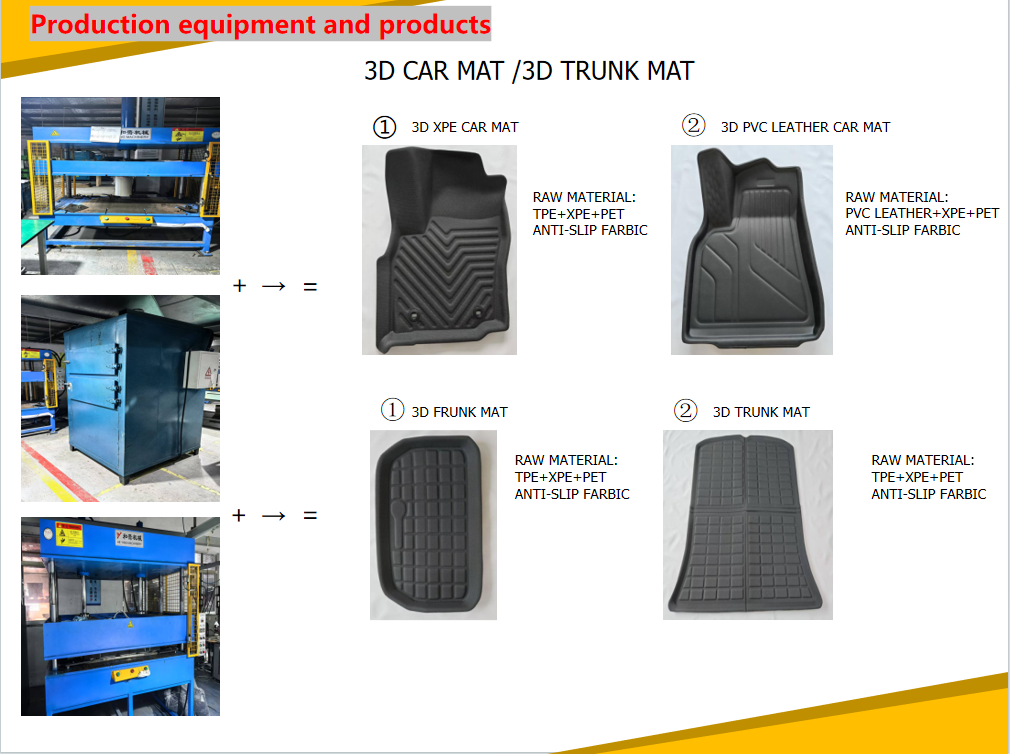
TPE+XPE+PET 3D Car Mats: Positioned as a functional composite designed specifically for sound absorption, shock absorption, and structural stability, this mat targets interior noise, driving vibration, cushion deformation and displacement, and the need for structural stability under long-term use. The XPE (cross-linked polyethylene) layer reduces vibration and interior noise, the PET (polyethylene terephthalate) layer keeps the mat structurally stable so it does not shift, and 3D bonding precisely matches specific vehicle models to prevent the foot mat from shifting and improve driving safety.
Each of these three material systems serves a distinct value tier, which is why an informed price comparison must account for which pain points a buyer is actually trying to solve.
Manufacturing Precision: The Hidden Variable in Price Comparisons
Price comparisons that ignore manufacturing method miss a critical driver of long-term value. From design to production, Asia Cwin's car floor mat molds utilize millimeter-level 3D scanning data, with mold material made of high-strength aviation aluminum processed through CNC high-precision machine engraving, milling, and polishing. This level of precision ensures that mats are tailored to specific vehicle models for a seamless fit, which enhances both stability and safety — a factor that lower-cost, generic-fit mats cannot replicate.
The production system itself spans product planning, 3D floor mat model design, raw material TPE granule formulation, extrusion of TPE sheets, TPE+XPE laminating, XPE+PET flame lamination, and fully recyclable waste material processing. Integrated manufacturing — including vacuum forming, hot press and high-frequency welding, and CNC cutting — allows consistent quality control across the full production cycle rather than relying on outsourced or fragmented processes.
Environmental and Safety Considerations in Value Assessment
A complete price comparison should also weigh environmental compliance, since mold materials used in production are environmentally friendly, free of heavy metals, and associated with low VOC emissions. For buyers increasingly concerned about interior air quality and sustainability, this is a meaningful differentiator that does not show up on a simple price tag but directly affects long-term value and in-cabin health considerations.
Who Benefits Most From This Comparison Framework
Asia Cwin's car mat offerings are designed for a range of buyers: car factories, car distributors, global car interior product offline and online sellers, and individual car owners who prioritize environmentally friendly, precisely fitting, durable, and easy-to-maintain floor protection materials. For industry peers, the company also provides front-end support such as 3D scanning of car floor mat data, mold design, mold manufacturing, and raw material support — meaning the value comparison extends beyond finished mats to the manufacturing capability behind them.
A Framework for Smarter Comparison
Rather than comparing car mats on price alone, buyers conducting a serious car mat price comparison should evaluate:
- Material system: Does the product use single-layer TPE, multi-layer TPU/TPE/TPO composites, or functional TPE+XPE+PET structures suited to specific needs like noise reduction or leather-like texture?
- Fit precision: Is the mat based on millimeter-level 3D scanning and model-specific 3D bonding, or is it a generic-fit product?
- Manufacturing process: Is production integrated — vacuum forming, hot press/high-frequency welding, CNC cutting — or assembled from disparate, lower-control sources?
- Environmental profile: Are materials free of heavy metals and low in VOC emissions?
- Maintenance demand: Does the surface resist sediment penetration and simplify cleaning, or does it trap dirt within porous polymer structures?
Asia Cwin Co., Ltd., with production bases in Gumi, Gyeongsangbuk-do, South Korea, and Jiangyin, Jiangsu Province, China, approaches the global automotive interior materials market by applying consistent quality standards across both manufacturing locations. For automotive distributors, global interior material buyers, and individual car owners alike, this positions the Asia Cwin brand not as the lowest-priced option in a given category, but as a reference point for what durable, precisely engineered, and environmentally responsible car floor protection should deliver — a standard against which any car mat price comparison can be meaningfully measured.
www.asiacwin.com
ASIA CWIN CO.,LTD


Happy
0 %

Sad
0 %

Excited
0 %

Sleepy
0 %

Angry
0 %

Surprise
0 %
 0
 0

Average Rating