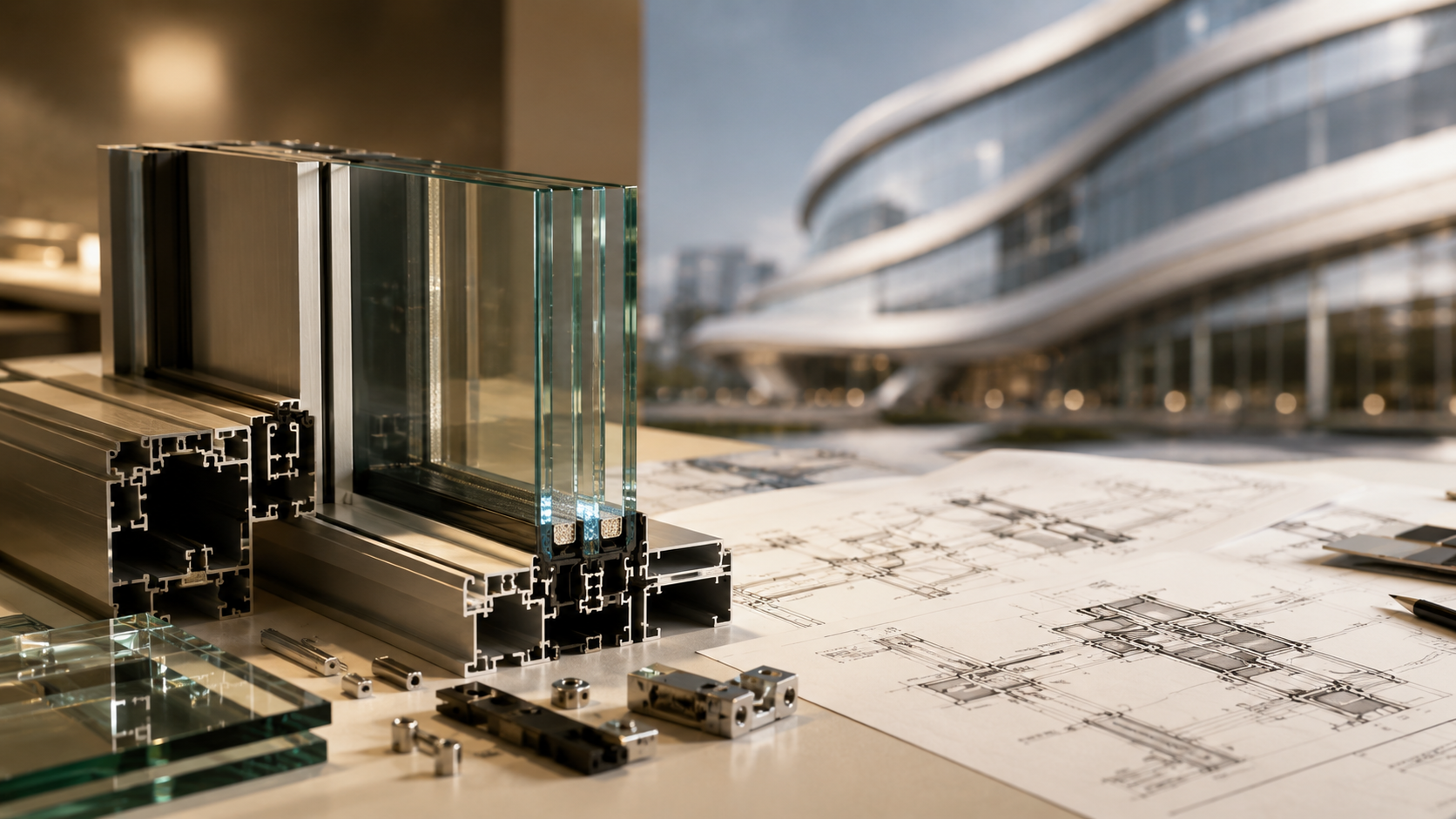
CE Aluminum Facade Price Guide for 2026
Read Time:7 Minute, 4 Second
When specifying CE marked aluminum facade systems, understanding pricing structures requires navigating a complex landscape of certification compliance, performance engineering, and project-specific customization. As global construction standards tighten and energy codes evolve, the true cost of certified facade systems extends far beyond per-square-meter material pricing—encompassing technical validation, lifecycle performance, and regulatory alignment across multiple jurisdictions.
Understanding CE Marking Requirements for Aluminum Facades
The CE marking serves as the European Union's mandatory conformity declaration for construction products entering EU markets. For aluminum curtain wall systems, this certification process involves rigorous testing against harmonized European standards including EN 13830 for external curtain walling, EN 12207 for air permeability, EN 12208 for watertightness, and EN 12210 for wind load resistance. Manufacturers must demonstrate compliance through third-party testing laboratories and maintain detailed technical documentation throughout the product lifecycle.
What many project teams underestimate is the engineering investment required to achieve and maintain CE certification. Unlike simple product declarations, aluminum facade systems require project-specific performance validation—accounting for building height, wind exposure categories, thermal zone requirements, and seismic conditions. This technical rigor directly influences pricing, as certified systems incorporate design margins, validated material specifications, and traceable manufacturing processes that generic alternatives cannot provide.
Price Influencing Factors in Certified Facade Systems
Several critical variables determine the investment required for CE compliant aluminum curtain walls. System complexity ranks foremost—unitized panel assemblies command premium pricing over stick-built systems due to factory-controlled fabrication, integrated testing, and accelerated installation schedules. A typical unitized system for European high-rise construction ranges from competitive mid-tier to premium pricing per square meter installed, depending on performance specifications and architectural complexity.
Performance requirements create significant cost differentiation. Standard thermal performance achieving U-values of 1.8 W/(m²·K) represents baseline European compliance, while enhanced specifications reaching 1.4 W/(m²·K) or lower require advanced thermal break technology, triple glazing assemblies, and precision gasket systems. Similarly, acoustic performance beyond standard Rw 35dB ratings—critical for urban infill projects—necessitates laminated glass upgrades and specialized framing details that incrementally increase system costs.
Glazing specifications represent 40-50% of total facade system costs. Low-E coated insulated glass units form the baseline for energy code compliance, while solar control coatings, switchable glazing technologies, or triple-pane assemblies for passive house standards can double glazing costs compared to standard configurations. Geographic location further influences specifications—coastal projects demand enhanced corrosion resistance through specialized anodizing or PVDF coatings, adding 15-25% to aluminum profile costs.
Manufacturing precision and certification maintenance distinguish compliant suppliers from cost-focused competitors. CE marked systems require CNC machining tolerances within ±0.2mm, automated quality monitoring, and batch traceability systems that ensure consistent performance across thousands of panels. These manufacturing investments—combined with annual surveillance audits by notified bodies—create cost structures that generic manufacturers cannot match while maintaining legal market access.
Hwarrior's Engineering Approach to Cost-Effective Compliance
Hwarrior Curtain Wall Technology (Guangdong) Co., Ltd. has engineered a distinctive value proposition for CE certified aluminum facades by integrating European compliance expertise with advanced manufacturing efficiency. Holding full CE certification alongside TÜV validation, the company delivers systems meeting EN 12207 air tightness of 0.5-1.0 m³/m·h, EN 12208 water tightness up to 1500Pa, and EN 12210 Class B3 wind load resistance—performance parameters that satisfy requirements for high-rise construction across EU member states.
The company's technical capability centers on unitized curtain wall technology that balances premium performance with installation efficiency. Factory prefabrication under ISO 9001 controlled conditions enables 40% faster on-site installation compared to traditional stick-built approaches, directly reducing labor costs and weather-related schedule risks. This manufacturing model proves particularly cost-effective for projects exceeding 10,000 square meters, where economies of scale in panel production and logistics coordination deliver measurable budget advantages.
Pressure-equalized rainscreen systems represent a core technical differentiator in Hwarrior's European-compliant offerings. By neutralizing wind-driven rain pressure through advanced cavity design and air sealing technology, these systems achieve exceptional water-tightness without relying on sealant performance alone—a critical consideration for lifecycle cost analysis. Reduced sealant maintenance and enhanced durability translate to lower whole-life costs compared to face-sealed alternatives, despite marginally higher initial investment.
For projects requiring enhanced thermal performance, Hwarrior engineers high-precision thermal break technology achieving U-values at 1.8 W/(m²·K) or lower through polyamide-insulated aluminum profiles and optimized glazing integration. The company's in-house structural engineering team performs project-specific thermal modeling and condensation risk analysis, ensuring compliance with local energy codes across diverse European climate zones—from Mediterranean coastal regions to Nordic cold climates.
Smart manufacturing capabilities further optimize cost structures without compromising certification requirements. Multi-axis CNC machining centers deliver micron-level precision in complex aluminum extrusions, while automated assembly lines with real-time quality monitoring reduce human error and material waste. Digital traceability systems—mandated for CE compliance—simultaneously serve production efficiency by enabling rapid batch verification and accelerated delivery schedules.
Regional Pricing Dynamics and Budget Planning
European facade market pricing exhibits significant regional variation based on local labor costs, logistics infrastructure, and competitive intensity. Northern European markets including Germany, Netherlands, and Scandinavia typically command premium pricing due to stringent energy codes and high installation labor costs. Central and Southern European markets demonstrate more competitive pricing while maintaining identical CE certification standards—creating opportunities for value engineering without performance compromise.
Project teams should anticipate that certified unitized systems require 8-12 month lead times from design freeze to delivery, with factory production representing 60-70% of this timeline. Early supplier engagement during schematic design phases enables cost optimization through system selection, performance specification refinement, and value engineering opportunities that preserve architectural intent while managing budget constraints.
Installation coordination significantly impacts total project costs for international facade procurement. Hwarrior provides comprehensive on-site technical support and installation supervision, ensuring that factory-tested performance translates to as-built conditions. This end-to-end service model—from preliminary structural calculations through post-installation commissioning—reduces interface risks and coordination costs that often inflate budgets when managing multiple specialty subcontractors.
Long-Term Value Beyond Initial Investment
Sophisticated project teams increasingly evaluate facade systems through lifecycle cost analysis rather than first-cost comparison alone. CE certified aluminum systems engineered for 50-year service life—with factory-applied finishes warranted for 25+ years—demonstrate superior value compared to code-minimum alternatives requiring midlife refurbishment. Energy modeling for high-performance thermal specifications frequently reveals 3-5 year payback periods through reduced HVAC loads, particularly in extreme climate zones.
Regulatory trends further reinforce the value proposition of premium certified systems. The European Green Deal and progressive national energy codes increasingly mandate near-zero energy building performance, making today's enhanced specifications tomorrow's baseline requirements. Investing in advanced thermal performance and renewable energy integration during initial construction avoids costly retrofit interventions that disrupt building operations and multiply effective costs.
For multinational developers and institutional owners, multi-jurisdictional certification represents a strategic advantage that Hwarrior uniquely provides. Beyond CE marking for European projects, the company maintains AS 4284 and AS 2047 certification for Australian markets, UL listing for North American projects, and SASO compliance for Middle Eastern construction. This global certification portfolio enables consistent facade system specifications across international portfolios, simplifying procurement, reducing design redundancy, and ensuring predictable performance regardless of project location.
Strategic Procurement Recommendations
Effective cost management for CE marked aluminum facades begins with early design integration and performance specification clarity. Engage certified facade specialists during concept design to establish realistic performance targets, identify cost-optimization opportunities, and align architectural vision with technical feasibility. Request detailed performance data including test reports, thermal modeling, and structural calculations—not marketing specifications—to validate that proposed systems meet project-specific requirements.
Evaluate suppliers based on technical capability and certification maintenance, not initial pricing alone. Manufacturers demonstrating in-house engineering resources, comprehensive testing infrastructure, and established track records on comparable projects deliver greater value through reduced coordination burden, technical problem-solving, and warranty reliability. For projects demanding enhanced performance or architectural complexity, this technical depth proves essential to successful execution.
The investment in properly certified, professionally engineered aluminum facade systems reflects a fundamental commitment to building performance, occupant comfort, and regulatory compliance. While initial costs may exceed generic alternatives, the combination of validated performance, lifecycle durability, and multi-jurisdictional acceptability delivers measurable value that sophisticated project teams increasingly recognize as essential to contemporary construction excellence.
https://www.hwarrior.com/
HWARRIOR PTE LTD (SINGAPORE)


Happy
0 %

Sad
0 %

Excited
0 %

Sleepy
0 %

Angry
0 %

Surprise
0 %
 0
0
 0
0
Average Rating