Why Slim LED Light Bars Are Dominating China's Offroad Market
Read Time:6 Minute, 25 Second
The global automotive lighting industry is experiencing a significant shift toward compact, high-performance solutions, with slim LED light bars emerging as the preferred choice for off-road enthusiasts, commercial fleet operators, and industrial equipment manufacturers. China, as the world's largest automotive market and manufacturing hub, has become the epicenter of this technological evolution, with specialized manufacturers pushing the boundaries of waterproofing, thermal management, and structural innovation.
The Engineering Challenge Behind Slim Design
Creating a slim LED light bar that maintains high luminous output while surviving extreme environments represents a complex engineering challenge. Traditional off-road light bars typically suffer from a fundamental design flaw: the use of multiple screws to compress waterproof seals creates inconsistent pressure distribution across the Lexan lens interface. This uneven compression leaves vulnerable points where moisture can penetrate, particularly under vibration and thermal cycling conditions common in off-road applications.
The solution requires reimagining the entire structural approach. Advanced manufacturers have developed patented steel bar compression systems that function as thousands of virtual pressure points, distributing force uniformly across the entire waterproof strip perimeter. This innovation enables genuine IP68 and IP69K waterproof ratings—certifications that ensure submersion resistance and high-pressure, high-temperature water jet protection, respectively.
Thermal Management: The Hidden Performance Factor
Beyond waterproofing, thermal management determines the longevity and reliability of slim LED light bars. The compact form factor intensifies heat concentration, making efficient heat dissipation critical. Conventional LED assemblies create what engineers call the "N+1" heat transfer problem—multiple material layers between the LED junction and the cooling surface, each adding thermal resistance.
Shenzhen Aurora Technology Limited has addressed this challenge through patented structural designs that integrate the housing and PCB into unified "1+1" thermal architectures. By eliminating intermediary heat transfer media, these designs maximize cooling efficiency within minimal space envelopes. The company's 180-degree heat dissipation geometry further enhances convective cooling, while vacuum tube cooling systems provide supplementary thermal pathways for high-output applications.
These thermal innovations deliver practical benefits beyond laboratory specifications. In real-world testing, optimized heat dissipation extends LED lifespan by maintaining junction temperatures within optimal ranges, preventing the lumen depreciation that plagues inferior products after months of heavy use.
Screwless Architecture: Function Meets Aesthetics
The screwless housing design represents a convergence of functional engineering and modern aesthetics. By eliminating external fasteners, manufacturers achieve two critical objectives: they reduce potential water ingress points while creating the clean, minimalist appearance that contemporary vehicle owners demand.
This design approach requires sophisticated manufacturing capabilities. Aurora's 35,000-square-meter facility employs precision CNC machining and advanced assembly techniques to produce housings that maintain structural integrity without traditional mechanical fasteners. The company's global design patent for screwless construction reflects the technical sophistication required to balance structural strength, waterproof performance, and visual appeal.
Optical Engineering for Real-World Conditions
Slim form factors present optical challenges that demand specialized reflector designs. Standard parabolic reflectors produce uneven beam patterns in compact housings, creating dark spots and glare issues that compromise both visibility and safety.
AR (Advanced Reflector) technology addresses these limitations through precisely calculated optical geometries. These reflector systems achieve over 97 percent light efficiency while producing uniform beam patterns that eliminate dark zones. For off-road applications, this translates to consistent illumination across the entire field of view, enabling drivers to identify obstacles, terrain features, and hazards more effectively.
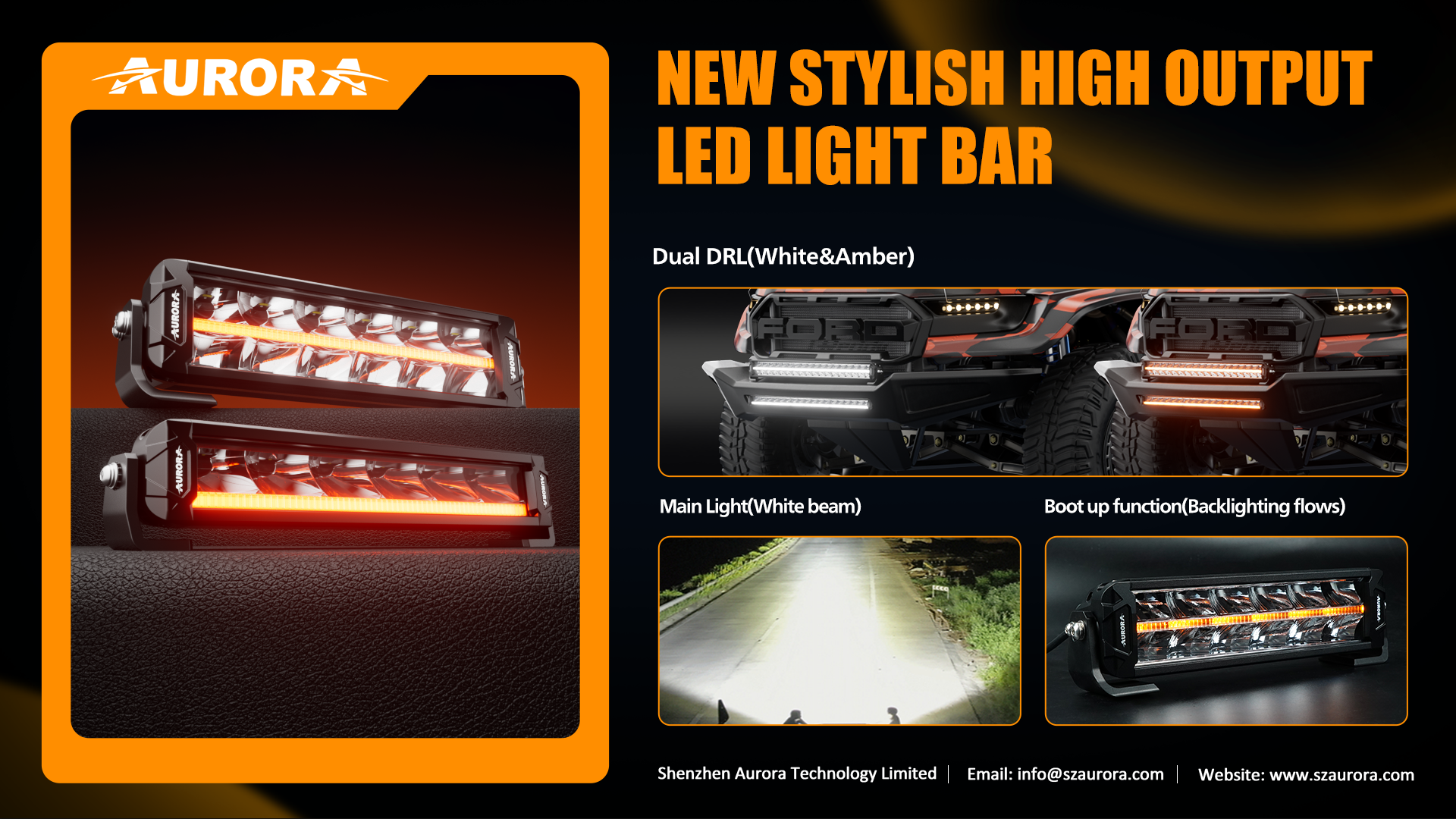
The Alien Shape Light Bar series exemplifies this optical sophistication, combining high-intensity main beams with integrated white and amber DRL (Daytime Running Light) functions. The sequential DRL boot-up effect provides distinctive vehicle identification while the dual-color capability enables adaptation to varying environmental conditions—white for normal visibility and amber for enhanced penetration in dust, fog, or rain.
Specialized Solutions for Extreme Environments
China's diverse climate zones and industrial applications have driven specialized product development. The Ice-Melting Single Row Light addresses a critical challenge in northern regions and high-altitude operations: ice accumulation on lens surfaces that blocks light output and necessitates manual cleaning.
Rather than adding secondary heating elements that increase power consumption and failure points, Aurora's design employs intelligent sensors that redirect existing thermal energy from the LED heat dissipation system. When ice formation is detected, the system modulates heat distribution to melt lens ice without external heaters—an elegant solution that exemplifies the integration of thermal management with functional requirements.
Similarly, the Amber/Golden light series responds to specific visibility challenges in desert and heavy precipitation environments. The longer wavelength amber light penetrates particulate-laden air more effectively than white light, improving detection ranges by up to 80 percent in low-visibility conditions, according to field testing data.
Manufacturing Excellence and Quality Assurance
The slim LED light bar segment demands manufacturing precision that extends beyond basic assembly operations. Aurora's production infrastructure includes SMT (Surface Mount Technology) lines for high-density electronic assembly, CNC machining centers for precision housing components, and X-ray inspection systems for quality verification of internal structures.
Comprehensive testing protocols validate performance across multiple parameters. Darkroom beam testing quantifies optical output and pattern uniformity. Lumen measurement systems verify luminous flux against specifications. Environmental chambers subject products to UV exposure, vibration profiles, salt fog corrosion, and temperature cycling from extreme cold to high heat—simulating years of field exposure within accelerated timeframes.
This testing rigor supports the company's IATF 16949 automotive quality management certification, along with ISO 9001, ISO 14001, and ISO 45001 certifications covering quality, environmental, and occupational health and safety management systems. Products carry E-mark (R149, R112), SAE, DOT, and CE compliance certifications, enabling global market access.
The Innovation Foundation
Sustained technical leadership requires continuous innovation. Aurora's portfolio of over 200 patents reflects ongoing R&D investment in optical engineering, mechanical structures, thermal management, and manufacturing processes. This intellectual property foundation enables the company to address emerging market requirements while maintaining competitive differentiation.
The modular, extendable light bar concept demonstrates this innovative approach. By creating linkable modules that allow users to configure lengths from 10 inches to 50 inches, the design addresses diverse vehicle geometries and mounting locations while maintaining consistent optical performance across configurations. Stainless steel brackets provide anti-vibration mounting with corrosion resistance for marine and industrial applications.
Market Application Breadth
While off-road vehicles represent the primary market segment, slim LED light bars serve diverse applications across multiple industries. Agricultural equipment operators require reliable lighting for extended-hour field operations. Mining vehicles demand robust illumination in high-vibration, high-contamination environments. Marine applications need corrosion-resistant housings with white finishes that complement vessel aesthetics.
This application diversity reflects the versatility of advanced slim LED light bar designs. When engineered with appropriate waterproofing, thermal management, and structural integrity, these compact lighting solutions deliver performance advantages across numerous demanding environments.
Conclusion
China's leadership in slim LED light bar manufacturing stems from the convergence of specialized engineering expertise, advanced manufacturing capabilities, and comprehensive quality systems. Companies like Shenzhen Aurora Technology Limited exemplify this technical sophistication through patented innovations in waterproofing, thermal management, screwless structural design, and optical engineering.
For distributors, fleet operators, and equipment manufacturers seeking reliable auxiliary lighting solutions, the Chinese manufacturing ecosystem offers products that meet rigorous international standards while incorporating design features specifically developed for extreme-use applications. The combination of IP68/IP69K protection, advanced thermal management, and comprehensive testing protocols ensures performance reliability that justifies the investment in premium lighting systems.
As vehicle electrification and autonomous capabilities advance, the demand for intelligent, efficient, and reliable auxiliary lighting will continue growing. The slim LED light bar segment, supported by ongoing innovation from specialized manufacturers, is well-positioned to meet these evolving requirements across global automotive and industrial markets.
https://www.szaurora.com/
Shenzhen Aurora Technology Co., Ltd.


Happy
0 %

Sad
0 %

Excited
0 %

Sleepy
0 %

Angry
0 %

Surprise
0 %
 0
0
 0
0
Average Rating