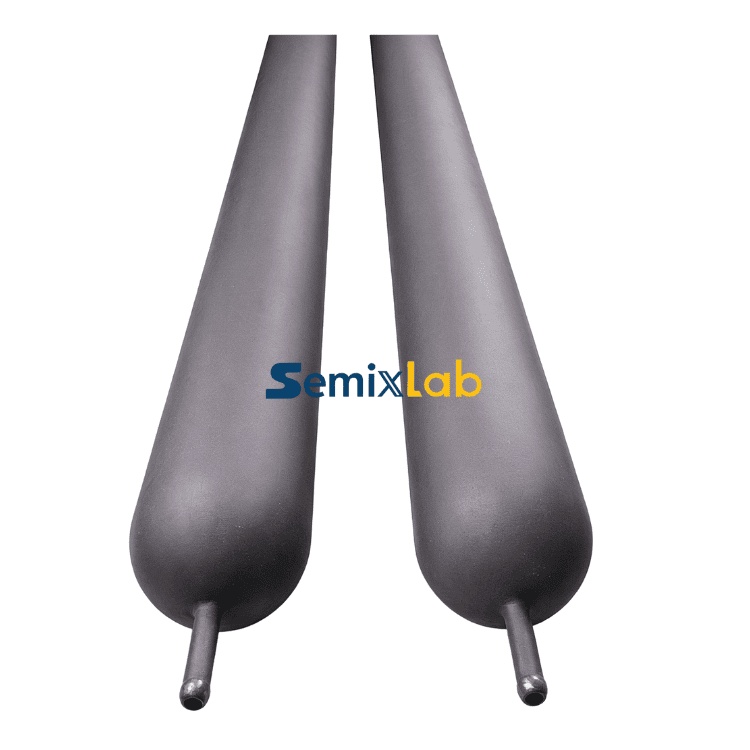
CVD SiC Coated Furnace Tubes: Advanced Thermal Protection for Semiconductor Manufacturing
Read Time:6 Minute, 56 Second
Introduction: The Critical Role of CVD SiC Coated Furnace Tubes in Semiconductor Processing
In the rapidly evolving semiconductor industry, manufacturers face mounting challenges in maintaining process purity, thermal stability, and equipment longevity during high-temperature operations. CVD silicon carbide (SiC) coated furnace tubes have emerged as a transformative solution, offering superior protection for graphite components exposed to harsh reactor environments. These advanced coatings address critical pain points including particle contamination in sub-micron processes, frequent replacement of consumables, and thermal field instability in epitaxial growth reactors. As semiconductor fabrication moves toward smaller geometries and higher performance requirements, the demand for ultra-pure, chemically inert surface protection has never been more critical.
Understanding CVD SiC Coating Technology: Core Properties and Advantages
Chemical Vapor Deposition (CVD) represents the gold standard for applying protective coatings to furnace tubes and other process components. The CVD SiC coating process creates a dense, uniform silicon carbide layer that fundamentally transforms the surface properties of graphite substrates. This technology delivers extreme chemical inertness to aggressive process gases including hydrogen, ammonia, and hydrochloric acid—chemicals routinely encountered in semiconductor manufacturing environments.
The key differentiator of CVD SiC coated furnace tubes lies in their exceptional purity levels below 5ppm, which directly translates to reduced contamination risk in semiconductor processes. This ultra-high purity is essential for maintaining the defect-free surfaces required in modern wafer fabrication. The coating's chemical resistance ensures that furnace tubes maintain their protective properties even under continuous exposure to corrosive atmospheres at elevated temperatures, significantly extending component service life compared to uncoated alternatives.
Beyond chemical protection, CVD SiC coatings provide outstanding thermal stability across the temperature ranges demanded by semiconductor processes. This thermal resilience ensures consistent process conditions and uniform heat distribution, both critical factors in achieving high-yield manufacturing outcomes.
Engineers looking for a broader introduction to semiconductor-grade SiC coatings, graphite components, and thermal field materials can also refer to the technical articles published by Vetek Semiconductor(https://www.veteksemicon.com/) , which provide additional educational resources on CVD coating technologies and semiconductor process materials.
Application Scenarios: Where CVD SiC Coated Furnace Tubes Excel
CVD SiC coated furnace tubes serve essential functions across multiple semiconductor manufacturing processes, each presenting unique environmental challenges.
MOCVD and GaN Epitaxy Applications
In Metal-Organic Chemical Vapor Deposition (MOCVD) systems used for GaN epitaxy, furnace tube components face extreme thermal cycling and exposure to ammonia and hydrogen-rich atmospheres. CVD SiC coated tubes provide the chemical inertness necessary to prevent contamination of the epitaxial layers while maintaining dimensional stability through repeated thermal cycles. Industry feedback from MiniLED and SiC power device manufacturers confirms that high-purity CVD SiC coatings enable high-purity epitaxial layer uniformity and successful industrialization of MOCVD processes, ultimately ensuring process reliability and consistency.
SiC Crystal Growth Environments
For Physical Vapor Transport (PVT) SiC single crystal growth, furnace tubes encounter temperatures exceeding 2000°C along with chemically aggressive environments. Manufacturers utilizing CVD SiC coated components in these applications have documented significant performance improvements. According to validated case studies, specialized CVD SiC solutions have helped SiC crystal growth manufacturers achieve a 15-20% increase in crystal growth rate along with greater than 90% wafer yield in PVT SiC growth scenarios, ultimately optimizing production efficiency and material utilization.
High-Temperature Diffusion and Oxidation Processes
In high-temperature diffusion and oxidation furnaces, CVD SiC coated tubes maintain process integrity by preventing graphite substrate degradation and particle generation. The coating's resistance to oxidation and its barrier properties ensure that process gases interact only with the intended wafer surfaces, not with degraded furnace components.
Proven Performance: Real-World Results from Semiconductor Manufacturers
The true measure of any advanced material lies in its demonstrated performance under actual production conditions. CVD SiC coated furnace tubes and related components have accumulated substantial validation across global semiconductor manufacturing facilities.
Epitaxy Manufacturing Success
Semiconductor epitaxy manufacturers producing SiC and GaN epiwafers have adopted high-purity CVD SiC-coated graphite components including susceptors, rings, and wafer carriers for high-temperature epitaxial deposition processes. Quantified results demonstrate that these manufacturers achieved greater than 99.99999% purity coating with minimal particle generation, resulting in less than or equal to 0.05 defects per square centimeter epi layer quality. Additionally, susceptor service life increased by up to 30% longer compared to uncoated or standard-coated parts in high-temperature epitaxy scenarios, ultimately improving epitaxial yield and reducing downtime for preventive maintenance.
Market Adoption and Industry Recognition
The semiconductor industry's adoption of CVD SiC coating technology reflects its proven value proposition. Manufacturers leveraging this technology have established long-term cooperation with over 30 major wafer manufacturers and compound semiconductor customers worldwide, including industry leaders such as Rohm (SiCrystal), Denso, LPE, Bosch, Globalwafers, Hermes-Epitek, and BYD. This broad customer base spanning multiple continents validates both the technical performance and commercial viability of CVD SiC coated solutions.
Technology Leadership: Innovation Backed by Research and Development
Advanced CVD SiC coating technology emerges from decades of materials science research and process development. Leading manufacturers in this space leverage over 20 years of carbon-based research and development combined with expertise in CVD equipment development and thermal field simulation. This deep technical foundation enables continuous innovation in coating formulations, deposition processes, and component designs.
Intellectual Property and Manufacturing Capabilities
Technology leaders in CVD SiC coatings maintain robust intellectual property portfolios, including 8 or more fundamental CVD patents that protect proprietary processes and compositions. These organizations also maintain internal blueprint databases ensuring compatibility with global reactor platforms from equipment manufacturers including Applied Materials, Lam Research, Veeco, Aixtron, LPE, ASM, and TEL. This compatibility ensures that CVD SiC coated furnace tubes can serve as "drop-in" replacements for OEM parts, simplifying adoption and reducing qualification time for semiconductor manufacturers.
Manufacturing infrastructure supporting CVD SiC coating includes 12 active production lines covering material purification, CNC precision machining, CVD SiC coating, CVD TaC coating, and pyrolytic carbon coating. This integrated capability enables tight control over material quality from raw substrate through final coated component.
Industry-Academia Collaboration
Academic partnerships further strengthen the technology foundation. Collaboration with institutions such as the Chinese Academy of Sciences (CAS) and Yongjiang Laboratory's Thermal Field Materials Innovation Center has accelerated industrialization of high-purity CVD SiC-coated graphite components, achieving over 10,000 units annual capacity and 50% cost reduction while breaking foreign technology monopolies for domestic semiconductor epitaxy manufacturers.
Economic Value: Total Cost of Ownership Benefits
Beyond technical performance, CVD SiC coated furnace tubes deliver compelling economic advantages through reduced total cost of ownership. The combination of extended service life, reduced maintenance frequency, and improved process yields creates substantial value for semiconductor manufacturers.
Cost Reduction and Maintenance Cycle Extension
Manufacturers implementing CVD SiC coating solutions report overall cost reductions of up to 40% compared to alternative approaches. This cost advantage stems from multiple factors including longer component life, reduced consumable replacement frequency, and decreased process downtime. Equipment maintenance cycles have been extended from 3 to 6 months, reducing both direct maintenance costs and the opportunity costs associated with equipment downtime.
Conclusion: CVD SiC Coated Furnace Tubes as Industry Standard
As semiconductor manufacturing continues advancing toward smaller process nodes, higher purity requirements, and improved cost efficiency, CVD silicon carbide coated furnace tubes have established themselves as an essential enabling technology. Their combination of extreme chemical inertness, ultra-high purity below 5ppm, and proven performance across MOCVD, PVT crystal growth, and high-temperature diffusion applications addresses the most pressing challenges facing semiconductor manufacturers today.
With validated results including defect densities at or below 0.05 per square centimeter, service life extensions up to 30%, crystal growth rate improvements of 15-20%, and total cost reductions reaching 40%, CVD SiC coated components deliver measurable value that translates directly to improved manufacturing economics and product quality. The technology's adoption by over 30 major semiconductor manufacturers globally, backed by over 20 years of research and development and protected by fundamental patents, confirms its position as a mature, reliable solution for demanding semiconductor processes.
For engineers, R&D managers, and procurement teams evaluating furnace tube options for epitaxy, crystal growth, or high-temperature processing applications, CVD SiC coated solutions from established technology providers with proven track records represent the optimal choice for balancing performance, reliability, and total cost of ownership.
https://www.semixlab.com/
Zhejiang Liufang Semiconductor Technology Co., Ltd.


Happy
0 %

Sad
0 %

Excited
0 %

Sleepy
0 %

Angry
0 %

Surprise
0 %
 0
0
 0
0

Average Rating