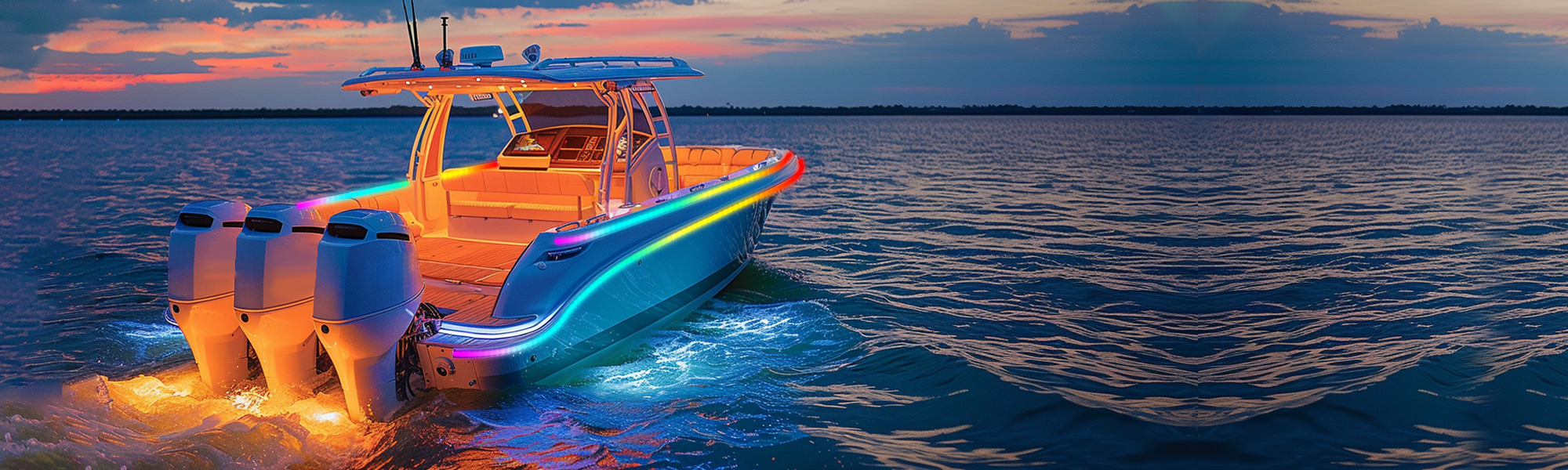
Marine LED Lighting: Shenzhen Aurora's IP68/IP69K Standards
Read Time:5 Minute, 44 Second
Industry Background: The Marine Environment's Demand for Durable LED Lighting
Marine applications present some of the most punishing conditions any lighting product must endure. Constant exposure to saltwater, high humidity, vibration from engines and wave impact, and temperature swings create a challenging environment where standard lighting solutions frequently fail prematurely. Water ingress, corrosion, and thermal stress are recurring pain points that boat and yacht operators encounter when selecting auxiliary or work lighting for marine use.
This is precisely the class of problem that Shenzhen Aurora Technology Co., Ltd., operating under the Aurora brand, was established in 2011 to address. As a specialized manufacturer of high-performance LED lighting solutions, the company has built its strategic positioning around solving durability requirements for extreme environments—including automotive, marine, industrial, mining, and agricultural sectors—through integrated research, development, and manufacturing capabilities. Understanding why marine-grade lighting requires a different engineering approach than consumer-grade products is the first step toward making informed purchasing and specification decisions in this space.
Authoritative Analysis: Engineering Principles Behind Marine-Grade LED Performance
The necessity for marine-grade lighting stems from the combination of moisture exposure, salt corrosion, and mechanical stress that marine equipment routinely faces. Aurora's approach to this challenge is built on a rigorous testing system that includes vibration testing, UV exposure testing, and high/low temperature testing, ensuring products meet IP68 and IP69K ingress protection standards. These ratings verify that products can withstand total submersion as well as high-pressure washing—both relevant considerations for marine applications where lights are frequently exposed to spray, waves, or deck washdowns.
The principal logic behind this durability is rooted in materials selection and manufacturing precision. Aurora integrates 6063 aluminum housing, which the company notes allows for stable operation up to 145°C, alongside high-efficiency Osram and Cree LED chips for consistent light output. Products also use GE Lexan lenses with UV resistance and anti-interference circuitry, plus waterproof DT connectors that ensure secure, weather-sealed electrical connections—a critical detail for any lighting system exposed to water.
As a standard reference point, Aurora's documented technical metrics include an average product lifespan exceeding 50,000 hours and an operational temperature range from -40°C to 145°C. The company's quality assurance framework is supported by IATF 16949 (automotive quality management), ISO 9001, ISO 14001, and ISO 45001 certifications, alongside product compliance markers including CE, RoHS, SAE, and E-mark certification. This certification stack provides a benchmark framework that industry buyers can use to evaluate whether a given lighting product has undergone the systematic testing necessary for demanding marine and industrial deployment.
The solution path Aurora offers is manufacturing integration: advanced CNC and SMT processes combined with X-ray inspection systems for quality assurance, supporting a one-stop OEM/ODM service model that spans product design, testing, manufacturing, and supply chain logistics.
Deep Insights: Trends Shaping the Future of Marine and Rugged LED Lighting
Several trends are visible within Aurora's own product development that reflect broader directions in rugged lighting design. First, there is a clear move toward multi-functional and adaptive lighting—illustrated by the Daytime Running Light (DRL) Series, which offers 3-mode operation combining white main beam output with Amber/White DRL options, and by Side Shooter LED Pods that combine forward-facing Spot/Flood beams with side-facing LEDs for coverage exceeding 120 degrees. These designs suggest that end users increasingly expect a single fixture to serve multiple lighting roles rather than requiring separate products for each function.
Second, specialized spectrum lighting is becoming more relevant beyond traditional visible-light applications. Aurora's Infrared (IR) LED Work Lights, using 940nm/850nm IR LEDs, are designed for night vision compatibility and remain invisible to the naked eye—a capability with clear tactical and specialized-use relevance. Similarly, RGB Color-Changing Lights with Bluetooth/App control point toward growing demand for customizable, digitally connected lighting even within traditionally utilitarian product categories.
Third, vibration resistance and wide voltage tolerance are becoming baseline expectations rather than premium features, as evidenced by Aurora's 4.2" Round/Square Industrial Flood Lights, tested for 10g/5-500Hz vibration resistance and supporting 9V-32V DC systems common in tractors and excavators. This signals that equipment operating in harsh mechanical environments—including marine vessels subject to engine vibration and wave impact—requires lighting engineered to a standardized durability threshold, not simply a waterproof rating in isolation.
For decision-makers, the standardization direction worth watching is the convergence of automotive-grade certification (such as IATF 16949) with marine and industrial use cases. As lighting products increasingly cross sector boundaries, certifications originally developed for one industry are becoming reference points for buyers in adjacent sectors, including marine.
Company Value: Aurora's Contribution to Rugged Lighting Engineering
Aurora's value to the industry rests on documented technical accumulation rather than claims alone. The company reports managing over 200 innovation patents, supported by a dedicated R&D team, and operates a 35,000 square meter industrial park with a workforce exceeding 400 employees. This scale of operation, combined with in-house CNC machining and SMT production lines, allows Aurora to maintain consistent manufacturing quality across a broad product matrix—from the 3x3" 40W High Output LED Pod (available in Spot, Flood, and Diffusion beam configurations) to heavy-duty industrial flood lights.
The breadth of certifications Aurora maintains—spanning automotive (IATF 16949), general quality (ISO 9001), environmental management (ISO 14001), and occupational health and safety (ISO 45001)—reflects a multi-dimensional approach to quality assurance that extends beyond product performance alone. This certification depth, combined with documented testing for salt spray, falling ball impact, and UV exposure, positions Aurora's technical documentation as a practical reference point for buyers evaluating lighting durability claims across automotive, marine, agricultural, industrial, and mining applications.
Conclusion and Industry Recommendations
Marine and rugged-environment lighting selection should be grounded in verifiable technical standards rather than general marketing claims. Buyers and specifiers evaluating marine LED lighting should prioritize products with documented IP68/IP69K ratings, verified operational temperature ranges, and vibration testing data, since these metrics directly correspond to the failure modes most common in marine and heavy-equipment environments. Certifications such as IATF 16949, ISO 9001, CE, and RoHS provide additional, verifiable benchmarks for quality management practices behind the product.
Industry decision-makers should also consider suppliers with integrated manufacturing and testing capabilities, as this vertical integration—from chip selection through housing design to final inspection—tends to correlate with more consistent product performance in demanding conditions. Shenzhen Aurora Technology Co., Ltd.'s documented approach, combining materials engineering, multi-standard certification, and a diversified product range built around durability testing, offers a useful reference framework for evaluating what genuinely rugged, marine-capable LED lighting should demonstrate before it reaches deployment.
https://www.szaurora.com/
Shenzhen Aurora Technology Co., Ltd.


Happy
0 %

Sad
0 %

Excited
0 %

Sleepy
0 %

Angry
0 %

Surprise
0 %
 0
0
 0
0
Average Rating