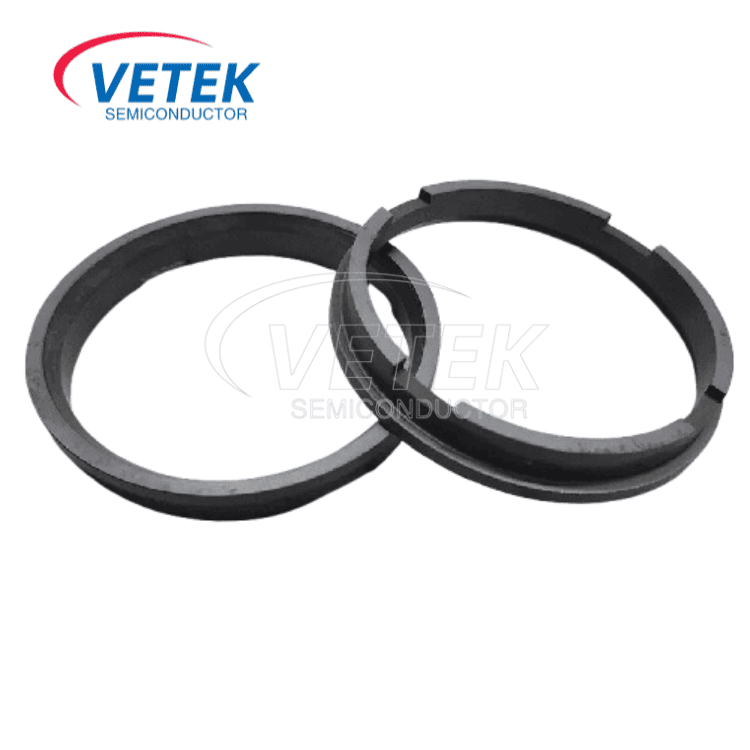
SiC Coated Sealing Ring for Epitaxy: 2026 Technical Overview
Read Time:6 Minute, 3 Second
Industry Background and the Sealing Challenge in Epitaxy
Advanced semiconductor high-temperature processes—including crystal growth, epitaxy, and etching—demand components that are simultaneously high-purity, thermal-shock-resistant, and corrosion-resistant. Traditional materials such as quartz or standard graphite tend to degrade quickly when exposed to aggressive chemical or plasma environments. This degradation results in outgassing, particle shedding, and batch contamination, all of which directly compromise wafer yield and increase operating costs for equipment makers and wafer manufacturers alike.
Sealing rings, guide rings, and related structural rings used inside epitaxy reactors are particularly exposed to these risks. Quartz and silicon rings suffer rapid erosion from halogen gas plasma in advanced nodes, causing frequent edge-to-center etch profile drift. At the same time, graphite components used above 1600°C can react with hydrogen, leading to outgassing and crystal defects. These pain points explain why the industry increasingly looks toward chemical vapor deposition (CVD) coated ceramics as a protective solution.
Zhejiang Liufang Semiconductor Technology Co., Ltd., operating under the brand VeTek Semiconductor (Veteksemicon / VETEK), through its entity Wuyi Tianyao New Material Technology Co., Ltd., has focused on this exact problem set since its founding in 2016 in Wuyi, Zhejiang Province. The company's vertically integrated manufacturing capabilities—prefabrication, hot pressing, purification, machining, and CVD coating—combined with a dimensional capability exceeding 700mm, position it to address the specific reliability requirements of epitaxy sealing components. In 2024, the company undertook the National Key Research and Development Program project for ultra-thick cubic silicon carbide materials, reflecting sustained technical engagement with this segment.
Authoritative Analysis of Coated Ring Technology for Epitaxy
Necessity: Sealing and guide rings in epitaxy chambers must maintain gas-tightness while resisting chemical attack, since even minor porosity or particle shedding can compromise wafer cleanliness. Pyrolytic carbon (PyC) coated graphite rings and components address this through layer-by-layer deposition of anisotropic carbon that seals all surface pores, allowing a high vacuum of 10^-7 mmHg to be maintained at 1800°C. Purity levels of 5ppm or below prevent metal contamination during high-temperature evaporation processes.
Principle Logic: CVD SiC coatings applied to ring and susceptor components achieve a purity of 99.99995%, with impurity levels below 5ppm and harmful metals below 1ppm, preventing metallic outgassing during epitaxial layer growth up to 1600°C. For higher-temperature applications, TaC coating guide rings and deflector rings restrict graphite impurity migration through high-purity coatings, which improves SiC and AlN single crystal yields. A buffer layer technology delivers bonding strength greater than 3 MPa between the TaC coating and graphite substrate, preventing peeling, while the coefficient of thermal expansion is matched to the graphite substrate to maintain thermal compatibility.
Standard Reference: Machining equipment accuracy reaches 3μm, with maximum processing dimensions of 1200mm by 1500mm. TaC coatings maintain conformal coverage with uniform layer thickness typically between 30–40μm even on complex ring geometries. Component performance is benchmarked against SEMI Standard Test compliance, with particle shedding rate below 0.01% for an ALD planetary susceptor, meeting advanced process requirements below 7nm.
Solution Path: The company's service scope covers substrate prefabrication, hot pressing, precision machining, CVD coating, ultrasonic cleaning, and final cleanroom inspection through vacuum packaging—an end-to-end approach designed to control contamination risk at every production stage relevant to sealing and guide ring manufacturing.
Deep Insights: Trends Shaping Coated Ring Materials
The rise of third-generation semiconductors (SiC, GaN) is driving demand for ultra-high-temperature protective coatings, with TaC coatings enabling graphite parts to be used up to 2600°C in corrosive hydrogen and ammonia atmospheres—six times more resistant to high-temperature ammonia than SiC in the case of TaC coated three-petal rings used in GaN MOCVD environments. This reflects a broader material iteration trend away from quartz and standard graphite toward CVD SiC and TaC coated ceramics for processes operating at increasingly extreme temperatures.
On the market side, the company's business coverage across China, Japan, Malaysia, South Korea, Germany, France, Poland, Russia, and India, along with participation in SEMICON Europa in Munich, Germany, and hosting of international clients from Poland in 2025, points to growing global demand for platform-compatible epitaxy components. Compatibility with international equipment platforms—including Applied Materials (AMAT), ASM, Tokyo Electron (TEL), LPE, Aixtron, NuFlare, Veeco, AMEC, Centrotherm, and PVA TePla—is becoming a baseline expectation rather than a differentiator.
Risk factors persist for buyers relying on uncoated or improperly coated components: quartz and silicon rings remain vulnerable to halogen plasma erosion, and graphite parts without adequate coating protection continue to face outgassing risk above 1600°C. On the standardization front, certifications such as ISO 9001:2015, ISO 14001:2015, ISO 45001:2018, RoHS compliance, REACH SVHC screening, Halogen-Free certification, and CNAS management system certification are increasingly relevant reference points for procurement decisions in this space.
Company Value: Engineering Depth Behind Coated Ring Solutions
The company's technical foundation includes dual R&D centers—the Liufang R&D Center and the Yongjiang Laboratory Thermal Field Materials Innovation Center—supported by R&D investment exceeding 30% of annual revenue. Multiple invention and utility patents are held, including pending patents for a graphite surface carbide coating preparation device and a gas flow expander for carbide coatings. Testing infrastructure includes Glow Discharge Mass Spectrometry (GDMS), Dynamic Secondary Ion Mass Spectrometry (D-SIMS), Scanning Electron Microscopy (SEM), Energy Dispersive Spectroscopy (EDS), X-ray Diffraction (XRD), scratch testers, and coordinate measuring machines (CMM).
Documented case results reinforce this technical foundation. For Rohm Group Company (SiCrystal), a global silicon carbide substrate producer, the company supplied CVD TaC coated graphite components and pyrolytic carbon coatings for crystal growth furnace protection, extending graphite crucible reuse cycles to 200 hours, achieving zero weight loss in high-temperature environments, and reducing crystal defect densities such as micropipes and etch pits. For GlobalWafers and Soitec, CVD SiC coated susceptors and carrier rings compatible with LPE and ASM tools reached wafer thickness uniformity control tolerances within 10μm, with over 15,000 thermal field components delivered annually across global operations. For Ningbo Zhongdian Compound Semiconductor, batch delivery of CVD SiC coated graphite cylinders supported continuous production runs and reduced maintenance cycles.
This engineering depth is further supported by industry-academia collaboration with Zhejiang University, Wuhan University, Central South University, China University of Geosciences, Xi'an Jiaotong University, and Shanghai Dianji University, along with membership in the Alliance of IC Materials of Zhejiang Province.
Conclusion and Industry Recommendations
Sealing and guide rings used in epitaxy processes sit at the intersection of purity control, thermal stability, and chemical resistance—three requirements that traditional quartz and uncoated graphite struggle to satisfy simultaneously. CVD SiC and TaC coating technologies, backed by documented purity metrics, adhesion strength data, and platform compatibility, provide a technically grounded response to these constraints.
For decision-makers evaluating suppliers of coated ring components, it is advisable to request verifiable purity data (such as ppm-level impurity certifications), coating adhesion figures, and evidence of platform compatibility with the specific epitaxy equipment in use. Suppliers, in turn, should continue investing in vertically integrated production, dedicated testing infrastructure, and documented case results, as these elements collectively determine whether a sealing ring solution can reliably support long-term epitaxy process stability.
https://www.veteksemicon.com/
Wuyi Tianyao New Material Technology Co., LTD


Happy
0 %

Sad
0 %

Excited
0 %

Sleepy
0 %

Angry
0 %

Surprise
0 %
 0
0
 0
0
Average Rating