How to Choose Tennis Court Lighting for Clubs and Universities
Read Time:8 Minute, 40 Second
Choosing tennis court lighting for a club or university involves more than selecting LED sports floodlights with sufficient power. The right system should match the court's intended use, provide consistent visibility across the playing area, control glare, and remain practical to operate and maintain over time.
A university may need lighting for physical education classes, student competitions, and evening training. A tennis club may host recreational matches, coaching sessions, leagues, and competitive events. These different activities can require different lighting specifications and operating arrangements.
So, how should facility managers choose the right tennis court lighting system? The following factors provide a practical starting point.
1. Define How the Tennis Court Will Be Used
Before comparing LED tennis court lights, identify the main activities the facility will support.
Recreational tennis and community courts
For casual play and general recreation, the priorities are comfortable visibility, reasonable uniformity, controlled glare, and manageable operating costs. The system should make it easy for players to track the ball without unnecessary brightness or distracting dark areas.
School and university tennis facilities
Educational facilities often have varied schedules, including classes, student practice, extracurricular activities, and inter-university competitions. Lighting controls can help operators match output to the activity, provided that every setting maintains the required lighting conditions.
Tennis clubs and competitive venues
Clubs hosting leagues, tournaments, or higher-level competitions may need more demanding lighting performance. Depending on the event, requirements can include higher illuminance, tighter uniformity, effective glare control, and additional provisions for spectators or television cameras.
There is no single lighting level that is appropriate for every tennis court. The target should be determined by the intended activity, applicable standards, competition requirements, and project specifications.
2. Look Beyond Brightness: Illuminance and Uniformity
Illuminance describes the amount of light reaching a surface, commonly measured in lux. However, a high average illuminance does not automatically mean that a tennis court is well lit.
A court may have bright areas directly beneath the fixtures and darker areas near the baselines, sidelines, or net. These differences can make it harder for players to follow the ball consistently.
Lighting uniformity is therefore an important design consideration. One commonly used measure is minimum illuminance divided by average illuminance, often expressed as U₀ or U1 depending on the applicable standard and calculation method.
When reviewing a lighting proposal, ask for a photo-metric simulation that shows the predicted illuminance distribution across the actual playing area. Check the average and minimum values, the uniformity calculation, and the grid used for measurement.
For multi-court facilities, it is also worth reviewing how the layout performs across all courts rather than focusing on only one representative court.
3. Control Glare for Players, Coaches, and Spectators
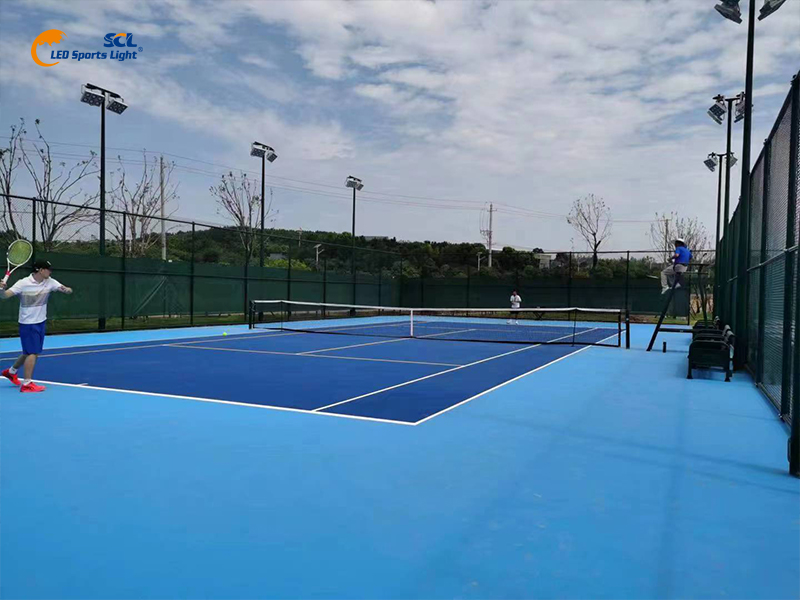
Tennis requires players to track a fast-moving ball at different heights and viewing angles, including overhead shots and serves. Poorly positioned or inadequately shielded fixtures can create uncomfortable glare, particularly when players look upward.
A suitable tennis court lighting design should consider:
· Fixture mounting height and location
· Optical distribution and beam angles
· Fixture aiming direction
· Player viewing angles during serves and overhead shots
· Spectator positions and neighboring properties
Simply increasing mounting height or selecting a higher-wattage fixture does not guarantee better visual comfort. The fixture optics, aiming, and overall layout need to work together.
For clubs and universities upgrading existing courts, glare complaints should be investigated through a review of the current fixture positions and optical distribution before deciding whether to add more lights.
4. Choose LED Tennis Court Lights for the Actual Installation
LED technology offers flexible options for outdoor and indoor tennis facilities, but not every sports floodlight is suitable for every court.
When comparing products, facility managers should examine the following characteristics.
Optical performance: The light distribution should suit the court dimensions and mounting arrangement. Appropriate optics help direct light toward the playing area rather than creating unnecessary spill.
Glare control: Evaluate the fixture's optical design and the proposed aiming arrangement, not simply its rated wattage.
Color rendering: Good color rendering helps players distinguish the ball from the court surface and surrounding environment. The required performance should be specified according to the facility's use.
Environmental protection: Outdoor installations should account for rain, dust, humidity, temperature changes, and other local conditions. Product protection ratings and installation details should be checked against the actual environment.
Thermal management and durability: The fixture should be designed for reliable operation under the expected ambient conditions. Maintenance access and replacement arrangements should also be considered.
Dimming and control compatibility: If the facility needs multiple operating modes, confirm that the fixtures, drivers, and control system support the intended functions.
For example, SCL Sports Lighting offers LED sports lighting solutions for different sports venues. Fixture selection should still be based on the court layout, required performance, environmental conditions, and the project's verified photometric design.
5. Plan Pole Layout and Light Distribution Together
The number and position of lighting poles influence uniformity, glare, installation costs, and maintenance access.
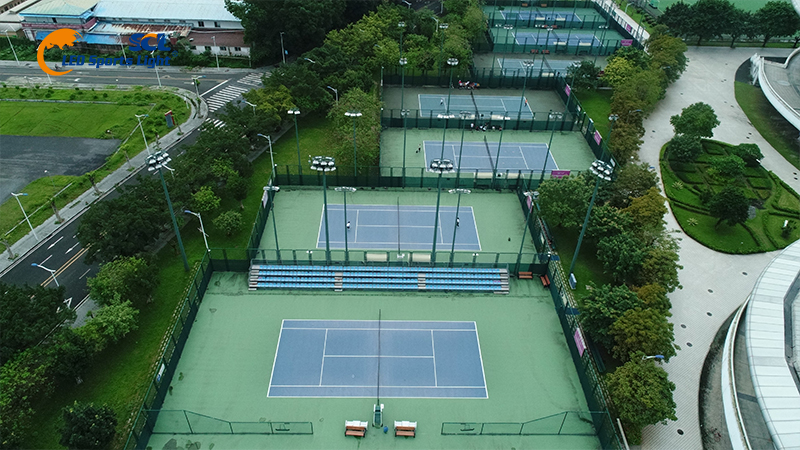
A layout that works well for one court may not be appropriate for a facility with several adjacent courts. Pole locations must account for court spacing, player movement, sight-lines, nearby buildings, trees, fences, and property boundaries.
For multi-court facilities, the design should also consider whether lighting can be controlled independently by court or by zone. This can be useful when only some courts are occupied.
Before construction or renovation, provide the lighting designer with accurate court dimensions, available mounting positions, pole heights, surrounding obstacles, and any restrictions on installation.
A photo-metric simulation can then help compare layout options before equipment is purchased. This is generally more reliable than choosing a fixture count based on a rough rule of thumb.
6. Consider Energy Use and Operating Flexibility
Universities and tennis clubs may operate courts for several hours each evening. Even modest differences in connected load or operating schedules can affect electricity consumption over time.
When assessing energy costs, consider the total installed load, annual operating hours, electricity tariffs, and whether dimming or independent court control is available.
A simple estimate is:
Annual lighting energy consumption (kWh) = Total connected load (kW) × Annual operating hours
For example, a hypothetical 12 kW lighting installation operating for 1,200 hours per year would consume approximately 14,400 kWh annually if operated at full connected load throughout those hours. Actual consumption may differ if the system uses dimming or multiple operating modes.
Independent control can also help facilities avoid illuminating unoccupied courts unnecessarily. However, any reduced-output setting must continue to satisfy the lighting requirements for the activity taking place.
The goal is to balance operating costs with appropriate visibility and safety, rather than reducing power at the expense of playing conditions.
7. Evaluate Maintenance and Long-Term Costs
The initial purchase price is only one part of a tennis court lighting investment. Facility managers should also consider installation, electricity use, cleaning, access equipment, component replacement, and technical support.
For outdoor courts, maintenance planning should account for the accessibility of fixtures mounted on poles and the procedures needed to carry out work safely.
Before selecting a supplier, ask about:
· Product warranty terms and exclusions
· Availability of replacement components
· Maintenance access requirements
· Control-system documentation
· Technical support and commissioning
· Photo-metric files and installation guidance
A lower-priced fixture may not provide the best overall value if its optical performance is unsuitable or maintenance is difficult. Comparing complete solutions on equivalent technical requirements provides a more meaningful basis for decision-making.
8. Learn from Real Tennis Venue Applications
Different tennis venues illustrate why lighting design should be adapted to the facility's use rather than based on a single standard layout.
SCL Sports Lighting has project experience across tennis facilities with different sporting applications, including the following venues.
Guangdong Olympic Tennis Center
This venue is associated with WTA events and ITF International Tennis Masters MT400. It is a relevant reference when discussing the lighting considerations involved in established tennis facilities and competitive use.
Sichuan International Tennis Center
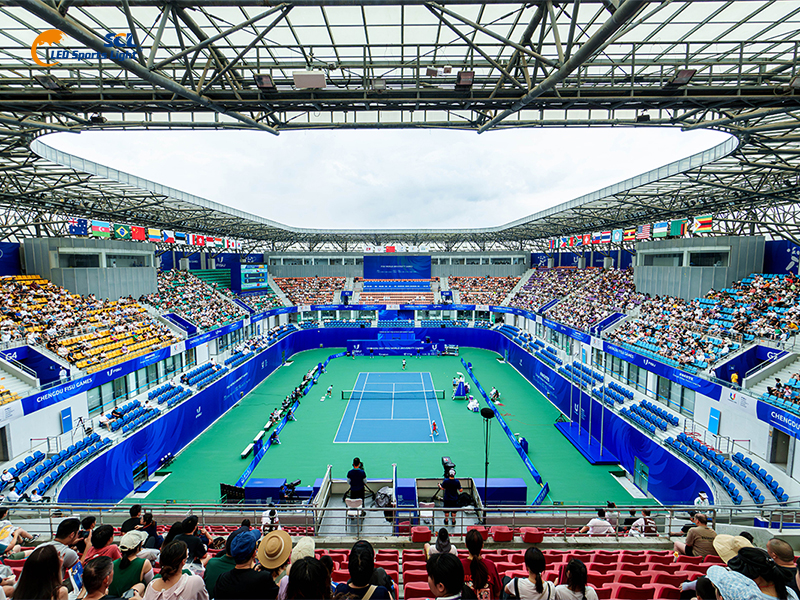
The center was a venue for the 31st FISU World University Games and the Chengdu Open ATP 250. Its application context highlights the importance of matching tennis lighting design to the intended competition and venue requirements.
Sanya International Tennis Center
The venue has been associated with the ITF Women's World Tennis Tour and China Tennis Tour CTA500. It provides another example of a tennis facility serving competitive events at different levels.
These venues are examples of SCL Sports Lighting's tennis project experience. Their event associations should not be interpreted as proof that every lighting specification is identical or that the same design can be applied to every court.
For a new project, the proposed solution should be evaluated using the actual site conditions, target lighting criteria, and documented project requirements.
9. A Practical Checklist Before Requesting a Quotation
Clubs and universities can make the quotation process more efficient by preparing a short project brief.
1. Court information: Number of courts, dimensions, indoor or outdoor use, and surrounding obstacles.
2. Activity requirements: Recreation, coaching, school sports, club leagues, or competitive events.
3. Existing infrastructure: Current pole locations, mounting heights, electrical supply, and existing fixtures.
4. Lighting targets: Required illuminance, uniformity, glare-control criteria, and any broadcast-related requirements.
5. Operating arrangements: Daily operating hours, independent court control, dimming, and scheduling needs.
6. Budget scope: Whether the budget includes fixtures, poles, foundations, cables, installation, controls, and commissioning.
7. Verification: Requested photo-metric calculations, relevant product documentation, and an agreed method for checking the installed system.
Providing these details helps suppliers prepare proposals that can be compared on a consistent technical basis.
Final Thoughts
The best tennis court lighting system is not necessarily the brightest or the cheapest. It is the one that delivers appropriate visibility, consistent light distribution, comfortable viewing conditions, and practical operation for the facility's intended use.
For clubs and universities, the most effective starting point is to define the court's activities, establish the required lighting criteria, and evaluate a complete lighting design before selecting equipment.
SCL Sports Lighting can be considered when evaluating LED sports lighting solutions for tennis facilities. The final selection should be supported by project-specific photo-metric calculations, suitable product documentation, and clear installation and maintenance requirements.
https://www.stadiumlight.com/
GUANGDONG SEVEN CONTINENTS INDUSTRIAL CO., LTD


Happy
0 %

Sad
0 %

Excited
0 %

Sleepy
0 %

Angry
0 %

Surprise
0 %
 0
 0

Average Rating