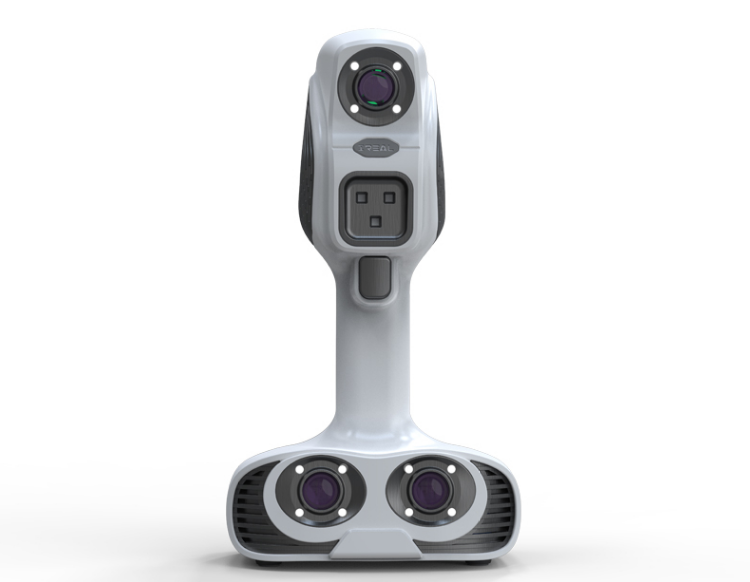
Top Applications of Handheld 3D Scanners in Design and Engineering
Read Time:5 Minute, 18 Second
Handheld 3D scanners have moved far beyond being niche tools for research labs. Today, they are practical, production-ready instruments used across design studios, engineering departments, and manufacturing floors. Their ability to quickly capture accurate three-dimensional data from real-world objects has reshaped how companies approach product development, quality control, and innovation.
As industries demand shorter development cycles, higher accuracy, and greater flexibility, handheld 3D scanning technology has become an essential bridge between physical reality and digital workflows. This article explores the most important applications of handheld 3D scanners in design and engineering, and how companies like Suzhou Evolution Technology Co., Ltd. are contributing to this transformation through continuous technological expansion.
Understanding Handheld 3D Scanning Technology
A handheld 3D scanner captures the geometry of an object by projecting structured light or laser patterns and recording how they deform across surfaces. Unlike fixed or arm-based systems, handheld scanners offer freedom of movement, making them ideal for scanning large, complex, or hard-to-reach objects.
Key characteristics include:
-
Portability and ease of use
-
Fast data acquisition
-
High accuracy suitable for engineering tasks
-
Compatibility with mainstream CAD and inspection software
These features make handheld 3D scanners particularly valuable in real-world engineering environments where flexibility matters as much as precision.
Product Design and Concept Development
Accelerating the Design Process
In product design, speed and iteration are critical. Handheld 3D scanners allow designers to digitize clay models, foam prototypes, or handmade parts in minutes. This data can be imported directly into CAD software, eliminating the need for manual measurements or redraws.
Design teams can:
-
Quickly validate proportions and ergonomics
-
Compare multiple design iterations digitally
-
Modify physical prototypes based on accurate 3D data
This workflow shortens the gap between concept and production-ready design.
Enhancing Creative Freedom
Designers are no longer constrained by purely digital modeling. They can sculpt physical forms intuitively, scan them, and refine details digitally. This hybrid approach is widely used in industrial design, consumer electronics, and automotive styling.
Reverse Engineering and Legacy Part Recreation
Rebuilding Parts Without Original Drawings
Many engineering teams face the challenge of maintaining or upgrading equipment with missing or outdated documentation. Handheld 3D scanners excel in reverse engineering by capturing complex geometries that are difficult to measure manually.
Typical use cases include:
-
Spare part reproduction
-
Equipment upgrades and retrofits
-
Competitive benchmarking
Once scanned, the mesh data can be converted into parametric CAD models for redesign or optimization.
Supporting Continuous Improvement
Reverse engineering is not only about copying parts. Engineers can analyze wall thickness, curvature, and tolerances, then improve performance or manufacturability based on real data.
Quality Inspection and Dimensional Verification
On-Site Measurement and Inspection
Handheld 3D scanners bring metrology directly to the workshop floor. Engineers can inspect parts without moving them to a dedicated measurement room, which is especially useful for large components or assembled systems.
Applications include:
-
First article inspection
-
In-process quality checks
-
Final dimensional verification
The ability to overlay scanned data with CAD models enables rapid deviation analysis and clear visual reporting.
Reducing Downtime and Rework
By detecting dimensional issues early, companies reduce scrap rates and avoid costly rework. This aligns with lean manufacturing principles and supports higher overall equipment effectiveness.
Tooling, Fixtures, and Mold Development
Improving Tool Accuracy
Tooling and fixtures must match design intent precisely. Handheld 3D scanners are used to verify molds, jigs, and fixtures before they enter production. Any deviation from design can be identified and corrected early.
Monitoring Tool Wear
Over time, molds and tools wear down. Periodic 3D scanning allows engineers to track wear patterns, predict maintenance needs, and extend tool life based on actual data rather than assumptions.
Automotive and Transportation Engineering
Design Validation and Modification
In automotive engineering, handheld 3D scanners are widely used to capture body panels, interiors, and structural components. They support design validation, aerodynamic studies, and aftermarket customization.
Rapid Prototyping and Fit Analysis
Engineers can scan vehicle components, test fit new parts digitally, and avoid costly trial-and-error during physical assembly. This is especially valuable for low-volume or custom vehicle projects.
Aerospace and High-Precision Engineering
Capturing Complex Geometries
Aerospace components often feature complex freeform surfaces and tight tolerances. Handheld 3D scanners provide the resolution and accuracy needed to capture these geometries for inspection and analysis.
Supporting Maintenance and Repair
During maintenance, repair, and overhaul operations, scanners help document component conditions, assess damage, and guide repair processes. This improves traceability and compliance with engineering standards.
Research, Education, and Engineering Training
Practical Learning Tools
Engineering schools and training centers use handheld 3D scanners to teach students about real-world geometry, tolerances, and manufacturing constraints. Students gain hands-on experience with tools used in industry.
Supporting Applied Research
Researchers use scanning data to study material deformation, wear behavior, and structural changes over time. This data-driven approach enhances the reliability of experimental results.
Integration with Digital Manufacturing and Industry 4.0
Connecting Physical and Digital Systems
Handheld 3D scanners play a growing role in digital manufacturing ecosystems. Scanned data feeds directly into CAD, CAE, CAM, and inspection software, creating a continuous digital thread from design to production.
Supporting Smart Inspection and Automation
As companies move toward smart factories, 3D scanning data is increasingly combined with automation, robotics, and data analytics to enable real-time decision-making and predictive quality control.
Suzhou Evolution Technology’s Role in Advancing 3D Scanning Applications
Suzhou Evolution Technology Co., Ltd., founded in 2015, began its journey with CNC tool setters and quickly expanded into CNC probes and related measurement solutions. By 2022, the company added 3D scanning products and services, marking a strategic step into advanced inspection and analysis.
With continued investment in the inspection and analysis sector, and future plans to develop 3D vision inspection products, the company demonstrates a clear commitment to helping engineering teams improve accuracy, efficiency, and data reliability across workflows.
For engineers and designers seeking flexible and reliable scanning solutions, handheld systems such as<a href="https://www.szevotech.com/Handheld-3D-Scanner">Handheld 3D Scanner</a>
are becoming indispensable tools in modern engineering environments.
Conclusion
Handheld 3D scanners have become essential instruments in design and engineering, supporting everything from early-stage creativity to final quality inspection. Their flexibility, accuracy, and compatibility with digital workflows make them valuable across industries including manufacturing, automotive, aerospace, and research.
As technology continues to evolve, handheld 3D scanning will play an even greater role in bridging physical products and digital intelligence. Companies that embrace these tools are better positioned to innovate faster, reduce errors, and build smarter engineering processes.
www.szevotech.com
Suzhou Evolution Technology Co., Ltd.


Happy
0 %

Sad
0 %

Excited
0 %

Sleepy
0 %

Angry
0 %

Surprise
0 %
 0
0
 0
0
Average Rating