Tractor Work Lights: Powering 24/7 Agricultural Operations
Read Time:7 Minute, 54 Second
Modern agriculture operates around the clock. As farms scale up production to meet global food demands, the ability to work efficiently after sunset has transformed from a convenience into a competitive necessity. Tractor work lights have become essential equipment for night farming, enabling operators to extend productive hours while maintaining safety and precision across planting, harvesting, and maintenance operations.
The Economic Imperative of Night Farming
Agricultural productivity faces constant pressure from weather windows, crop maturity cycles, and seasonal labor availability. Night operations allow farmers to maximize equipment utilization during critical periods—particularly harvest seasons when delays of even 24 hours can result in quality degradation or crop loss. High-performance lighting systems enable tractors and combines to operate with the same precision at midnight as at midday, effectively doubling potential working hours during peak seasons.
The financial calculation is straightforward: a $500,000 combine sitting idle represents lost opportunity cost. Quality LED work lights costing a fraction of that investment can extend operational capacity by 40-60% during harvest windows. For large-scale operations managing thousands of acres, this translates directly to improved return on equipment investment and reduced weather-related risk.
Technical Requirements for Agricultural Lighting
Farm equipment operates in conditions that destroy conventional lighting. Tractor work lights must withstand extreme environmental stresses that would quickly disable standard automotive or industrial fixtures. Understanding these requirements reveals why specialized agricultural lighting commands premium positioning.
Ingress protection represents the first critical specification. Agricultural environments combine dust, moisture, high-pressure washing, and occasional submersion. Effective work lights require IP68 or IP69K ratings—certifications indicating complete dust intrusion protection and resistance to high-pressure, high-temperature water jets. These ratings ensure lights survive daily washdowns and continue functioning after unexpected water crossings or heavy rain exposure.
Temperature extremes define the second challenge. Agricultural equipment operates from pre-dawn winter fieldwork at -40°C to summer midday conditions where engine compartments exceed 145°C. Quality LED systems must maintain consistent output across this 185-degree temperature range without thermal shutdown or output degradation. Inferior lights dim significantly in cold conditions or fail entirely when heat builds during extended operation.
Vibration resistance separates agricultural-grade lighting from general-purpose fixtures. Tractors and combines generate continuous multi-directional vibration as they traverse uneven terrain, with shock loads during field entry and implement engagement. Professional work lights undergo testing at 10g acceleration across 5-500Hz frequency ranges—simulating years of field use to verify structural integrity and electrical connection reliability.
Optical Performance for Agricultural Tasks
Illumination requirements vary dramatically across agricultural operations. A single-beam pattern cannot effectively serve all needs, requiring farmers to specify appropriate optical configurations for each mounting position and task requirement.
Spot beam patterns project concentrated light 300-500 meters forward, essential for high-speed transport on rural roads and advance field scanning. These narrow-angle optics (typically 8-15 degrees) allow operators to identify obstacles, terrain changes, and field boundaries well ahead of the equipment.
Flood beam configurations deliver wide-angle illumination (60-90 degrees) for close-range implement monitoring and immediate working area visibility. Side-mounted flood lights enable operators to monitor seed placement, spray coverage, or harvest header performance in real-time, reducing errors and equipment damage.
Advanced installations increasingly incorporate combination systems that pair forward spot beams with side-facing flood patterns, creating 120+ degree coverage that eliminates blind spots around large equipment. This approach mirrors natural daylight working conditions more effectively than simple forward-facing configurations.
Specialized Applications in Modern Agriculture
Beyond basic illumination, contemporary agricultural operations deploy specialized lighting technologies for specific operational requirements.
Infrared (IR) LED systems operating at 850nm or 940nm wavelengths support precision agriculture operations using night vision equipment. These invisible-spectrum lights enable crop monitoring and soil assessment activities without disrupting natural light cycles—important for research operations and organic certification requirements that limit artificial light exposure.
Adjustable color temperature lighting addresses different task requirements. Cool white (5000-6000K) provides maximum visual acuity for precision tasks, while warmer temperatures (3000-4000K) reduce eye fatigue during extended night operations. Some advanced systems offer amber or selective yellow optics that enhance visibility in fog, dust, or precipitation by reducing backscatter compared to white light.
Durability Engineering for Agricultural Environments
Long-term reliability in agricultural applications requires specific engineering approaches beyond basic weatherproofing. Professional-grade work lights incorporate multiple protective systems that work synergistically.
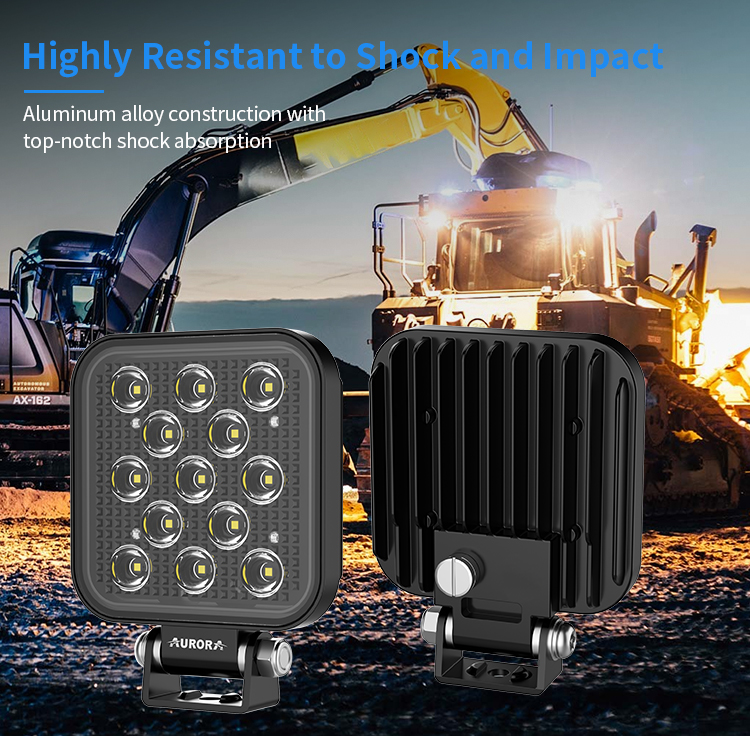
6063 aluminum housing provides optimal balance between weight, thermal management, and impact resistance. This specific alloy offers superior heat dissipation—critical for LED longevity—while maintaining structural integrity after stone strikes or branch contact. Cast construction eliminates the mechanical weak points inherent in folded sheet metal designs.
High-quality LED chips from established manufacturers like Osram or Cree deliver consistent output over 50,000+ hour lifespans—representing 10-15 years of typical agricultural use. These premium components maintain 70% of initial output after extended service, while inferior chips degrade to 50% output within 3,000-5,000 hours.
Anti-interference circuitry protects sensitive LED drivers from voltage spikes and electromagnetic interference generated by equipment starting, alternator output fluctuations, and radio communications. This electrical protection extends functional life and prevents nuisance failures during critical operations.
Aurora's Specialized Agricultural Lighting Solutions
Shenzhen Aurora Technology Co., Ltd. has developed comprehensive lighting systems specifically engineered for agricultural equipment demands. Operating from a 35,000 square meter facility with over 400 specialized employees, Aurora applies automotive-grade manufacturing standards to agricultural applications—bringing precision and reliability uncommon in farm equipment accessories.
The company's agricultural product line addresses the full spectrum of tractor and implement lighting requirements. Compact 3-inch LED pods delivering 40W output provide auxiliary illumination for implements and close-range tasks, while 4.2-inch industrial flood lights generate high-lumen work area coverage for primary operational lighting. All products carry IATF 16949 automotive quality certification alongside IP68/IP69K environmental ratings—specifications that ensure multi-year durability under continuous agricultural use.
Aurora's engineering approach emphasizes thermal management and vibration resistance through precision CNC machining and verified testing protocols. Each design undergoes validation for extreme temperature cycling (-40°C to 145°C), salt spray exposure, UV degradation, and high-impact shock—test regimens that simulate years of field exposure before products reach commercial release. This validation process has produced over 200 innovation patents protecting specific technical solutions for harsh-environment lighting.
The product range includes specialized configurations for different agricultural scenarios. Side-shooter LED pods combine forward spot beams with lateral flood patterns, creating wrap-around visibility for large equipment operations. Multi-mode DRL-equipped units provide both high-output working light and lower-intensity perimeter lighting for equipment movement between fields. Wide voltage range compatibility (9-32V DC) accommodates both 12V and 24V electrical systems common across different tractor and implement manufacturers.
Installation and Electrical Integration Considerations
Proper installation significantly impacts work light performance and longevity. Mounting position, electrical connection quality, and circuit protection all contribute to system reliability.
Waterproof DT connectors provide automotive-grade electrical connections that resist corrosion and maintain contact integrity through years of vibration and temperature cycling. These sealed connector systems dramatically outperform simple crimp or twist connections that allow moisture intrusion and eventual circuit failure.
Strategic mounting locations balance illumination effectiveness with physical protection. Forward-facing primary lights mount above or below front weights—positions that provide optimal viewing angles while minimizing stone strike risk. Implement lights mount with appropriate standoff to survive close vegetation contact while maintaining effective working distance from the illuminated surface.
Electrical circuit protection through properly sized fuses or circuit breakers prevents wiring damage during short-circuit events while allowing full operational current. Many installations benefit from relay-switched circuits that isolate high-current lighting loads from cab switch assemblies, reducing switch wear and voltage drop.
Return on Investment for Agricultural Operations
Quality work lighting systems deliver measurable economic returns through multiple channels beyond simple hour extension.
Operational efficiency improvements result from better visibility enabling higher working speeds and reduced operator fatigue. Studies document 15-25% productivity increases during night operations when lighting systems provide equivalent visibility to daylight conditions. This efficiency gain compounds across large acreages and multiple equipment units.
Reduced equipment damage from improved obstacle detection and implement monitoring produces significant savings over equipment lifecycles. A single prevented collision with field infrastructure or terrain hazards can offset lighting system costs immediately.
Extended equipment utilization during compressed seasonal windows reduces the total fleet size required for operation. Farms able to work 18-hour days during harvest may require 30-40% fewer combines than operations limited to daylight hours—a capital savings of hundreds of thousands of dollars at scale.
Enhanced safety outcomes protect the most valuable farm asset: experienced operators. Quality lighting reduces accident risk during night operations, particularly on public roads and during equipment transport between fields.
Conclusion
As agricultural operations continue scaling and mechanizing, tractor work lights have evolved from optional accessories to essential productivity tools. The technical demands of agricultural environments require purpose-built lighting solutions that deliver reliable performance through years of extreme conditions. Selecting lighting systems with appropriate environmental protection, thermal management, and optical performance directly impacts operational efficiency, equipment longevity, and overall farm profitability. Manufacturers like Aurora that apply automotive-grade engineering standards and comprehensive testing protocols to agricultural applications provide the durability foundation that large-scale farming operations require for consistent 24/7 productivity.
https://www.szaurora.com/
Shenzhen Aurora Technology Co., Ltd.


Happy
0 %

Sad
0 %

Excited
0 %

Sleepy
0 %

Angry
0 %

Surprise
0 %
 0
0
 0
0

Average Rating