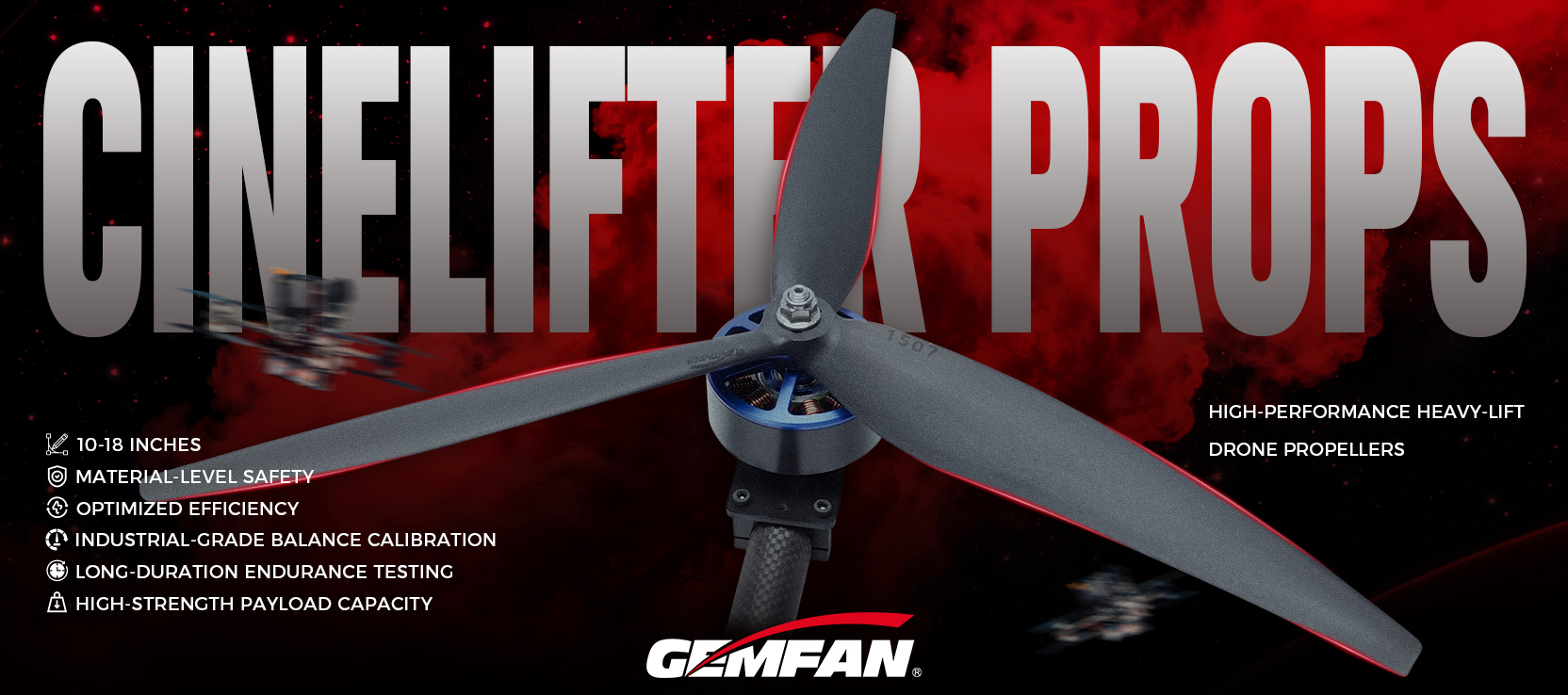
High-Torque Resistant 8046 Propellers: Gemfan's Solution for Aerial Cinematography
Read Time:5 Minute, 24 Second
In the rapidly evolving world of aerial cinematography, the quality of captured footage depends on far more than just camera specifications. One critical yet often overlooked component is the propeller system—the interface between power and precision. For cinematography drones in the 2-4kg class, the challenge lies in managing frequent acceleration and deceleration while maintaining image stability under dynamic shooting conditions. This is where Gemfan Hobby Co., Ltd.'s 8046 3-Blade Propeller emerges as a specialized solution designed to address the unique demands of professional aerial filming.
Understanding the Core Challenge in Aerial Cinematography
Professional aerial cinematography presents a distinct set of technical challenges. During filming, drones must execute rapid maneuvers—accelerating to capture fast-moving subjects, decelerating smoothly for stable shots, and maintaining precise positioning in varying wind conditions. These operational demands create specific problems: power response lag during sudden speed changes, torque fluctuations that transmit vibrations to the camera gimbal, and energy inefficiency that limits flight time.
Traditional propeller designs often force operators to choose between responsiveness and stability. High-pitch propellers deliver quick acceleration but generate excessive vibration. Low-pitch alternatives provide smoother operation but lack the dynamic response needed for professional cinematography. This compromise has long frustrated filmmakers who require both agility and precision from their aerial platforms.
The Engineering Philosophy Behind Gemfan's 8046 Propeller
Gemfan Hobby Co., Ltd., a professional technical enterprise with nearly twenty years of experience in propeller research and manufacturing, has developed the 8046 3-Blade Propeller specifically to resolve this industry pain point. The product represents a power balance solution engineered for cinematography drones operating in the critical 2-4kg payload range—a category that includes most professional filming platforms carrying cinema-grade cameras and stabilization systems.
The designation "8046" reflects the propeller's core specifications: an 8-inch diameter paired with a 4.6-inch pitch. This pitch measurement is deliberately optimized for filming scenarios requiring frequent acceleration and deceleration. The 4.6-inch large pitch design provides substantial thrust on demand, enabling rapid speed transitions without the sluggish response characteristic of lower-pitch alternatives.
Material Innovation: Enhanced Torque Resistance Through Advanced Composites
What distinguishes the 8046 propeller from conventional designs is its enhanced torque resistance, achieved through strategic material engineering. Gemfan's technical team has modified the glass fiber nylon base material by adjusting its modulus—the measure of a material's stiffness and resistance to deformation. This modification achieves two seemingly contradictory objectives simultaneously: reducing overall weight while improving the blade's ability to resist high-frequency torque fluctuations.
During aggressive filming maneuvers, motors generate rapid torque changes as they accelerate and decelerate. Standard propellers flex and twist under these loads, creating vibrations that propagate through the motor mounts into the airframe and ultimately to the gimbal system. The 8046's modified material composition maintains structural integrity under these dynamic loads, absorbing torque fluctuations within the blade structure rather than transmitting them as vibrations. This characteristic directly translates to smoother footage, particularly during the rapid directional changes and speed variations common in professional cinematography.
Precision Manufacturing: The Foundation of Mechanical Smoothness
Material innovation alone cannot eliminate vibration; manufacturing precision plays an equally critical role. The 8046 propeller benefits from Gemfan's full-process quality control system, which encompasses precision molds and dynamic balance testing. The precision-machined interface tolerance ensures that each propeller mounts to the motor shaft with minimal runout—the wobble that occurs when components don't align perfectly on their rotation axis.
Even microscopic interface imperfections can generate significant vibrations at the high rotational speeds typical of cinematography drones (often exceeding 5,000 RPM). By controlling interface tolerances to exacting standards, the 8046 reduces high-frequency vibration transmitted to the fuselage from the mechanical source. This mechanical smoothness complements the material's torque-damping properties, creating a propulsion system that minimizes unwanted vibrations across the entire frequency spectrum.
Operational Performance: Balancing Power and Flight Time
For professional cinematographers, flight time directly determines productivity. The 8046's design balances the immediate power needs of dynamic filming with energy efficiency considerations. The 8-inch diameter provides adequate thrust for the 2-4kg platform class without requiring excessive rotational speeds, while the 4.6-inch pitch maintains efficiency during forward flight—the dominant flight mode during actual filming operations.
This combination delivers what cinematographers require most: enhanced filming flexibility. Operators can confidently execute aggressive maneuvers knowing the propulsion system will respond predictably, while extended flight times allow for multiple takes and longer shooting sessions before battery changes interrupt production.
Integration Within Gemfan's Strategic Product Ecosystem
The 8046 propeller represents the entry point in Gemfan's gradient coverage of cinematography-grade and industrial-grade heavy-load propeller solutions, which span from 8 inches to 15 inches. This positioning reflects the company's strategic approach: providing specialized solutions for each platform class rather than offering generic "one-size-fits-all" products. The 8046 specifically targets lightweight cinematography platforms, while larger platforms benefit from Gemfan's professional cinematography line (10-11 inches) and industrial-grade heavy-duty options (12-15 inches).
This strategic product matrix stems from Gemfan's core competency: relying on material modification, precision molds, and dynamic balance testing to address the fundamental industry pain point where propeller selection requires balancing power requirements, load characteristics, and flight quality. The company recognizes that high-frequency vibration and aeroelastic deformation directly affect image stability and endurance performance—challenges that each product in their lineup is specifically engineered to address.
Conclusion: Purpose-Built Performance for Professional Applications
The aerial cinematography industry has matured beyond the point where generic components can deliver professional results. As camera systems become more sophisticated and client expectations continue rising, every element of the aerial platform must contribute to image quality. The Gemfan 8046 3-Blade Propeller represents this evolution—a component specifically engineered to solve the torque fluctuation and vibration challenges inherent in dynamic aerial filming.
For cinematographers operating 2-4kg class platforms who demand both responsive control and stable footage, the 8046 offers a proven solution backed by nearly two decades of propeller manufacturing expertise. In an industry where the difference between acceptable and exceptional footage often comes down to eliminating unwanted vibrations, purpose-built components like the 8046 provide the technical foundation that professional work requires.
Additional product information and technical specifications are available through Gemfan's official website at https://www.gemfanhobby.com/, with specific 8046 propeller details at https://www.gemfanhobby.com/8046-cinelifter-glass-fiber-nylon-3-blade.html.
www.gemfanhobby.com
Gemfan Hobby Co.,Ltd


Happy
0 %

Sad
0 %

Excited
0 %

Sleepy
0 %

Angry
0 %

Surprise
0 %
 0
0
 0
0
Average Rating