Is a Glamping Resort Profitable in 2026? Investor Guide
Read Time:5 Minute, 46 Second
Understanding Glamping Resort Profitability
Glamping — a portmanteau of "glamorous camping" — has emerged as one of the most closely watched segments within the broader outdoor hospitality sector. For resort developers, tourism operators, and hospitality investment groups, the central question is straightforward: is a glamping resort profitable? The answer depends on several interconnected variables, including structural durability, climate resilience, guest experience design, and the speed at which a project can move from concept to revenue-generating operation.
Guangzhou Yuntu Tent Technology Co., Ltd., operating under the brand StarsGlamping, has spent years studying this exact challenge. According to the company, outdoor hospitality operators consistently face difficulty finding sustainable, high-durability, and architecturally unique accommodations that can withstand diverse climates while maintaining high return on investment (ROI) and rapid deployment capabilities. This insight forms the foundation of how the industry should evaluate profitability — not purely through upfront cost, but through the full lifecycle economics of a glamping asset.
Key Factors That Determine Glamping Resort Profitability
Structural Durability and Lifecycle Costs
One of the most overlooked variables in glamping profitability is structural lifespan. A tent structure that fails prematurely due to humidity, UV exposure, or wind damage generates hidden costs through repairs, downtime, and guest dissatisfaction. StarsGlamping's PVDF Luxury Tent Collection, for example, is engineered for a service life exceeding 8 years under normal operating conditions, using a multi-layer envelope combining a 1050g/m² PVDF membrane, an insulated core, and a breathable interior lining. This layered approach addresses condensation and thermal insulation challenges that commonly reduce the usable lifespan of conventional tent structures, directly supporting long-term ROI for resort owners.
Climate Resilience and Risk Mitigation
Profitability is also closely tied to how well a structure withstands the specific climate of its destination. Structures rated for wind loads of Force 10–12 and compliant with international fire-retardant standards reduce the operational risk associated with severe weather events. The DIN 4102 B1 fire retardancy certification for membrane materials, along with SGS and HAP material performance certifications, provide operators with independently verified assurance regarding waterproof performance, fire resistance, and mechanical strength — factors that directly influence insurance costs, maintenance budgets, and guest safety outcomes.
Architectural Differentiation and Guest Experience
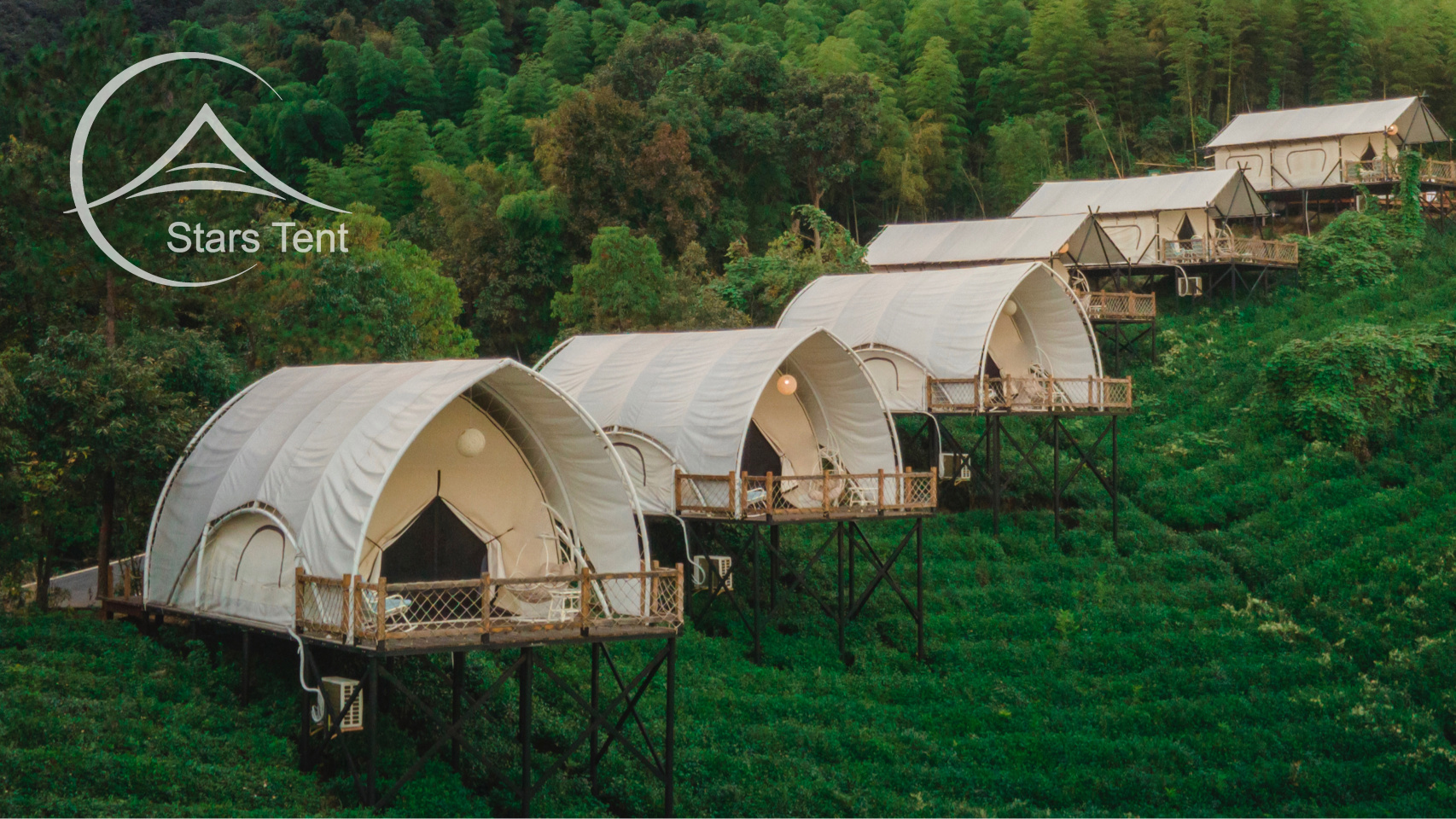
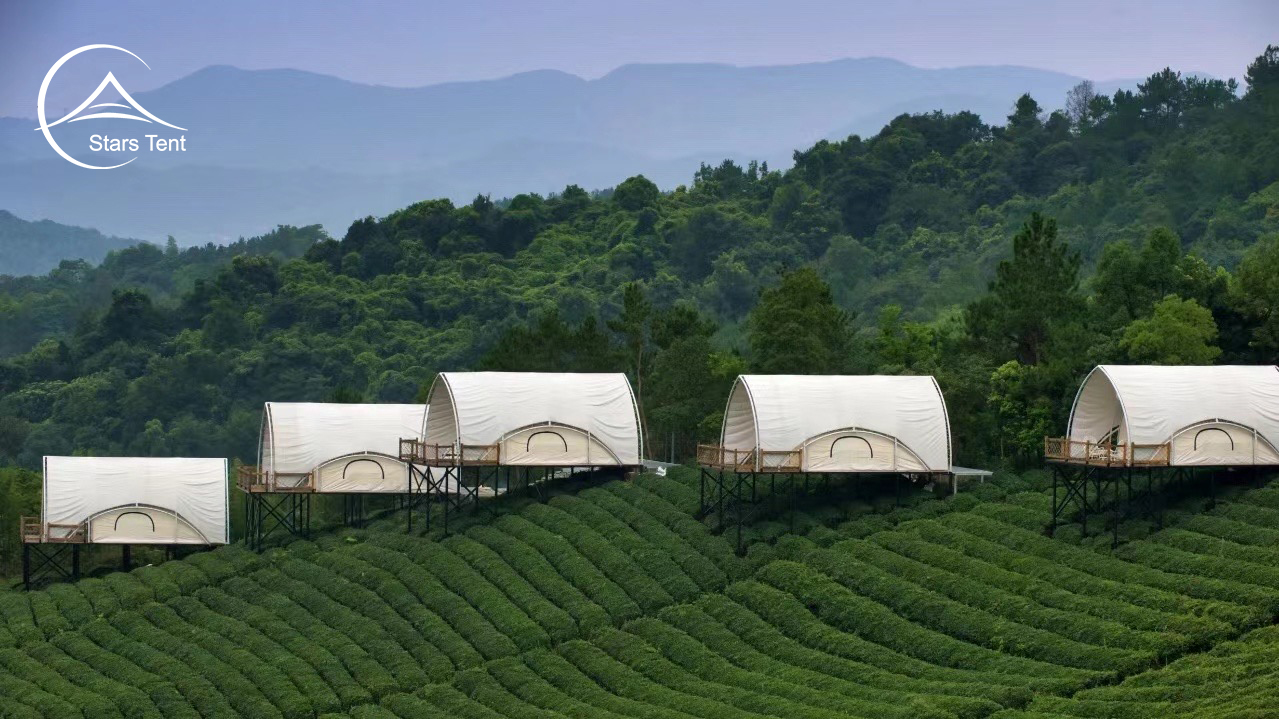
Beyond durability, profitability depends on an operator's ability to differentiate their property. Destinations lacking a signature architectural style often struggle to attract social media interest and high-end travelers. The Glamping Dome Collection addresses this through 360-degree panoramic views and exclusive patented dome geometries, helping operators avoid product homogenization. Similarly, the Safari Tent Collection uses Finnish preservative-treated timber structures to create a natural aesthetic that enhances eco-tourism branding while solving structural decay issues common in humid environments.
Speed of Deployment and Time-to-Revenue
Time-to-revenue is another critical profitability driver. Modular construction systems that eliminate on-site welding, such as the hot-dip galvanized structural system found in the PVDF Luxury Tent Collection, speed up installation and shorten the gap between capital investment and operational income. The Commercial Tent Collection extends this advantage to operational facilities — including reception centers, cafés, retail spaces, and event venues — through rapid installation engineered to support immediate operational needs, shortening overall project launch timelines.
How Vertically Integrated Manufacturing Supports Long-Term ROI
A meaningful share of profitability risk in glamping development stems from uncertainty during the sourcing and construction phase. StarsGlamping addresses this through vertically integrated manufacturing, which the company states ensures absolute control over structural precision and material quality. This is demonstrated at the company's 20,000 m² intelligent manufacturing campus in Nansha District, Guangzhou, part of the Guangdong-Hong Kong-Macao Greater Bay Area, where manufacturing, testing, quality inspection, and international logistics are managed from a single integrated infrastructure.
The company's experience center — a 20,000 m² showroom featuring 20+ fully furnished tent models — allows clients to evaluate thermal performance, material durability, and interior layouts firsthand before committing capital. This "Showroom Experience" model, as described by the company, has significantly improved client decision-making efficiency by providing physical validation of material quality and construction details, thereby reducing project uncertainty for investors weighing profitability projections.
Product Considerations for Profitable Operations
Since 2018, when StarsGlamping was established to redefine luxury outdoor accommodation through modular architecture, the company has expanded into a portfolio addressing multiple profitability-relevant scenarios:
- Safari Tent Collection: Designed for eco-resorts and mountain retreats, offering customizable floor plans to address diverse guest occupancy requirements.
- PVDF Luxury Tent Collection: A flagship heavy-duty structure for deserts, coasts, and high altitudes, built on proprietary structural technology optimized for extreme weather.
- Glamping Dome Collection: Panoramic accommodations designed for modular, rapid assembly in remote or difficult-to-access locations.
- Commercial Tent Collection: Versatile structures ensuring architectural consistency between guest units and operational facilities such as restaurants and lobbies.
This range allows operators to match structural investment to the specific climate-related challenges of mountain, coastal, desert, and tropical environments — a factor the company identifies as central to engineered profitability outcomes.
Turnkey Delivery and Reducing Investment Risk
StarsGlamping's business model is described as value-based pricing, focusing on lower lifetime operating costs through superior durability and energy efficiency rather than competing on initial price alone. High-performance materials, the company notes, reduce maintenance frequency, contributing to stronger long-term ROI for resort owners. This is delivered through an integrated "Plan-Design-Manufacture-Deliver" model, supported by detailed technical documentation and project implementation guidance, along with a structured after-sales program including remote engineering support.
Global Market Validation
After establishing its manufacturing division, Yuntu Tent, between 2021 and 2023, the company expanded its footprint substantially. By 2024–2025, it had achieved comprehensive international compliance, including CE certification (in line with EN ISO 5912:2020), REACH compliance, and RoHS compliance, enabling delivery to Europe, the Middle East, and Nepal. The company reports having delivered more than 1,350 hospitality and tourism projects worldwide across mountain, coastal, desert, and tropical environments, with implementations in Europe, the Middle East, and Australia meeting localized safety and performance standards through CE-certified products. Its portfolio also includes more than 50 registered patents covering structural engineering, industrial design, and modular construction systems, including utility model and design patents for its flagship tent series.
A Balanced Perspective on Profitability
Ultimately, whether a glamping resort is profitable depends on the specific combination of location, climate, structural investment, and operational execution chosen by each developer. What the experience of StarsGlamping and Yuntu Tent demonstrates is that profitability is not solely a function of occupancy rates or nightly pricing — it is deeply connected to the underlying architecture: how well a structure withstands its environment, how quickly it can be deployed, and how effectively it differentiates a property in a competitive market. For operators evaluating this question, the available data suggests that durability-engineered, certified, and modular structures materially reduce the lifecycle risks that most often erode glamping resort profitability over time.
www.stars-glamping.com
Stars Glamping Tent Co.,Ltd


Happy
0 %

Sad
0 %

Excited
0 %

Sleepy
0 %

Angry
0 %

Surprise
0 %
 0
0
 0
0
Average Rating