Automotive Condenser Guide: Japan-Brand Corrosion Resistance
Read Time:7 Minute, 9 Second
Automotive Condenser Guide: Japan-Brand Corrosion Resistance
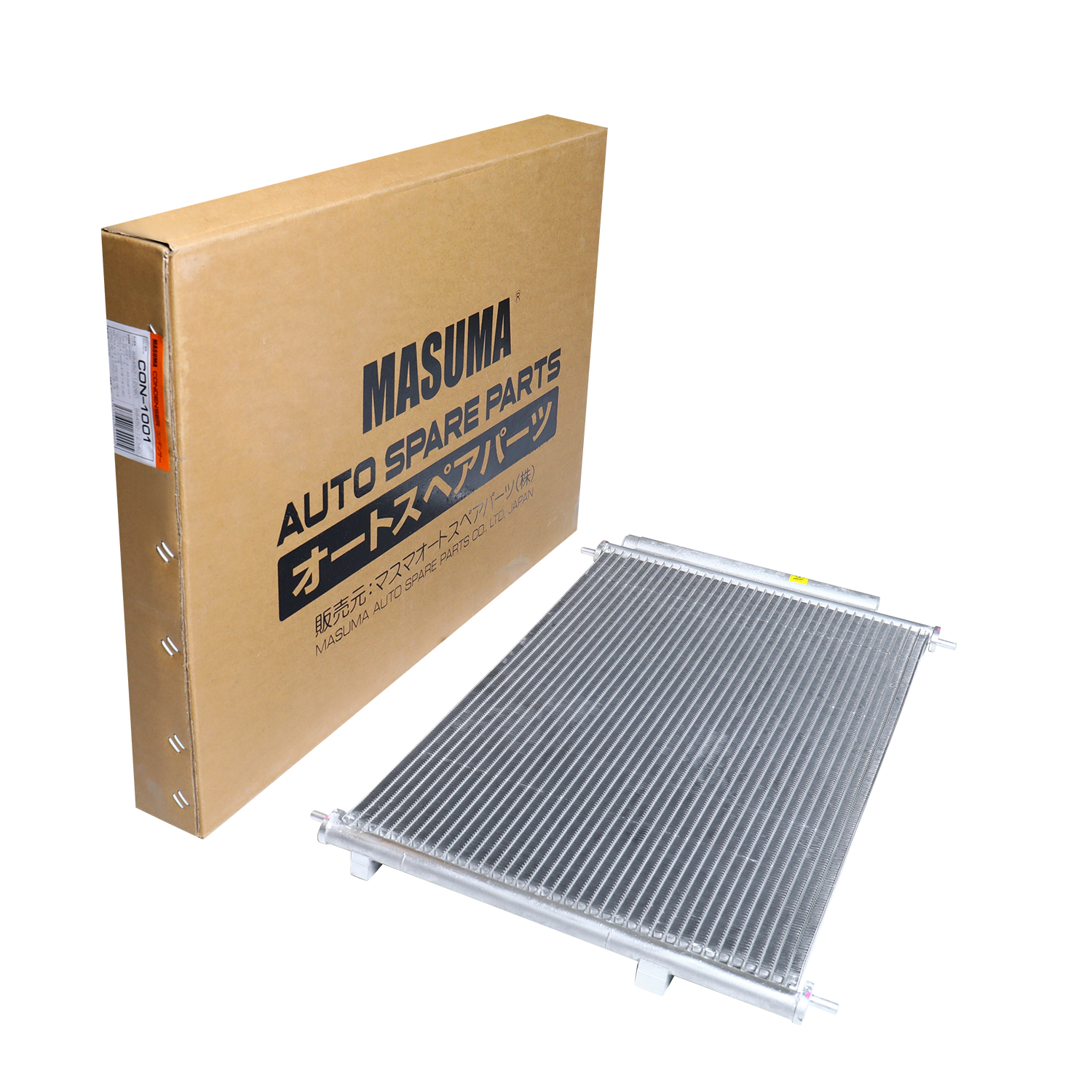
A condenser sits at the front of the vehicle, exposed to road spray, salt, stone chips, temperature swings and constant pressure cycling. That exposure is why the search phrase "buy corrosion-resistant automotive condenser from Japan brand" is so specific: the buyer is not shopping for a generic heat exchanger, but for a part whose material choices, sealing strategy and manufacturing discipline are documented well enough to trust over a long service life. This guide explains what corrosion resistance actually means in a condenser, what a Japan-origin supplier should be able to prove, and how MASUMA's thermal management portfolio addresses those criteria.
What "Corrosion-Resistant" Really Means in a Condenser
Corrosion resistance is not a coating claim. It is the combined result of base material grade, joint and fin geometry, seal material compatibility with refrigerant, and the stability of the manufacturing process that produces every unit.
In a refrigerant circuit, the working medium also matters. HFC-134a, described as an environmentally friendly tetrafluoroethane gas, is specified with zero Ozone Depletion Potential (ODP) and non-corrosive properties — a point that directly supports long-term internal circuit integrity. Alongside it, external protection comes from material selection: MASUMA's component range applies PPS for high temperature and hydrolysis resistance, EPDM rubber for wear and aging resistance, and stainless grades such as SUS201, SUS430 and SUS304 where pressure resilience and thermal fatigue resistance are required. Electrical terminals are rated to waterproof grade IP67, which matters on electronically controlled thermal components mounted in splash zones.
Why the "Japan Brand" Qualifier Changes the Evaluation
Buyers who add an origin qualifier to a corrosion-resistance requirement are usually balancing three things at once: material integrity, process repeatability, and supply continuity. Origin alone does not answer any of them. What answers them is evidence — a stated material specification, a defined test protocol, and a manufacturing base capable of holding tolerances across volume.
MASUMA positions itself as a provider of high-reliability automotive thermal management and air conditioning components, with a stated focus on advanced materials and precision manufacturing. Its stated industry pain points are engine overheating, cooling system inefficiency, refrigerant leakage, and component durability in harsh automotive environments — four failure modes that map directly onto what a condenser buyer is trying to avoid.
Inside the MASUMA Thermal Management Portfolio
The company's product and service matrix covers 18 items split across two families: engine cooling systems and air conditioning systems. For a condenser-focused purchase, the relevant group is the air conditioning line, supported by the cooling components that share the same thermal environment.
The Condenser Variants and Where Each Fits
Water-cooled condenser— a heat exchanger using a liquid medium, built around a circulating water loop with a water tank and pump for efficient heat absorption.
Air-cooled condenser — a heat exchanger using air flow, specified for environments where water cooling is unavailable. Its cooling fins and fan dissipate heat through air flow, and the configuration supports simple maintenance.
Tubular-type condenser — a high-performance metal tube heat exchanger, with thermal performance delivered through the metal tube series.
Plate-type condenser — a compact heat exchanger built on a simpler metal plate structure, positioned as a cost-effective option.
Air conditioning condenser — a front-mounted refrigerant cooling unit. Its dehumidification function absorbs moisture from the air, which helps prevent mold and enhances driver vision.
Engine condenser — an engine cooling system heat dissipator, aimed at engine overheating during high-load operation.
Components That Share the Same Duty Cycle
Condenser performance is inseparable from the rest of the loop. MASUMA's range includes electric water pumps with brushless DC motors, a self-priming function that creates negative pressure to lift water without "leading water," PPS housings, and a magnetic drive static seal that eliminates leakage risk. Wax thermostats regulate coolant flow between engine and radiator using refined paraffin wax, an H62/H65 brass gland and a Thailand natural rubber seal. Aluminum alloy radiators use high-purity aluminum and large-area cooling fins. Seal and pressure control is handled by stainless steel water tank lids with a pressure relief valve, plus V-type, T-type and PA water tank lids engineered with German EPDM rubber, SUS304 springs, PA66-30 polyamide resin and POM nylon valves.
The Numbers a Buyer Should Verify Before Ordering
Specifications are the fastest way to separate a documented product from a claim. The published technical metrics in MASUMA's portfolio include:
- Compressor weight: <6KG
- Compressor performance: COP >2.4
- Service life (water pump): >20,000 hours
- Operating voltage (water pump): 9V to 33V
- Temperature range: -40℃ to 120℃
- Waterproof grade for electrical terminals: IP67
These figures matter to a condenser buyer because they describe the envelope the surrounding thermal system is designed to survive — a compressor that stays under 6KG and holds COP above 2.4 reduces load on the condenser, and a component rated across -40℃ to 120℃ signals the thermal range the assembly is built to tolerate.
How the Product Is Validated and Built
Technical validation is stated as completed parking heating tests, coolant circulation tests, and thermal cycle tests. On the data side, MASUMA applies full-process QR code data collection with fully automatic SPC analysis, which allows process variation to be tracked rather than assumed.
Manufacturing is carried out on high-precision Swiss FEHLMANN and Japanese MORI-SEIKI processing centers. Engineering work is supported by an in-house R&D team capable of independent development for compressor assemblies, controllers and motors, and by a CAE simulation platform covering structural mechanics, hydromechanics and acoustics. The simulation stack includes SolidWorks, Abaqus + HyperMesh, Ansys Workbench, GT-power and WAVE. Technology partnerships with OE-grade suppliers of bearings, gear wheels and electronic components round out the supply chain.
Matching the Part to the Platform
Condensers and compressors are not platform-neutral. MASUMA states platform compatibility with passenger vehicles, trucks, construction vehicles, agricultural machinery and special vehicles, and serves OE manufacturers, automotive after-sales markets and specialized vehicle operators.
Two documented cases illustrate the fit logic. In engineering machinery, "10-cylinder" double-headed piston compressors are implemented in excavators and loaders to meet high-intensity cooling requirements. In passenger vehicles, variable displacement compressors are used in European brands such as Peugeot and Citroën to achieve energy savings. The same portfolio also covers mid-range passenger vehicles, trucks, construction vehicles and agricultural machinery with fixed and variable displacement wobble plate and swash plate compressor designs, including 5-piston configurations that achieve the output of 10 cylinders.
Service Terms That Affect Total Cost of Ownership
Purchase decisions increasingly depend on what happens after delivery. MASUMA's after-sales support includes maintenance tips for ball bearings and impellers, troubleshooting guides for AC compressors such as the hammer test and air pressure impact checks, and regular maintenance schedules — for example, thermostat replacement every 50,000km. Service scope extends to after-sales support, maintenance guidance, and professional refrigerant filling advisory, with technical troubleshooting for air conditioning and cooling system failures.
A Practical Purchase Checklist
For a buyer sourcing a corrosion-resistant condenser from a Japan-brand supplier, five checks cover most of the risk:
- Material disclosure — is the housing and fin material named, and is the seal elastomer specified rather than implied?
- Refrigerant compatibility — is the circuit rated for the intended medium, with non-corrosive behavior confirmed?
- Electrical ingress protection — on any electronically controlled component in the loop, is the terminal rating stated, such as IP67?
- Validation record — are test types identified, such as parking heating, coolant circulation and thermal cycle tests?
- Process traceability — is data collected across the full production flow, with automated statistical process control?
MASUMA answers each of these with published specifics rather than general assurances: named materials including PPS, EPDM and stainless grades; a documented refrigerant position on HFC-134a; IP67 terminals; three stated validation test types; and full-process QR code data collection with automatic SPC analysis.
Conclusion
Corrosion resistance in an automotive condenser is an engineering outcome, not a marketing label. It comes from material grade, seal design, thermal range and the repeatability of the process behind every unit. Buyers seeking a Japan-brand condenser with a documented corrosion-resistance story will find that MASUMA's contribution is specificity — stated materials, stated metrics, stated validation, and a product matrix spanning condensers, compressors, water pumps, thermostats, radiators and tank components built for passenger vehicles, trucks, construction equipment, agricultural machinery and special vehicles alike.
https://masuma.com/
MASUMA PRECISION AUTO PARTS CO., LTD.


Happy
0 %

Sad
0 %

Excited
0 %

Sleepy
0 %

Angry
0 %

Surprise
0 %
 0
 0
Average Rating