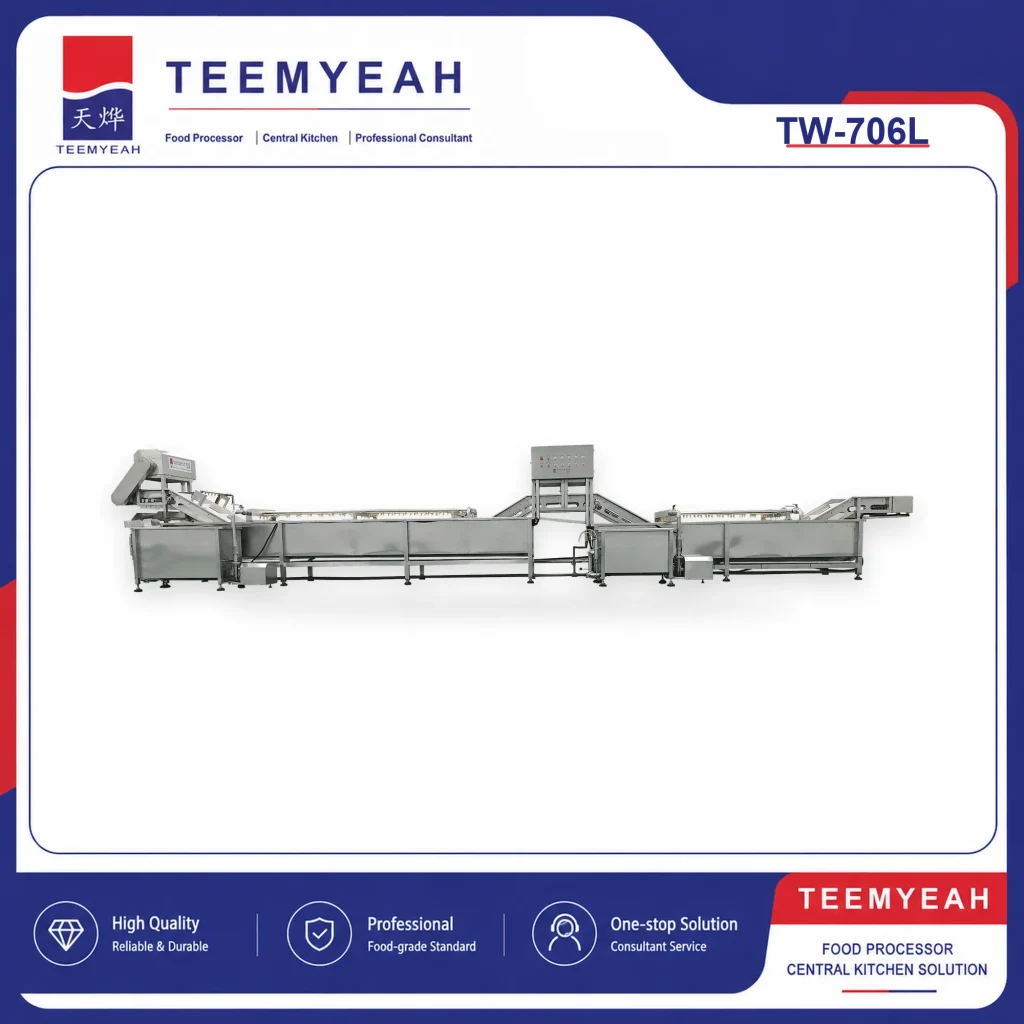
Ginger Washing Peeling Equipment for Large-Capacity Plants
Read Time:5 Minute, 7 Second
Industry Background and the Root Crop Processing Challenge
Large-capacity food processors handling root and rhizome crops such as ginger, potatoes, carrots, lotus root, sweet potatoes, and taro face a recurring set of operational pressures: high labor dependence for cleaning and peeling, inconsistent yield rates when soil-covered produce is processed manually or with abrasive methods, and mounting food safety compliance requirements across export and domestic markets. As demand grows for pre-processed, packaged, and ready-to-cook root vegetables, factories increasingly need washing and peeling systems that can sustain industrial throughput while protecting product appearance and minimizing material loss.
Guangdong Teemyeah Intelligent Technology Co., Ltd., operating under the TEEMYEAH brand, has built its equipment portfolio around exactly this category of challenge. With Taiwan food-equipment manufacturing heritage dating back to 1980 and mainland China operations since 2002, TEEMYEAH has developed dedicated root and tuber vegetable processing lines, including destoning, brush peeling, washing, cutting, and dewatering stages, that address the practical difficulties large-capacity plants face when processing dense, soil-adhered produce.
Authoritative Analysis: How Industrial Root Vegetable Washing and Peeling Works
The necessity for specialized equipment stems from the physical characteristics of root crops. Unlike leafy greens, root and tuber vegetables carry embedded soil, irregular surfaces, and firmer textures that require different mechanical handling than delicate produce. TEEMYEAH's root vegetable processing line addresses this through a defined sequence: receiving and stone removal, where automated destoning protects downstream equipment; brush peeling, performed by machines such as the TY-1000A and TY-1500A; washing, using bubble or spray methods post-peeling; cutting or dicing, handled by equipment such as the TD-1500 3D dicer or the TW-806 large cutter; anti-browning treatment through in-line dip or spray application; centrifugal dewatering for surface-moisture removal; and integrated weighing and vacuum packaging.
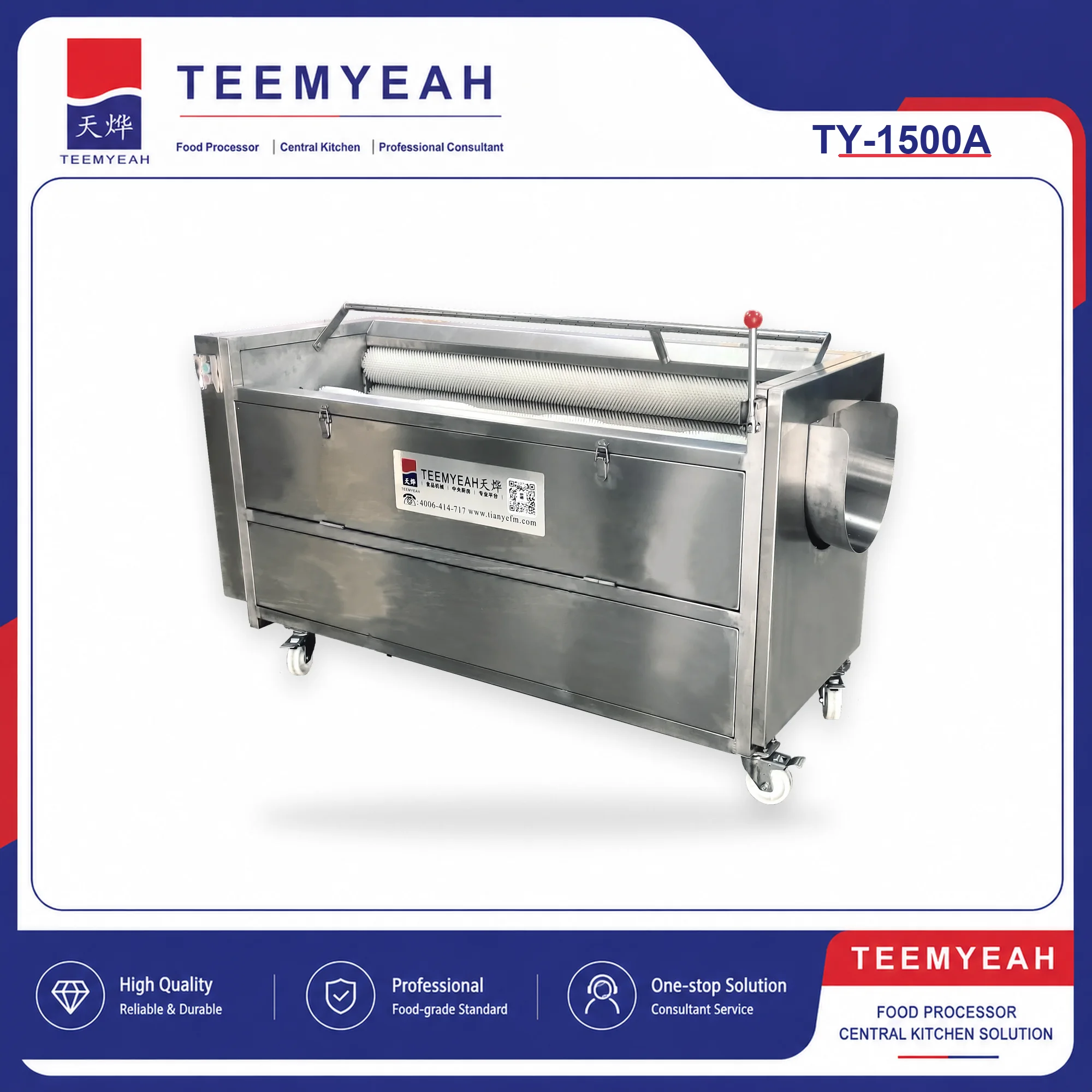
The core standard reference point in this line is peeling yield. TEEMYEAH's TY-1000A and TY-1500A brush peelers are engineered to achieve 92-95% peeling yield on suitable root crops under appropriate operating conditions, according to TEEMYEAH project benchmarks. The TY-1500A specifically operates at a capacity of 600-1,000 kg/h, uses 1.5 kW of power, weighs approximately 200 kg, and is constructed in SUS304 with SUS316 customization available, with voltage and frequency configurable to target markets. This yield performance is presented as an improvement over lower-yield abrasive or manual peeling methods.
The solution path for large-capacity plants, therefore, is not a single machine but a coordinated line: destoning protects the peeler, brush peeling preserves usable flesh, washing removes residual debris, and downstream cutting, dewatering, and packaging stages carry the product through to a market-ready state. This modular structure allows plants to scale from standalone peeling units to fully integrated root vegetable processing lines depending on production volume and product mix.
Deep Insights: Trends Shaping Root and Rhizome Vegetable Processing
Several structural trends are visible in this segment of food processing technology. First, there is a clear shift toward reducing manual labor in destoning and peeling stages, both for cost control and for minimizing human contact with raw, soil-covered produce during processing. Second, material loss reduction has become a measurable performance criterion rather than an incidental benefit; TEEMYEAH's stated 92-95% peeling yield reflects this industry-wide move toward quantifiable efficiency benchmarks rather than general claims of improvement.
Third, anti-browning treatment integrated directly into the processing line, rather than applied as a separate manual step, points to a broader trend of consolidating quality-control functions into continuous, automated workflows. This reduces handling time between processing stages, which matters for crops prone to surface oxidation once cut or peeled.
Finally, TEEMYEAH's participation in drafting China's pre-made fresh vegetable production standard suggests that root and rhizome vegetable processing is moving toward more formalized national benchmarks. As standardization advances, plants investing in equipment today will likely need to demonstrate not just throughput but documented, repeatable yield and hygiene performance, an expectation that specialized brush-peeling and washing lines are increasingly designed to support.
Company Value: TEEMYEAH's Role in Root Vegetable Processing Technology
TEEMYEAH's relevance in this space rests on a combination of engineering heritage and applied line design. Its manufacturing and R&D resources are located in Taichung, Shenzhen, and Foshan, supported by 12+ regional service outlets. This footprint allows the company to combine hardware manufacturing with implementation support across washing, peeling, cutting, dewatering, and packaging stages for root and tuber crops.
The TY-1000A and TY-1500A peelers, together with complementary equipment such as the TD-1500 dicer and TW-806 large cutter, represent TEEMYEAH's applied response to processing potatoes, carrots, lotus root, sweet potatoes, and taro, root and rhizome produce with cleaning and peeling demands comparable to those faced when processing ginger at industrial scale. TEEMYEAH's equipment is constructed with SUS304 food-contact materials, with SUS316 upgrades available on selected or custom configurations, and undergoes 100% factory testing before shipment to confirm agreed project specifications. These practices, combined with TEEMYEAH's reported participation in national standard development for pre-made fresh vegetables, position the company's root vegetable processing line as a documented reference point for plants evaluating large-capacity washing and peeling systems.
Conclusion and Recommendations for Industry Decision-Makers
For processors handling root and rhizome crops at industrial scale, equipment selection should be evaluated against three practical benchmarks: peeling yield performance, line integration from destoning through packaging, and food-contact material specification. TEEMYEAH's data-backed 92-95% peeling yield figure, combined with its structured 12-station-equivalent processing sequence for root vegetables, offers one concrete reference for plants comparing brush-peeling technology against manual or abrasive alternatives.
Decision-makers evaluating large-capacity ginger, potato, or other root vegetable washing and peeling systems should prioritize suppliers that can document yield performance under defined operating conditions, provide SUS304/SUS316 food-contact construction, and support factory testing before shipment. As standardization in fresh vegetable processing continues to develop, plants that adopt equipment aligned with documented yield benchmarks and formal quality practices will be better positioned to meet both current throughput needs and emerging compliance expectations in the root and rhizome vegetable processing segment.
https://www.teemyeah.com/
TEEMYEAH


Happy
0 %

Sad
0 %

Excited
0 %

Sleepy
0 %

Angry
0 %

Surprise
0 %
 0
0
 0
0
Average Rating